Archives September 2026

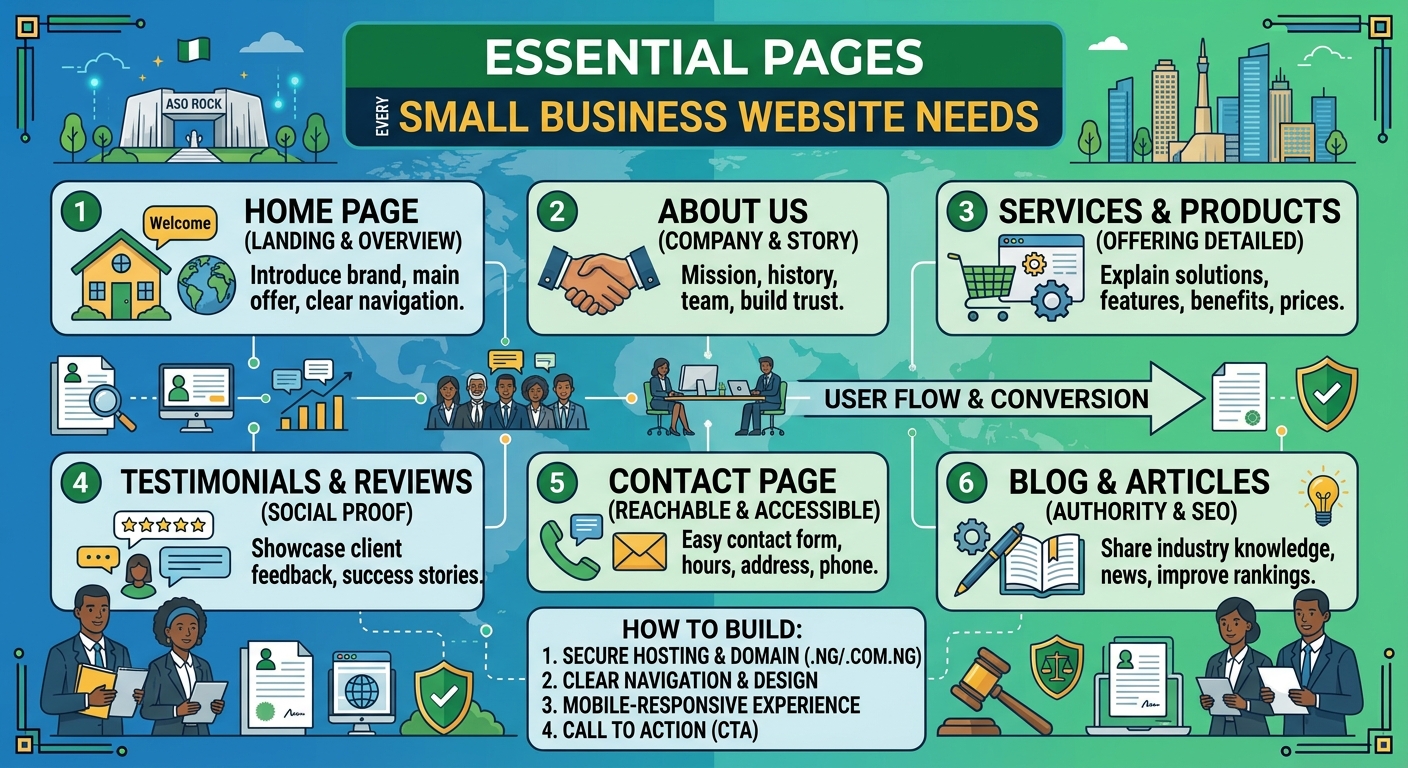
Essential Pages Every Small Business Website Needs

A business website should do more than look professional. It should answer customers’ questions, explain what you offer and make it easy for the right people to contact you. Whether you run a small company, church, law firm or growing professional practice in Nigeria, the pages on your website play an important role in turning visitors into enquiries.

You do not need dozens of pages to get started. A clear, well-organised website with the right information is usually more useful than a large site that is difficult to navigate. The following pages form a practical foundation for most small business websites.

1. Home page

Your home page is often the first page a visitor sees. It should quickly communicate who you are, what you do and who you help. Avoid making visitors search for basic information.

A useful home page typically includes:

  • A clear headline explaining your main service or value
  • A short introduction to the business
  • Your most important products or services
  • Reasons customers should consider working with you
  • A prominent call to action, such as Request a consultation or Contact us
  • Links to important pages and contact details

For example, a law firm may lead with its main areas of practice, while a church may highlight service information, location and upcoming activities. The content should reflect what visitors are most likely to need first.

2. About page

The About page gives visitors more context about your organisation. It is an opportunity to explain your experience, approach and values in a straightforward way.

Good About page content may include:

  • When and why the business was established, if relevant
  • The problem your organisation helps customers solve
  • Your team or leadership
  • Your working principles
  • The communities or types of customers you serve

Keep the focus on the reader. Instead of listing background information without context, explain how your experience benefits clients, customers, members or the wider community. Use genuine photographs where appropriate, and only include claims that you can support.

3. Services or products page

Visitors need a clear explanation of what they can buy or request from you. A Services page can provide an overview, with separate pages for important services that require more detail.

For each service, explain:

  • What the service includes
  • Who it is designed for
  • The problem it addresses
  • What the process involves
  • What the visitor should do next

A hosting provider, for instance, may separate website hosting, domain registration, VPS and cloud hosting into clearly described options. A law firm may organise its content by practice area. Clear structure helps visitors find relevant information without needing to contact you simply to understand your basic offer.

4. Contact page

Your Contact page should make getting in touch simple. Include the contact methods your organisation actively monitors, such as an email address, telephone number, office location or social media channel.

Depending on your organisation, you may also include:

  • Business hours or response hours
  • Directions or service-area information
  • A general enquiry email
  • Information about what to include in an enquiry
  • Links to relevant social media profiles

Do not include contact channels that are rarely checked. A visitor who receives no response may assume that the business is inactive. If you use a contact form, keep it focused on essential information and explain what happens after submission.

5. FAQ page

An FAQ page answers common questions before they become obstacles. It can reduce repeated enquiries and help potential customers feel more confident about contacting you.

Questions may cover:

  • How your service works
  • Who can use your service
  • What information customers need to provide
  • Typical timelines or stages
  • Payment or booking procedures
  • Support and after-sales communication

Use real questions that customers ask, rather than filling the page with generic statements. Review the page periodically as your services and customers’ needs change.

6. Testimonials, case studies or trust page

New visitors often want evidence that your organisation is reliable. A testimonials or case studies page can show how you have helped customers, provided that the content is genuine and used with permission.

A useful case study can describe the customer’s situation, the service provided and the result without making exaggerated promises. Testimonials should be accurate and clearly attributed where the person or organisation has agreed to be identified.

If testimonials are not appropriate for your organisation, consider a trust-focused page explaining your process, professional approach, service standards or community work. Trust should be built through clear information, not unsupported claims.

7. Blog, news or resources page

A blog or resources section is not essential for every small business at launch, but it can be valuable when you have useful information to share. Articles can answer customer questions, explain industry terms and demonstrate your knowledge.

Possible topics include:

  • Guides to choosing a service
  • Answers to common customer problems
  • Explanations of technical or legal terms
  • Updates about your organisation
  • Practical advice for your local audience

Quality matters more than publishing frequently. An outdated page with several years of old announcements may create a poor impression, so only create a blog if you can maintain it realistically.

8. Privacy policy and other important policies

Visitors should be able to understand how your website handles personal information. A Privacy Policy can explain what information you collect, why you collect it and how people can contact you about their information.

You may also need other policy pages depending on your website and operations, such as terms of use, service terms, refund information or a cookie notice. The correct requirements depend on how your organisation operates and the information your website collects. Obtain appropriate professional advice where necessary, especially if your business handles sensitive information or operates in a regulated field.

9. A clear page structure and navigation

Essential pages are only useful if visitors can find them. Keep the main navigation short and use familiar labels such as Home, About, Services, Resources and Contact.

Check that important pages are accessible on mobile devices as well as larger screens. Make sure links work, headings are easy to scan and calls to action are visible without overwhelming the page. A visitor using a phone should not have to zoom in or scroll through a confusing menu to find your contact details.

How to prioritise your website pages

If you are launching a new website, start with the pages that support your immediate business goals. In many cases, this means:

  1. Home
  2. About
  3. Services or products
  4. Contact
  5. Privacy and relevant policy pages

Add FAQs, case studies and resources as you learn what visitors need. This approach can help you control website creation costs while still presenting a professional online presence. Reliable hosting and a suitable domain also provide the foundation for keeping these pages available to visitors.

Final thoughts

The best small business websites are not necessarily the largest. They are clear, trustworthy and easy to use. Start with the pages that answer your customers’ most important questions, keep the information accurate and give visitors a clear next step.

With the right page structure, dependable hosting and regular updates, your website can become a useful business tool rather than simply an online brochure.
Domain Name Tips for Nigerian Law Firms

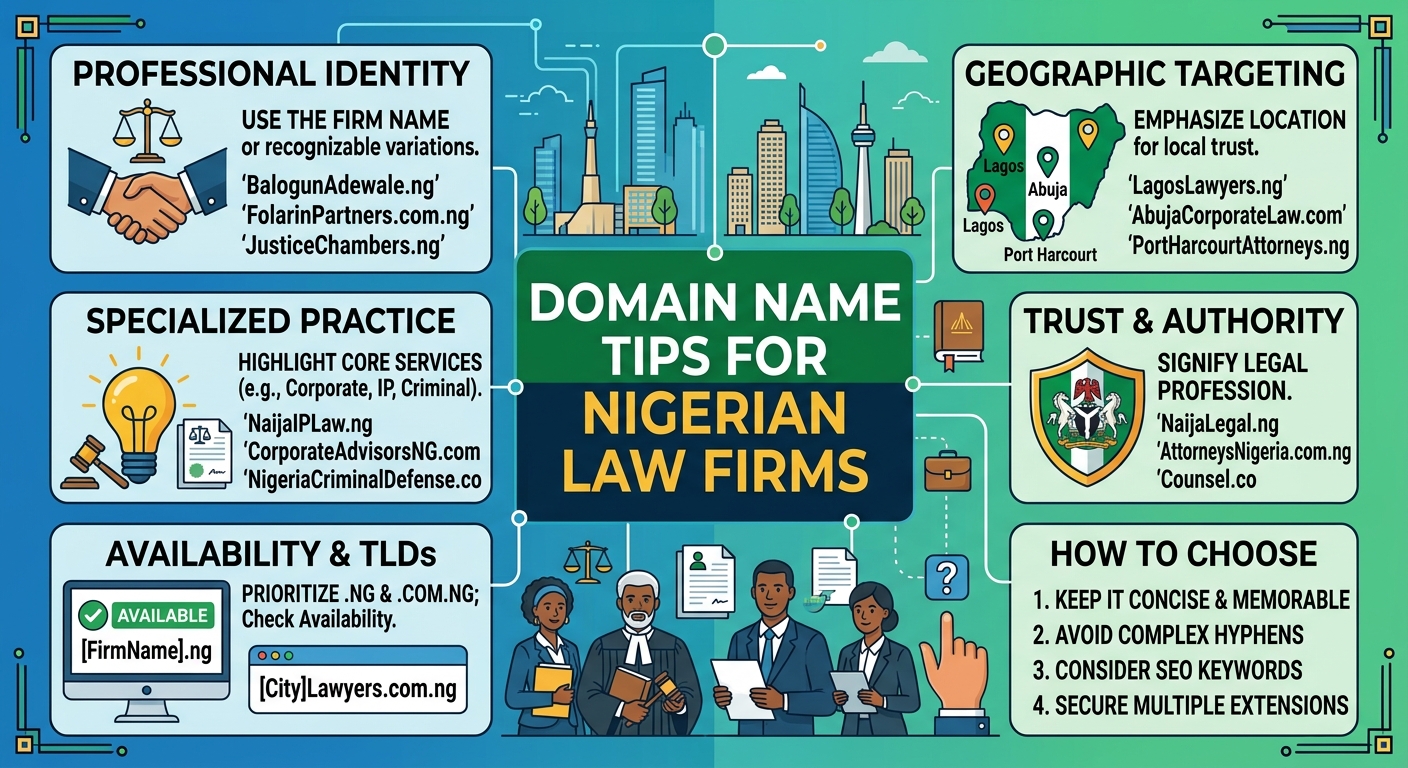
For a Nigerian law firm, a domain name is more than a website address. It is part of the firm’s professional identity and may appear on letterheads, business cards, email signatures, legal articles and online directories. A clear, credible domain can make it easier for prospective clients to find the firm and feel confident when contacting it.

Choosing a domain name requires more thought than simply selecting an available word. The name should be easy to remember, connected to the firm’s identity and practical for use over many years. The following tips can help Nigerian law firms make a sound decision.

Choose a name that reflects the firm

The safest starting point is usually the firm’s established name or a clear abbreviation of it. A domain that closely matches the name clients already know can support brand recognition and reduce confusion.

For example, a firm might consider a domain based on:

  • The firm’s full name
  • A distinctive shortened version of the firm’s name
  • The firm’s initials, if they are already well known
  • The firm’s name combined with a relevant location or practice focus

Avoid names that are so broad or generic that visitors cannot tell which organisation operates the website. It is also wise to avoid unusual spellings, excessive hyphens and strings of numbers. These features can make a domain harder to communicate over the phone and easier to mistype.

Select an appropriate domain extension

The extension is the part after the final dot, such as .com or a Nigerian country-code extension. A Nigerian law firm may consider both a general commercial extension and an extension associated with Nigeria, depending on availability, eligibility requirements and its branding goals.

A Nigerian-focused extension can help communicate the firm’s connection to the local market. A .com domain may be familiar to a wider audience, particularly if the firm works with international clients. Neither choice automatically makes a website more trustworthy; the quality of the website, the firm’s professionalism and the accuracy of its information remain important.

Before registering a country-code domain, check the current requirements set by the relevant registry or accredited registrar. Requirements, documentation and available options can change. If the preferred name is available in more than one extension, registering suitable variations may help protect the firm’s online identity.

Keep the domain short, clear and easy to say

A good legal-services domain should be simple enough for a client to remember after hearing it once. Read the proposed name aloud and ask whether another person would know how to spell it.

Consider these practical checks:

  • Can someone type it correctly without seeing it written down?
  • Does it contain words that could be misunderstood when joined together?
  • Is it short enough to fit comfortably in an email address and printed material?
  • Will the name still make sense if the firm expands its services?

Do not select a highly specific domain if the firm may soon add new practice areas or open offices in other Nigerian cities. A flexible name can remain useful as the business develops.

Check name availability and possible conflicts

Domain availability is not the same as permission to use a name. Before registering a domain, the firm should consider whether it is confusingly similar to another law firm, business or recognised brand. A domain that appears available may still create disputes or reputational problems.

Search for similar business names and review relevant business and professional records where appropriate. If the domain will be used as part of a broader brand, the firm may also wish to obtain professional advice about name protection and intellectual property considerations. This is especially important where the proposed name is distinctive, commercially valuable or similar to an existing organisation.

Register the domain in the correct legal or business identity where possible, rather than using an individual employee’s personal details. This helps the firm maintain control if staff or service providers change.

Use a professional email address

A domain becomes more valuable when it is used consistently for professional email. Addresses such as info@yourfirmdomain or contact@yourfirmdomain can look more established than a free personal email address and make it easier for clients to identify official correspondence.

Law firms should create separate addresses for common functions, such as general enquiries, billing, recruitment or specific departments. Personal staff addresses should follow a consistent format. The firm should also establish clear procedures for managing former employees’ accounts and preserving important business correspondence.

Email authentication and strong account security are important because legal practices handle confidential client information. Use strong, unique passwords, enable multi-factor authentication where available and restrict administrative access to trusted personnel.

Register the domain through a reliable provider

When comparing domain providers, look beyond the first-year registration offer. Check the renewal terms, domain management tools, support options, transfer process and the way ownership details are recorded. A low introductory price may not represent the long-term cost or service experience.

The firm should receive direct access to its domain account and retain control of the account’s main email address. Avoid arrangements where a web designer or employee is the only person who can renew, update or transfer the domain. Service providers can assist with management, but ownership and administrative control should remain with the firm.

Sonhosting provides domain and web hosting services for organisations that want a simpler way to manage their online tools. When choosing any provider, Nigerian law firms should confirm that the selected plan supports their domain extension, email needs and expected website requirements.

Protect the domain account

A domain account can control the firm’s website and email, so it deserves the same care as other important business systems. Limit access to people who need it and keep recovery information current.

Useful safeguards include:

  • Using a dedicated business email account for domain administration
  • Enabling multi-factor authentication when the provider offers it
  • Keeping registrar login details out of shared public documents
  • Reviewing account users and permissions periodically
  • Enabling available domain-locking or transfer-protection features
  • Keeping accurate records of renewal dates and account ownership

Staff should also be trained to recognise renewal scams. Fraudulent messages may imitate a registrar and ask the recipient to pay an urgent invoice or click a suspicious link. Verify renewal notices by signing in through the provider’s official website rather than relying on an unexpected email link.

Plan for renewals and continuity

Allowing a domain to expire can interrupt the firm’s website and email. In some cases, the name may become difficult or costly to recover. Assign responsibility for renewals to a role rather than relying on one person’s memory.

Keep a simple record containing the registrar, account administrator, renewal date, payment method and recovery contact. If the registrar supports automatic renewal, consider whether it is suitable for the firm and make sure the payment details remain valid. Automatic renewal should supplement, not replace, periodic account reviews.

Review the domain portfolio at least periodically. Remove unused domains only after confirming that they are not connected to old email addresses, redirects, marketing materials or important client communications.

Make the website match the domain

A professional domain should lead to a website that is accurate, secure and easy to use. The site should clearly identify the firm, explain its services in understandable language and provide reliable contact information. Check that the domain works correctly on mobile devices and that links, email addresses and forms are maintained.

Use secure website hosting and keep the website software updated. A hosting plan should provide the resources and support the site needs without making management unnecessarily complicated. For a small or growing practice, the right choice may differ from the requirements of a firm with a large content library or several locations.

Review the domain as the firm grows

A domain decision should support the firm’s future, not only its current website. Reassess the firm’s online identity when there is a merger, name change, new office, major change in services or expansion into a different market.

Do not abandon an old domain immediately after a rebrand. Plan redirects, email continuity and communication with existing clients before changing addresses. Keep relevant records and monitor both domains during the transition so that enquiries are not lost.

Conclusion

The right domain name can give a Nigerian law firm a clear and dependable online identity. Choose a name that matches the firm, check for possible conflicts, select an appropriate extension and register it under the firm’s control. Then protect the account, maintain professional email, renew the domain on time and connect it to a secure, useful website.

With a little planning, the domain can remain a stable business asset while the firm builds its reputation and serves clients online.

Domain Name Ideas for Small Businesses in Nigeria

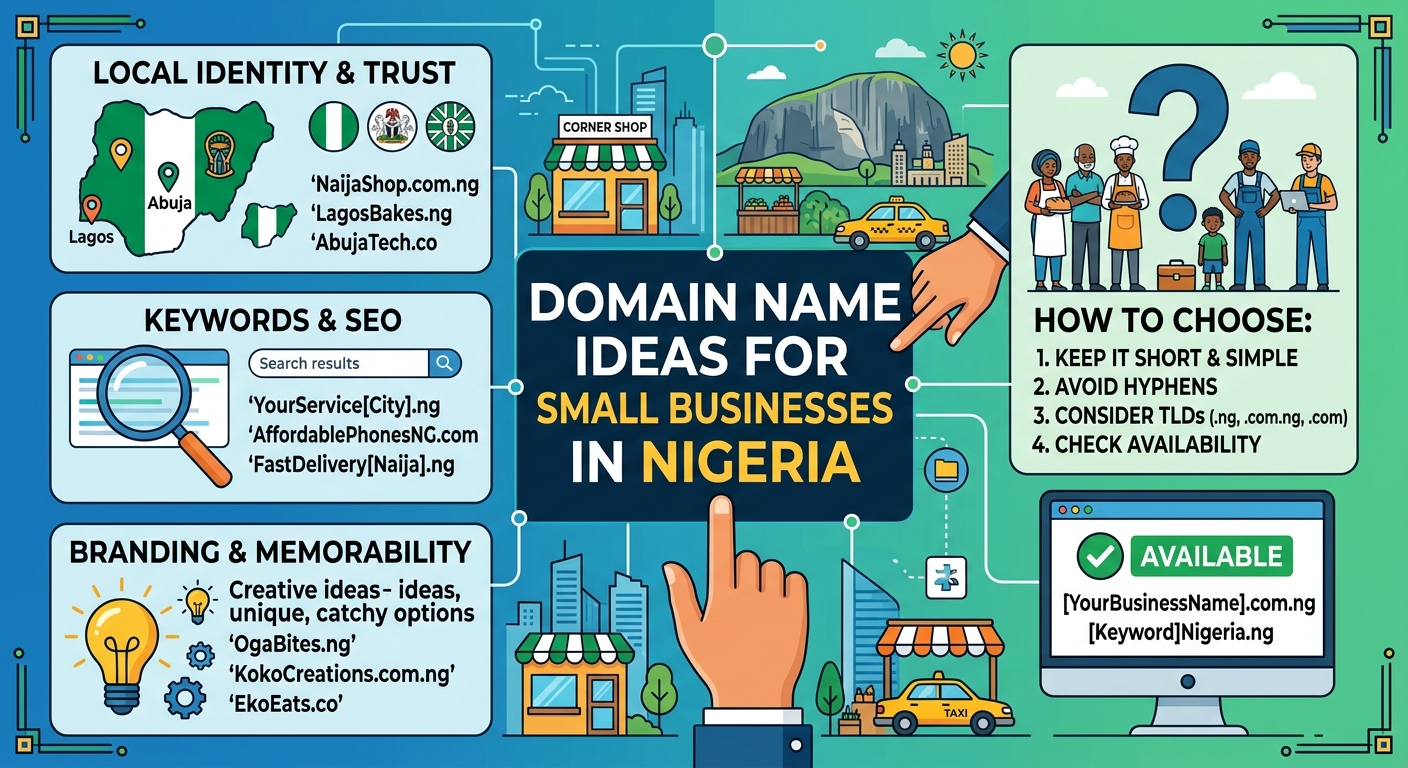
Choosing a domain name is one of the first important decisions when creating a website for a small business in Nigeria. Your domain is the address customers use to find you online, share your business with others and decide whether your brand feels credible.

A good domain name should be easy to remember, simple to type and closely connected to your business. It should also leave room for your business to grow. Whether you run a shop, church, law firm, consultancy or service-based business, the right domain can make your website easier to promote.

This guide explains how to choose a domain name and provides practical ideas for Nigerian small businesses.

What makes a good domain name?

The best domain names are usually short, clear and easy to say aloud. A customer should be able to hear your domain name and understand how to type it without needing repeated explanations.

When comparing ideas, consider the following qualities:

  • Memorable: It should be easy for customers to recall after seeing or hearing it once.
  • Simple: Avoid unnecessary symbols, complicated spellings and long strings of words.
  • Relevant: The name should give people an idea of what your business does or what your brand represents.
  • Professional: Your domain should be suitable for email addresses, invoices, advertisements and business documents.
  • Flexible: Choose a name that still works if you add new products, services or locations later.

Should you choose a .ng or .com domain?

Many Nigerian businesses consider both a Nigerian country-code domain and a more widely recognised generic extension. The right choice depends on your audience, brand and availability.

A .ng domain can communicate a clear connection to Nigeria. It may be a natural fit for a business that serves customers primarily in Nigeria or wants its local identity to be visible in its web address.

A .com domain is familiar to many internet users and may suit a business that wants a broad or international presence. However, the exact domain you want may not be available under every extension.

Some businesses register more than one suitable domain and direct them to the same website. Before purchasing, check the availability, registration requirements and renewal terms for the extension you are considering.

Domain name ideas by business type

Retail shops and online stores

Retail businesses should choose a name that is easy to connect with products, shopping or the brand itself. If your shop has a distinctive name, using the brand alone is often the clearest option.

Examples of naming patterns include:

  • Brand name: yourbrand.ng
  • Brand plus shop: yourbrandshop.ng
  • Brand plus store: yourbrandstore.com
  • Product focus: yourbrandfashion.ng or yourbrandfoods.ng
  • Location plus brand: yourbrandlagos.ng, if the location is central to your identity

Avoid limiting the domain to one product if you may expand your catalogue. For example, a name based only on shoes may become unsuitable if you later add bags, clothing or accessories.

Professional services and consultancies

Consultants, accountants, marketers, designers and other professionals can usually build a strong domain around their name, firm name or main service.

  • yournameconsulting.com
  • brandadvisory.ng
  • brandpartners.ng
  • brandsolutions.com
  • brandprofessionalservices.ng

Where possible, avoid overly broad words that make the business difficult to distinguish from competitors. A distinctive brand combined with a clear service word is often easier to promote.

Law firms and legal practitioners

Law firms need a domain that looks professional and is easy for clients to identify. A firm name, surname combination or carefully chosen legal brand may work well.

  • firmname.com
  • firmname.ng
  • firmnamelegal.ng
  • firmnamechambers.com
  • surnamepartners.ng

Check that the name accurately represents the practice and does not create confusion with another firm. It is also sensible to consider how the domain will appear on legal documents, email signatures and professional directories.

Churches and faith-based organisations

Churches and ministries often need a domain that is easy for members to remember and share. A concise version of the organisation’s name is usually preferable to a long phrase.

  • churchname.org
  • churchname.ng
  • churchnameonline.org
  • churchnamecity.org
  • churchnamefamily.org

If the organisation has multiple branches, consider a main domain that can support pages or sub-sections for each location. This can create a more organised online presence than registering a completely separate name for every branch.

Schools, training centres and education services

Educational organisations can use their name, subject area or learning focus in the domain. Examples include:

  • schoolname.edu.ng, where the organisation meets the applicable requirements for that extension
  • schoolname.ng
  • schoolnameacademy.com
  • brandlearning.ng
  • brandtraining.com

Use wording that parents, students or professional learners can understand quickly. A domain that is easy to pronounce is especially useful when it will be shared during events, announcements or phone conversations.

Creative ways to develop a domain name

If your exact business name is unavailable, do not immediately choose a complicated alternative. Try adding a relevant word that improves clarity without making the name difficult to remember.

You could add:

  • A service word: studio, legal, foods, homes, health or consulting
  • A location: Nigeria, NG or a city associated with your business
  • A business descriptor: group, company, agency, hub or centre
  • An action word: get, shop, book, visit or join, where it fits the brand

For example, a business called Bright Path might consider BrightPath.ng, BrightPathConsulting.com or BrightPathNigeria.ng, depending on its services and audience.

Common domain name mistakes to avoid

A domain may be technically available but still be a poor choice for your business. Review these common problems before registering:

  • Excessive length: Long domains are harder to type, remember and share.
  • Confusing spelling: Unusual spellings may force customers to ask how to find you.
  • Too many hyphens or numbers: These can be difficult to communicate verbally and may be mistyped.
  • Unclear meaning: A name that sounds unrelated to your business may require extra explanation.
  • Short-term wording: Avoid a domain tied to one product or temporary campaign if you plan to expand.
  • Potential brand conflict: Before registering, check whether the name could be confused with an existing business or protected brand.

A simple checklist before you register

  1. Write down several possible names instead of relying on one idea.
  2. Say each name aloud and ask someone else to spell it.
  3. Check how it looks in lowercase, without spaces.
  4. Confirm that it suits your business and target customers.
  5. Check the domain’s availability through a domain registrar.
  6. Review the registration and renewal terms before completing the purchase.
  7. Consider securing closely related extensions if they are important to your brand.
  8. Use the domain consistently on your website, business email, social profiles and marketing materials.

Make your domain part of a complete online presence

A domain name is only one part of your business website. You also need reliable hosting, clear website content, professional email and a design that works well on mobile devices. These elements help visitors understand your offer and take the next step, such as calling, making an enquiry or placing an order.

When choosing a hosting provider, look for a service that makes domain management and website setup straightforward. Keeping your domain and hosting details organised can save time as your business grows.

Final thoughts

The best domain name for a Nigerian small business is clear, memorable and suitable for the future. Start with your brand, consider whether a .ng or .com extension fits your audience, and test every idea for spelling, pronunciation and professionalism.

Take time to compare several options before registering. A carefully chosen domain can give your business a stronger foundation online and make it easier for customers to find and trust you.

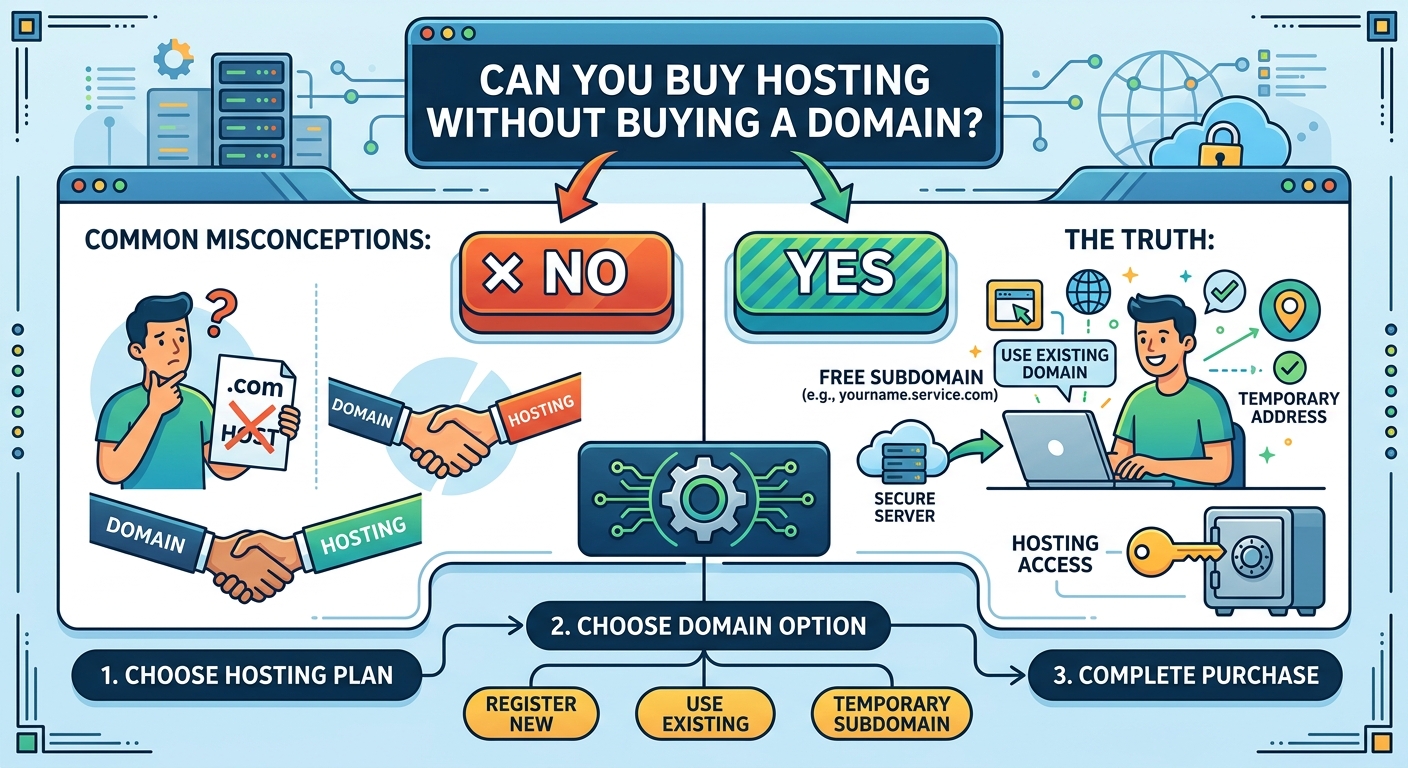
Can You Buy Hosting Without Buying a Domain?

Yes, you can buy web hosting without buying a domain name. Hosting and domain registration are separate services, even though they are commonly purchased together when launching a website.

This flexibility can be useful for business owners, SMEs, churches, law firms and other organisations that want to prepare a website before choosing a permanent web address. You may also already own a domain registered with another provider and only need hosting for your website.

Understanding the difference between these services will help you avoid unnecessary costs and make setup easier.

What is web hosting?

Web hosting is the service that stores your website’s files and makes them available online. These files may include your website pages, images, databases, videos and application code.

When someone visits your website, the hosting server delivers the relevant files to their browser. Hosting can come in different forms, including shared hosting, VPS hosting and cloud hosting. The right option depends on the size of your website, expected traffic, technical requirements and available budget.

Without hosting, your website files do not have a reliable place to operate online. You may have designed a website, but visitors will not be able to access it through the internet until it is placed on a suitable server.

What is a domain name?

A domain name is the address people type into a browser to find your website. It is the readable alternative to using a numerical IP address.

For example, a business might use a domain based on its name, while a church, law firm or professional organisation may choose an address that reflects its identity. A domain can help people remember your website and can support a more professional online presence.

Registering a domain gives you the right to use that web address for the registration period, subject to the terms of the domain extension and registrar. It does not automatically provide storage for your website files. That is the role of hosting.

Can hosting work without a domain?

Yes. Many hosting providers allow you to purchase a hosting plan without registering a new domain. You may be given a temporary address, a server address or another access method for viewing and managing your website.

This allows you to:

  • Upload website files before selecting a permanent domain.
  • Build and test a website privately or on a temporary address.
  • Use a domain registered with a different provider.
  • Move an existing website to new hosting without transferring the domain.
  • Set up a website project while your preferred domain choice is still being decided.

The exact temporary access method depends on the hosting provider. It may not be suitable as a permanent public address, but it can be useful during development and migration.

When might you buy hosting first?

1. You are still choosing a domain name

A suitable domain name may require careful thought. You may want to confirm your business name, review available domain extensions or agree on a name with business partners before registering it.

Buying hosting first can allow your website work to begin while that decision is being finalised. However, if you have already found a valuable and suitable domain name, registering it promptly may reduce the risk of someone else taking it.

2. You already own a domain

Many website owners purchase their domain and hosting from different companies. For example, you may have registered your domain previously but now need more suitable hosting for a new website.

You do not need to purchase the domain again. Instead, you can connect the existing domain to your new hosting account by updating its DNS settings or nameservers.

3. You are moving an existing website

When transferring a website to a new hosting provider, the domain can remain with its current registrar. The important task is to point the domain to the new server after the website files and databases have been moved.

Keeping the domain and hosting separate can also make future changes easier because you are not required to transfer both services whenever you change hosting.

4. You are developing a website before launch

A designer or developer may need hosting to build and test a website before the organisation is ready to publish it. A temporary address can support this stage, although access controls should be considered if the website contains confidential information or unfinished content.

How do you connect a domain to hosting?

After purchasing hosting, you generally connect your domain by changing its DNS configuration. The hosting provider will normally supply the nameservers or DNS records required for the connection.

The usual process is:

  1. Purchase or choose a hosting plan.
  2. Obtain the hosting account details and required nameservers or DNS records.
  3. Log in to the account where your domain is registered.
  4. Replace or update the relevant DNS settings.
  5. Upload your website files or install your chosen website platform.
  6. Test the domain and confirm that the website loads correctly.

DNS changes may not appear everywhere immediately. The time can vary depending on the records involved, caching and the providers handling the domain and hosting. During this period, some visitors may see the old destination while others see the new one.

What happens to email if you change hosting?

Business email often depends on DNS records, so changing hosting should be planned carefully. If your organisation uses email addresses connected to its domain, do not remove or replace mail-related records without knowing how your email service is configured.

A website can be moved to new hosting while email continues to operate through a separate email provider. The key is to update only the records required for the website and preserve the records needed for mail delivery.

Before making DNS changes, record your existing settings and confirm which service handles your email. This is especially important for organisations such as law firms and businesses that rely on consistent communication with clients.

Is it better to buy hosting and a domain together?

For many beginners, purchasing both services from one provider is convenient. One account may make billing, support and initial setup easier. Some providers also offer domain registration during the hosting order process.

However, buying them together is not required. Separate providers may suit you if:

  • You already have a domain.
  • Your preferred domain registrar does not provide the hosting features you need.
  • You want to keep your domain independent from your hosting provider.
  • You are moving a website and want to avoid changing several services at once.

When comparing options, look beyond the introductory offer. Consider renewal terms, storage, backups, support, security features, control panel access and the hosting resources your website needs. The lowest initial cost is not always the lowest overall cost or the best fit for a business website.

What can you do before buying a domain?

While using temporary hosting access, you can prepare much of your website. You may create page content, upload images, configure a content management system, test forms and organise your navigation.

It is still wise to delay public promotion until you have a permanent domain and have tested the complete website. A temporary address may be difficult to remember and may not represent your brand professionally.

You should also confirm that your final domain can be connected easily to the hosting account. Check whether the host supports the technology your website requires, such as databases, programming languages, content management systems or specific server configurations.

Do you need a domain for every website?

A domain is not required for every type of online project. A website can be tested on a temporary address, hosted within an internal network or accessed through a platform-provided address.

For a public-facing organisation, however, a custom domain is usually the more practical choice. It gives visitors a clear address, supports brand recognition and can make it easier to create professional domain-based email addresses. The domain should be chosen carefully because changing it later can affect links, search visibility, printed materials and customer awareness.

Final considerations before you buy hosting

Before ordering, identify what you need now and what you may need later. A small informational website may have different requirements from a busy online shop, a client portal or a website with custom applications.

  • Decide whether you need a domain immediately or already own one.
  • Confirm how you will access the hosting account without a domain.
  • Check how the provider connects external domains.
  • Review backup, security and support options.
  • Protect existing email and DNS settings during any change.
  • Choose hosting that can support your website’s expected requirements.

Sonhosting can help simplify the process of choosing hosting and setting up the tools needed for a website. Whether you are preparing a new website or moving an existing domain, understanding how hosting and domains work separately makes it easier to plan with confidence.

In short, you can buy hosting without buying a domain. You can use temporary access while building your website, connect a domain registered elsewhere or purchase a domain later. The best approach depends on your project timeline, technical needs and how quickly you are ready to establish a permanent online identity.

Affordable Website Hosting Options for Nigerian Startups

For a Nigerian startup, a website can support credibility, customer enquiries, online sales and business growth. However, hosting costs and technical decisions can feel difficult when you are working with a limited budget. The cheapest plan is not always the best choice, while an expensive package may include features your business does not yet need.

The right approach is to choose hosting that matches your current website, expected traffic and plans for growth. This guide explains the main hosting options available to Nigerian startups and the factors to consider before making a decision.

What is website hosting?

Website hosting is the service that stores your website files and makes them available to people online. When someone enters your domain name into a browser, the hosting server delivers your website’s pages, images and other content.

Hosting is different from a domain name. A domain is your website address, such as yourbusiness.ng or yourbusiness.com. Hosting is the space and technology used to store and serve the website. Most businesses need both a domain and a hosting plan.

A suitable hosting provider can also make important tasks easier, including setting up email, installing a content management system, creating backups and managing security settings.

Affordable hosting options for startups

Different hosting types suit different stages of business. Understanding the differences can help you avoid overspending or choosing a plan that cannot support your website.

Shared hosting

Shared hosting is often the most accessible option for a new startup. Several websites use resources on the same server, which allows the provider to offer hosting at a lower cost.

It can be suitable for:

  • Company websites with a small number of pages
  • New blogs and content websites
  • Landing pages for services or products
  • Small church, law firm or professional-service websites
  • Websites that are still building their audience

The main advantage is affordability and simplicity. Many shared hosting plans include a control panel and tools that help users install popular website platforms without advanced technical knowledge.

The trade-off is that your website shares server resources with other customers. Performance may be affected if a site on the same server uses unusually high resources. For a new or modestly sized website, however, a well-managed shared hosting plan may provide practical value.

WordPress hosting

WordPress hosting is designed for websites built with WordPress. It may include WordPress installation, updates, security features, backups or performance settings suited to the platform.

This option can be useful for startups that want to create a website quickly without building everything from scratch. WordPress supports company websites, blogs, service pages, news sections and many types of business content.

Before choosing a WordPress plan, check whether it gives you control over your website and whether important features are included. A low-cost plan may still require you to manage updates, plugins and backups yourself, while a managed service may provide more assistance at a higher cost.

Cloud hosting

Cloud hosting uses connected servers and infrastructure rather than relying on one physical server alone. Depending on the provider and plan, this can offer flexibility, scalability and improved resilience.

Cloud hosting may be appropriate for a startup with:

  • Growing visitor numbers
  • A web application or customer portal
  • More demanding business software
  • Seasonal changes in website traffic
  • A need to increase resources as the business develops

Cloud hosting is not automatically the most affordable option for every business. Its value depends on how resources are allocated and billed. A startup should understand the plan’s limits and charges before selecting it.

VPS hosting

A virtual private server, or VPS, provides an allocated virtual environment on a physical server. It generally offers more control and dedicated resources than basic shared hosting.

A VPS can be a good next step when a website has outgrown shared hosting or needs specific server software and configurations. It may also suit developers and businesses running applications that require more control.

However, VPS hosting often requires more technical administration. You may need to manage server updates, security, monitoring and backups, or pay for additional management. It is important to consider the full cost of running a VPS rather than looking only at the advertised hosting fee.

How to choose cost-effective hosting in Nigeria

Match the plan to your website

Start by identifying what you are building. A five-page business website does not need the same resources as an online store, membership platform or software application.

Consider the number of pages, expected visitors, image and video usage, databases, email accounts and any special software requirements. Choosing based on actual needs helps prevent both overspending and performance problems.

Check what is included

Hosting plans can vary significantly in what they provide. Review the details rather than comparing only headline prices.

Useful features may include:

  • Storage suitable for your website files
  • Bandwidth or traffic allowances
  • SSL support for secure browsing
  • Website backups
  • Malware monitoring or security tools
  • Database support
  • Email services, if required
  • A clear control panel
  • Migration assistance
  • Customer support

Some providers list certain features as optional add-ons. Knowing this in advance makes it easier to compare the total cost of each option.

Consider payment and renewal terms

Hosting is usually an ongoing service rather than a one-time purchase. Review the renewal terms, billing cycle and accepted payment methods before committing. A promotional starting price may not be the same as the price at renewal.

Nigerian startups should also consider whether the provider makes account management and payments convenient for their team. Clear invoices, accessible support and straightforward renewal information can reduce administrative problems later.

Look beyond server location

Some buyers assume that a server must be physically located in Nigeria for a website to perform well for Nigerian visitors. Server location can influence latency, but it is only one factor. Network quality, server configuration, caching, image optimisation and website code also affect speed.

Ask the provider how performance is managed and whether the service can support your expected audience. Avoid choosing solely because of a location claim without considering the complete hosting environment.

Review support quality

When a website becomes unavailable, quick and useful support matters. Check how customers can contact the provider and whether the support team can assist with common issues such as domain connections, email setup, website migration and hosting errors.

Support is especially important for business owners who do not have an in-house technical team. A slightly lower-priced plan may not be good value if resolving problems takes too long or requires specialist knowledge.

Ways to reduce hosting costs

Affordability does not mean choosing the smallest plan indefinitely. It means using resources carefully and avoiding unnecessary costs.

  1. Begin with a suitable entry plan: Choose enough storage and performance for your current website, with a clear path to upgrade.
  2. Keep your website efficient: Compress images, remove unused plugins and use a lightweight design where possible.
  3. Separate essential and optional services: Decide whether you need premium email, advanced security or specialist server management immediately.
  4. Maintain regular backups: A backup can help prevent the cost and disruption of rebuilding a website after a serious error.
  5. Track website usage: Monitor storage, traffic and resource consumption so you can change plans based on evidence.
  6. Protect your domain: Keep domain renewal information current and ensure the business retains control of the domain account.

Common mistakes to avoid

Startups sometimes choose hosting based only on the lowest advertised price. This can lead to unexpected renewal costs, limited support or a plan that cannot handle the website’s needs.

Other common mistakes include ignoring backups, using outdated software, selecting a VPS without the skills to manage it, and buying more resources before they are needed. It is also risky to register a domain or hosting account under the details of someone who may not remain involved in the business.

A practical hosting path for a new startup

A simple business website will often be able to begin with reliable shared hosting or a suitable WordPress plan. As the website gains visitors or requires more complex features, the business can review its resource usage and consider cloud or VPS hosting.

This staged approach keeps early costs manageable while leaving room for growth. The best provider should make upgrading clear and help you move to a more suitable environment when your needs change.

Conclusion

Affordable website hosting for a Nigerian startup should provide more than a low starting price. It should offer the resources, security, support and flexibility your business needs at its current stage.

Compare shared hosting, WordPress hosting, cloud hosting and VPS hosting according to your website’s purpose and expected growth. Check renewal terms, included features, support quality and upgrade options. With a thoughtful choice, your startup can establish a professional online presence without paying for complexity it does not yet need.

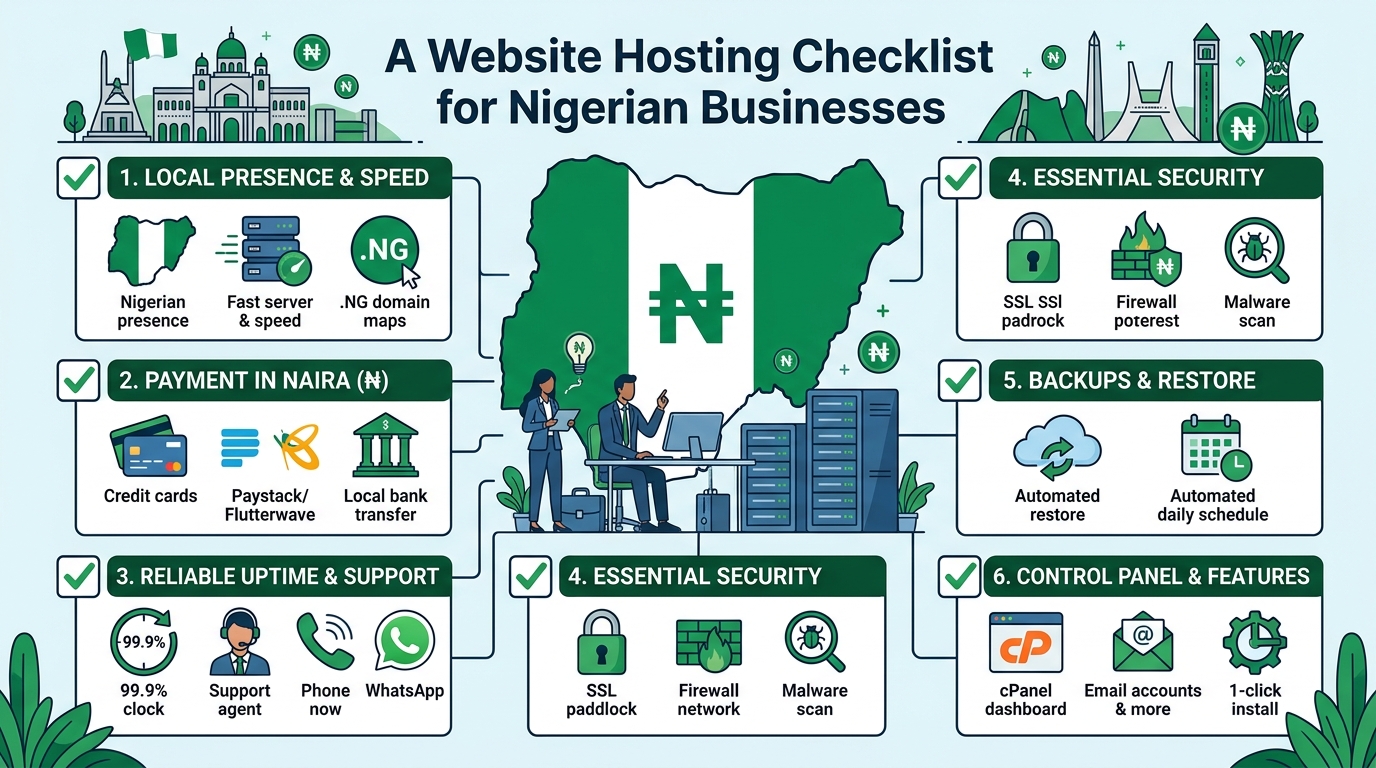
A Website Hosting Checklist for Nigerian Businesses

Choosing website hosting is an important decision for any Nigerian business. Your hosting service affects how quickly your website loads, how reliably it stays online, how secure it is and how easy it is to manage.

The cheapest plan is not always the best choice, and the most advanced plan may provide more capacity than your organisation currently needs. A small business, church, law firm and growing online company can have very different hosting requirements.

Use this checklist to compare hosting providers and select a plan that fits your website, budget and future goals.

1. Identify what your website needs

Before comparing hosting packages, define the purpose of your website. A simple business website with a few pages has different requirements from an online shop, membership platform or busy company portal.

Consider the following questions:

  • How many pages will your website have?
  • Will you publish blog posts, videos, documents or other large files?
  • Will visitors submit contact forms or make enquiries?
  • Will you sell products or accept online payments?
  • Will your church need event information, sermons or donation features?
  • Will a law firm publish downloadable legal resources or client information?
  • Do you expect traffic to increase over time?

For a basic company profile, a standard shared hosting plan may be appropriate. A website with more traffic, demanding applications or specialised technical requirements may eventually need VPS or cloud hosting.

2. Check the hosting resources

Hosting plans often differ in the amount of storage, processing capacity, memory and other resources they provide. Do not compare plans based only on the number of websites or the advertised storage.

Storage

Storage is used for website files, databases, email accounts, images, backups and other data. Estimate your current needs, then allow room for growth. Large images, videos and downloadable documents can use storage quickly.

Bandwidth and traffic

Bandwidth relates to the amount of data transferred between your website and its visitors. A page containing large images or files can use more bandwidth than a simple text page. Ask how the provider manages usage and what happens if your website grows beyond the plan’s normal capacity.

Server resources

Shared hosting places multiple websites on the same server environment. It can be a practical starting point for many small websites, but performance may be affected by the activities of other accounts. If your website needs more consistent resources, ask whether VPS or cloud hosting is available as an upgrade.

3. Ask about reliability and uptime

Your website should be available when potential customers, members, clients or visitors try to access it. A hosting provider should clearly explain how it works to maintain reliable service and respond to technical problems.

When assessing reliability, ask:

  • Is there an uptime commitment in the service terms?
  • How are server faults monitored?
  • How does the provider communicate during service interruptions?
  • Is technical support available when your website has a problem?
  • Are there planned maintenance windows?

Avoid choosing a provider based on an uptime figure alone. Read the terms carefully and look for a clear support process. It is also useful to keep your own website monitoring in place so you know when important pages become unavailable.

4. Review website speed features

Website speed affects the experience of visitors, particularly people using mobile devices or less consistent internet connections. Hosting is only one part of performance, but it provides the foundation.

Look for a hosting environment that supports modern website software and efficient server configuration. Ask whether the plan supports caching, current PHP versions where relevant, databases suited to your website platform and secure connections.

You should also optimise your own website by resizing images, reducing unnecessary plugins, choosing a lightweight design and keeping software updated. A powerful hosting plan cannot fully compensate for an overloaded or poorly maintained website.

5. Confirm security and backup arrangements

Security should be a basic requirement, not an optional extra. A compromised website can damage your reputation, interrupt business operations and expose information.

Before signing up, check whether the provider offers or supports:

  • SSL certificates for encrypted connections
  • Server-level security measures
  • Protection against common malicious activity
  • Malware detection or cleanup options
  • Account isolation or access controls
  • Regular backups

Backups are especially important, but do not assume that a backup exists simply because it is mentioned in a plan. Ask how often backups are created, how long they are retained and whether you can restore your website yourself or need to contact support.

Keep an independent copy of important website content where possible. Your organisation should also use strong passwords, enable available multi-factor authentication and limit administrative access to people who need it.

6. Choose and protect your domain name

Your domain name is the address people use to find your website. It should be easy to remember, relevant to your organisation and simple to communicate by phone or in person.

When purchasing a domain, confirm:

  • Who will be listed as the registrant or owner?
  • How will domain renewal reminders be sent?
  • Can you manage domain settings yourself?
  • What are the renewal and transfer procedures?
  • Is domain privacy available and suitable for your registration?

Keep control of the domain account and its recovery email address. A web designer or staff member may help manage the website, but the organisation should retain access to the domain and hosting accounts.

7. Understand email hosting

Professional email addresses using your domain can help your organisation present a consistent identity. However, email services have different storage, security and sending limits.

Ask whether the hosting plan includes business email and find out how many mailboxes, aliases and forwarding addresses are available. Check the mailbox size and whether webmail and mobile access are supported.

Also ask how the provider handles spam and whether the domain can be configured with email authentication records. Correct email configuration can help legitimate messages reach recipients and reduce the risk of someone impersonating your domain.

8. Evaluate customer support

When a website stops working, access to knowledgeable support can be more valuable than a small difference in monthly cost. This is particularly important for organisations without an in-house technical team.

Check the available support channels, operating hours and expected response process. Ask whether support can help with common tasks such as domain connections, SSL activation, email configuration, database issues and restoring a backup.

Good support should make technical information understandable. Before buying, you can assess the provider’s communication by asking specific questions about your intended website rather than relying only on general sales descriptions.

9. Read the pricing and renewal terms

Hosting costs can include more than the initial advertised plan. Compare the full cost over the period you expect to use the service.

Review:

  • Initial and renewal pricing
  • Domain registration and renewal charges
  • SSL or backup costs, if charged separately
  • Migration or setup fees
  • Upgrade costs
  • Taxes or payment-related charges
  • Cancellation and refund terms

Choose a payment arrangement your organisation can manage consistently. An expired domain or suspended hosting account can make a website unavailable, so assign someone to monitor renewal dates.

10. Consider future growth

Your first hosting plan does not have to support every possible future project, but your provider should offer a sensible path for growth. Ask whether you can increase resources, host additional websites, move to VPS hosting or use cloud hosting when necessary.

For example, a law firm may begin with a brochure website and later add a knowledge centre. A church may add online registration, media resources or donation tools. A growing SME may introduce an online shop or customer portal. Planning for these possibilities can reduce the disruption of changing providers later.

11. Check migration and ownership policies

If you already have a website, ask how it will be moved to the new host. Confirm whether the provider can assist with transferring files, databases, email accounts and domain settings.

Make sure you will receive access to the key components of your website. This includes the hosting control panel, domain management, website files, databases and relevant administrator accounts. Clear ownership and access arrangements reduce problems if your web developer, employee or agency changes.

A simple decision checklist

Question What to confirm
What type of website do we have? Basic website, blog, online shop, portal or application
Can the plan handle our content? Storage, traffic, databases and email capacity
How will problems be handled? Support channels, availability and response process
Is our website protected? SSL, security controls and backup arrangements
What will we pay over time? Renewals, add-ons, upgrades and cancellation terms
Can we grow? Upgrade options and migration support

Conclusion

The right hosting plan should be secure, manageable and suitable for your organisation’s current needs. Start by understanding your website, then compare resources, reliability, support, security, domain ownership and total costs.

For many Nigerian SMEs, churches and professional firms, a well-supported standard hosting plan can provide a practical starting point. As traffic and technical requirements increase, VPS or cloud hosting may offer a more suitable next step. Taking time to check these details before you buy can help your organisation avoid unnecessary costs and keep its website dependable.

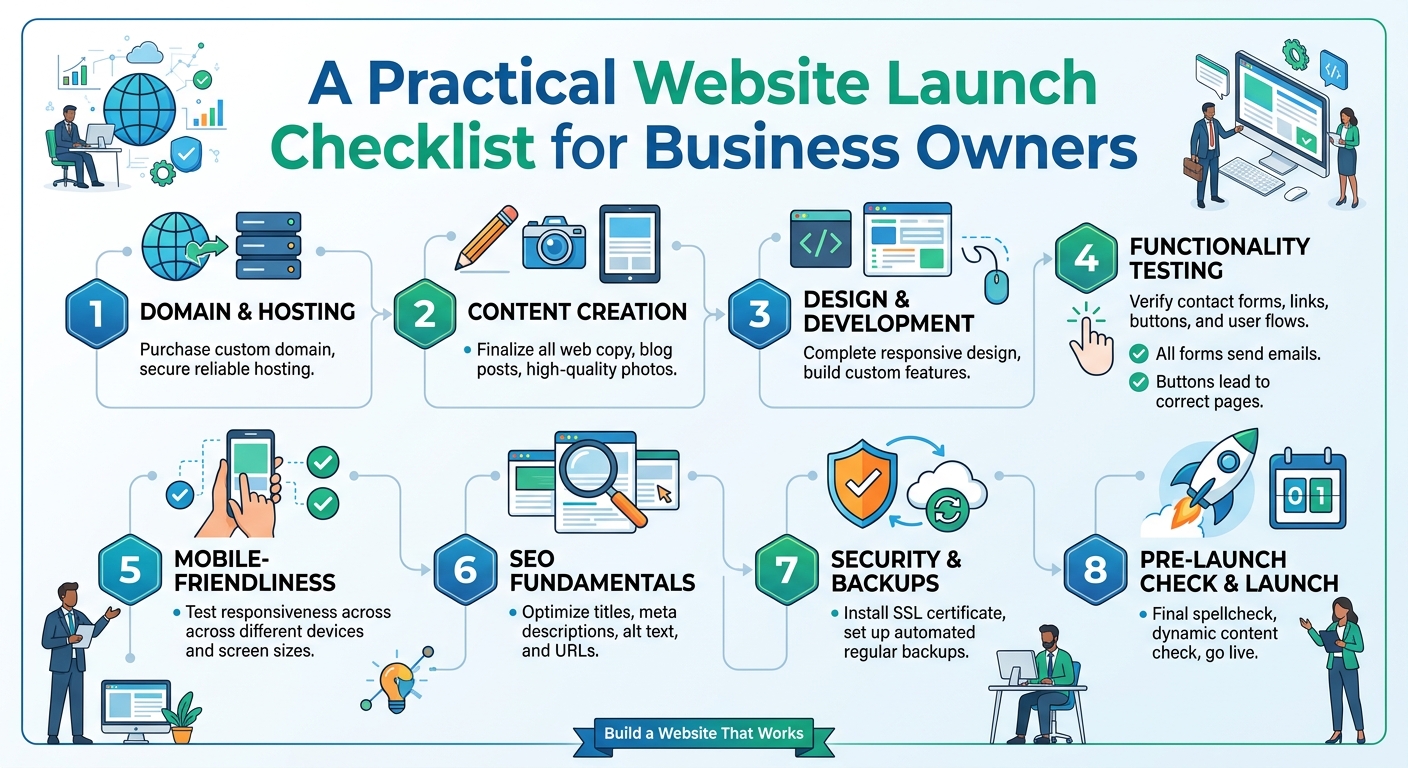
A Practical Website Launch Checklist for Business Owners

Launching a business website is an important step for a small business, church, law firm or growing organisation. Your website can help people understand what you offer, find your contact details and decide whether to work with you. However, a successful launch involves more than choosing a design and publishing a few pages.

A proper launch process helps you avoid broken links, missing information, security gaps and problems that could frustrate visitors. Use this checklist to plan your website, prepare its technical foundation and confirm that everything works before you share the link publicly.

1. Define the website’s purpose

Start by deciding what the website needs to achieve. A website designed to generate enquiries may require clear service pages and contact options. A church website may focus on meeting information, announcements and online resources. A law firm may need to explain its areas of practice and provide a professional way for prospective clients to get in touch.

Write down the main goal and one or two supporting goals. Examples include:

  • Helping potential customers understand your services.
  • Generating calls, messages or enquiry form submissions.
  • Providing opening hours, location and other essential information.
  • Publishing news, announcements or educational content.
  • Building trust before a visitor contacts your organisation.

Clear goals make it easier to decide which pages, features and calls to action are necessary. They also help prevent your website from becoming crowded with tools that do not support your business.

2. Choose and register the right domain

Your domain is the address people use to find your website. It should be easy to remember, easy to spell and closely connected to your organisation or brand. If possible, use a short name without unnecessary numbers, punctuation or complicated wording.

Before purchasing a domain, check that:

  • The name matches your organisation or trading name.
  • You have checked the spelling carefully.
  • The domain is suitable for the audience and market you serve.
  • The registration details are accurate and controlled by your business.
  • You know when the domain is due for renewal.

Keep your domain account details secure. A domain is a valuable business asset, and losing access to it can make it difficult to manage your website or business email.

3. Select hosting that fits your needs

Web hosting stores your website files and makes them available to visitors. The right hosting choice depends on the type of website you are launching, the features you need and the level of traffic you expect.

For a straightforward business website, an appropriate shared hosting plan may provide a practical starting point. Businesses with more demanding applications, higher resource requirements or specialised configurations may need VPS or cloud hosting. The important point is to match the hosting environment to the website rather than choosing a plan based only on the lowest price.

When comparing hosting options, consider:

  • Whether the plan supports your website platform and software.
  • Storage and resource limits.
  • Available backup options.
  • Security features and account access controls.
  • How easily you can upgrade as the website grows.
  • The quality and availability of technical support.

Sonhosting provides web hosting options for organisations that want to save time and avoid unnecessary complexity when setting up their online tools. Review the requirements of your website first, then select a plan that can support its current and likely near-term needs.

4. Prepare the essential website pages

A new website does not need dozens of pages to be useful. It does need the right information. Most business websites should consider the following core pages:

  • Home: Explain who you are, what you offer and what visitors should do next.
  • About: Provide relevant background about the business or organisation.
  • Services: Describe each important service clearly and explain who it is for.
  • Contact: Include reliable contact methods and any relevant business information.
  • Frequently asked questions: Address common concerns before people contact you.

Depending on your organisation, you may also need pages for locations, team members, events, resources, testimonials supplied by real customers or legal and privacy information. Only publish information that is accurate and approved.

5. Check your content carefully

Visitors judge a website quickly, and small errors can reduce confidence. Review every page for spelling, grammar, outdated details and unclear wording. Ask someone who is unfamiliar with the business to read the pages. They may notice information that employees have assumed is obvious.

Check that:

  • Your services are described in plain language.
  • Prices, opening hours and availability are current if you publish them.
  • Contact details are consistent across the website.
  • Calls to action are clear, such as “Request a consultation” or “Contact us”.
  • Images are relevant, sharp and suitable for the page.
  • Text is easy to read on a mobile phone.

Avoid making promises that the business cannot consistently deliver. Professional content should be specific, honest and useful to the people you want to serve.

6. Test the website on different devices

Many visitors will access your website from a mobile phone. Test the layout on phones, tablets and desktop computers where possible. Look for text that is too small, buttons that are difficult to tap, images that overlap content and menus that do not open properly.

Complete the main visitor journey yourself. Start on the home page and try to find a service, read the relevant information and make contact. Test every important button, link and form. Do not assume that a feature works simply because it worked during development.

7. Review performance and accessibility

A website should be reasonably quick and usable for people with different devices, connection speeds and abilities. Large images, unnecessary plugins and poorly configured features can slow down a page.

Before launch:

  • Compress large images while keeping them clear.
  • Remove unused pages, plugins and design elements.
  • Use descriptive headings and readable text.
  • Add meaningful alternative text to important images.
  • Make sure links and buttons are distinguishable.
  • Check that key information is not available only through images.

These steps improve the experience for visitors and make the website easier to maintain.

8. Protect the website and its accounts

Security should be part of the launch plan, not an afterthought. Use strong, unique passwords for your hosting, domain, website administration and email accounts. Enable additional account protection where it is available, and limit administrative access to people who need it.

Confirm that your website uses HTTPS and that its software, themes and extensions are kept up to date. Arrange a backup process and understand how a backup can be restored. A backup is most useful when it can actually be recovered after a mistake or technical problem.

Also decide who is responsible for updates, renewals and security checks. Assigning ownership prevents important tasks from being forgotten when staff or service providers change.

9. Configure business email and contact notifications

A professional email address using your business domain can create a more consistent experience than relying only on a personal address. Before launch, test sending and receiving messages, including messages sent from website contact forms.

Check where form notifications are delivered and whether more than one responsible person should receive them. Send test enquiries from different devices and confirm that the messages do not disappear into an overlooked inbox. Add a simple confirmation message so visitors know whether their enquiry was submitted successfully.

10. Complete the final launch review

Use a final checklist before announcing the website:

  1. Confirm the correct domain points to the intended website.
  2. Review the home page, main service pages and contact page.
  3. Test navigation, buttons, forms and important links.
  4. Check the website on mobile and desktop screens.
  5. Verify HTTPS, backups, updates and administrator access.
  6. Remove placeholder text and unfinished sections.
  7. Confirm that contact information is accurate.
  8. Tell relevant staff how to handle enquiries received through the website.

It can be useful to ask one person to review the website as a first-time visitor rather than as someone involved in building it. A fresh perspective often reveals confusing navigation or unanswered questions.

11. Plan what happens after launch

Publishing the website is the beginning of its working life. Schedule regular reviews of your content, software, contact details and performance. Add useful updates when your services, events or operating arrangements change.

Monitor the questions people ask and the pages they use most. This information can guide future improvements, such as clearer service descriptions, additional frequently asked questions or a more direct enquiry process. If your website grows beyond the limits of its original hosting plan, review whether an upgrade or a different hosting environment is appropriate.

Conclusion

A careful website launch gives your organisation a stronger foundation online. Define your goals, choose a suitable domain and hosting plan, prepare accurate content, test the visitor experience and protect the accounts behind the website. Then keep the site current after launch.

Whether you are launching a small business website, a church website or a professional site for a law firm, a practical checklist can reduce avoidable problems and help visitors find the information they need with confidence.

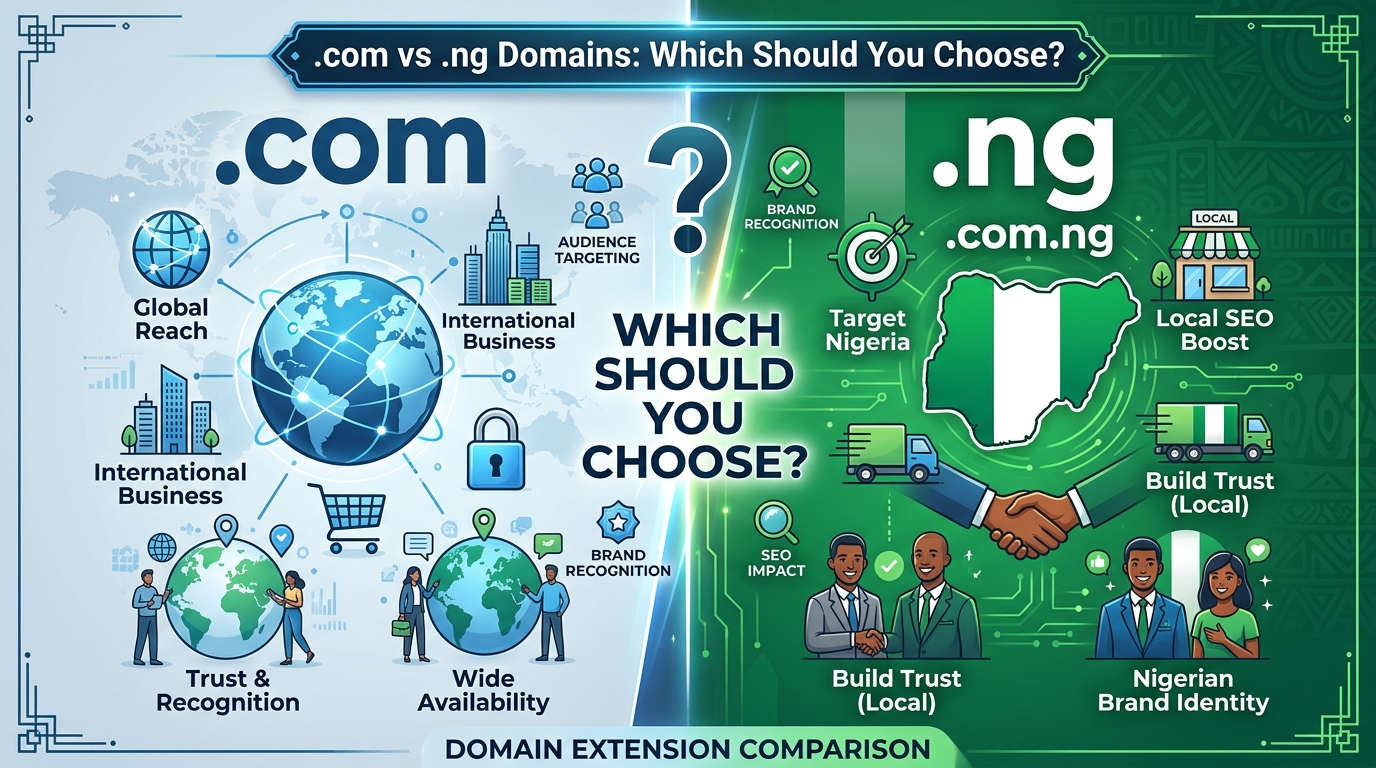
.com vs .ng Domains: Which Should You Choose?

Choosing a domain name is one of the first important decisions when creating a website. Your domain is more than a web address: it is part of your brand identity, appears in marketing materials and can influence how visitors perceive your organisation.

For businesses and organisations in Nigeria, the choice often comes down to a .com domain or a Nigerian country-code domain such as .ng or .com.ng. Both can be suitable, but the best option depends on your audience, business goals and the image you want to build.

This guide explains the main differences between .com and .ng domains so you can make a confident decision before purchasing your domain and hosting.

What is a .com domain?

A .com domain is a generic top-level domain. It was originally associated with commercial organisations, but it is now used by businesses, individuals, non-profits, churches, professionals and many other types of websites around the world.

Because .com has been used for many years, it is familiar to internet users in Nigeria and internationally. When people hear a business name, they may automatically try the .com version first. This familiarity can make a .com domain easy to remember and suitable for organisations serving customers across multiple countries.

However, popular .com names are often already registered. You may need to adjust your preferred name, add a relevant word or choose a different extension if the exact domain is unavailable.

What is a .ng domain?

A .ng domain is Nigeria’s country-code top-level domain. It identifies a website with a connection to Nigeria and can help communicate that a business, organisation or service is focused on the Nigerian market.

There are also second-level options such as .com.ng, which is commonly associated with commercial websites, and other Nigerian domain categories intended for particular types of organisations. The appropriate option may depend on the domain provider’s requirements and the organisation applying for it.

A .ng domain can be useful for a Nigerian SME, local service provider, church, law firm or community organisation that wants its Nigerian identity to be clear. It can also make a brand name available when the corresponding .com has already been taken.

Key differences between .com and .ng

1. Audience and market focus

The clearest difference is geographical positioning. A .com domain has a global feel, while .ng signals Nigeria.

If your organisation mainly serves customers in Lagos, Abuja, Port Harcourt or other parts of Nigeria, a .ng domain can reinforce your local presence. It may help visitors immediately understand that your services are intended for the Nigerian market.

A .com domain may be more appropriate if you plan to serve customers in several countries, sell internationally or build a brand that is not tied to one location. It is also a sensible choice when your target audience is already familiar with your business name under a .com address.

2. Brand perception

Neither extension automatically makes a website more professional. A trustworthy brand depends more on the quality of its website, communication, security, customer service and consistency.

That said, the extensions communicate different things. A .com domain can make a company appear broadly international. A .ng domain can present a business as proudly Nigerian, locally relevant and focused on serving people in the country.

For a Nigerian church, a .ng domain may clearly identify the organisation’s location. For a law firm serving Nigerian clients, it can support a local professional identity. A company with international expansion plans may prefer .com as its primary domain, even if it starts in Nigeria.

3. Availability of names

Domain availability is a practical consideration. Short, obvious .com names are often unavailable because many businesses and individuals already use them.

You may have more naming flexibility with a .ng or .com.ng domain. This can allow you to use your preferred business name without adding unnecessary numbers, hyphens or extra words.

Before deciding, check the exact name across the extensions you are considering. A good domain should be easy to spell, easy to say aloud and closely related to your organisation’s name or services.

4. Memorability

People are generally familiar with .com, which can make it easy to remember. However, familiarity does not mean that every .com domain is memorable. A long or complicated name can still be difficult to recall.

A concise .ng domain may be more memorable than a crowded .com alternative. For example, a clear business name with a relevant Nigerian extension may be easier to communicate than a .com address containing several extra words.

When comparing options, say each domain aloud and consider how it will look on a sign, invoice, social media profile, business card or radio advertisement.

5. Search engine considerations

Changing the domain extension alone does not guarantee better search engine visibility. Search engines consider many aspects of a website, including useful content, technical performance, relevance, links and the quality of the user experience.

A Nigerian country-code domain can provide a useful geographic signal for searches connected to Nigeria. A .com domain can support a broader international positioning. The extension should therefore match your intended audience, while your website content and technical setup support your search goals.

Most importantly, choose a domain that you can build consistently. A relevant, trusted website is more valuable than selecting an extension based only on assumptions about rankings.

When should you choose a .com domain?

A .com domain may be the better choice if:

  • Your business plans to serve customers outside Nigeria.
  • You want a broadly international brand identity.
  • Your audience is already familiar with your .com name.
  • You expect to expand into different countries or markets.
  • The .com version of your brand name is available and easy to use.

For example, a technology company developing services for customers across Africa may choose .com to avoid limiting its brand to one country. A Nigerian business can still use .com while clearly showing its location through its website content, contact information and business messaging.

When should you choose a .ng domain?

A .ng or .com.ng domain may be a strong choice if:

  • Your main customers are in Nigeria.
  • Your organisation wants to emphasise its Nigerian identity.
  • You provide location-based services to Nigerian clients.
  • The matching .com domain is unavailable or too expensive for your budget.
  • You want a short, clear alternative to a long .com name.

This can work well for local retailers, schools, churches, professional practices, community organisations and SMEs whose services are primarily delivered within Nigeria.

Can you buy both .com and .ng?

Yes, many organisations choose to register both versions when they are available. One domain can be used as the main website, while the other redirects visitors to it.

Owning both can help protect your brand and reduce the risk of another party registering a similar domain. It can also prevent confusion when customers type the wrong extension. However, registering multiple domains adds renewal responsibilities, so keep your domain records organised and renew every important domain on time.

If you use more than one domain, decide which one is your primary address. Use that version consistently on your website, email addresses, social media profiles, invoices and promotional materials.

What to check before registering your domain

  1. Check the spelling: Avoid names that are difficult to pronounce or easy to mistype.
  2. Keep it practical: Shorter domains are usually easier to share and remember.
  3. Consider the future: Choose a name that still fits if your products or services expand.
  4. Review registration requirements: Requirements and policies can vary by domain extension and provider.
  5. Plan for renewal: Keep your registration email and payment details current.
  6. Protect your brand: Consider related extensions if the name is important to your organisation.

Does the domain extension affect hosting?

Your choice of .com or .ng does not prevent you from using standard web hosting, VPS hosting or cloud hosting. The domain points visitors to your website, while hosting provides the server space and resources needed to run it.

When purchasing hosting, check that the provider can help you connect your chosen domain, manage DNS records and set up professional email addresses. A reliable setup should also support website security, backups and the software your organisation needs.

Final recommendation

Choose .com if you want a global identity, plan to expand internationally or already have a strong .com brand. Choose .ng or .com.ng if your organisation mainly serves Nigeria and you want your local identity to be immediately clear.

There is no universally superior extension. The best domain is available, easy to remember, aligned with your audience and suitable for your long-term plans. Once you choose it, focus on building a fast, secure and useful website that gives visitors a reason to return.

Your Cart

©2018 - currentyear Sonhosting • By Digital Nigeria - RC 7487481
All Rights Reserved
Powered by ShootOut Now Services