How to Buy a Domain Name for Your Business

How to Buy a Domain Name for Your Business

Choosing a domain name is one of the first important decisions when building a business website. Your domain is the address customers use to find you online, and it can also support professional email, marketing and long-term brand recognition.

For a Nigerian business, entrepreneur or organisation, the right domain should be easy to remember, connected to your name or service, and registered under information you control. Buying the cheapest available name is not always the best decision. You also need to consider the domain extension, ownership details, renewal process and how the name will work as your business grows.

What is a domain name?

A domain name is the readable address people enter to visit a website, such as yourbusiness.com. Computers use numerical IP addresses to locate websites, but domain names make those addresses easier for people to remember and share.

A domain is not the same as web hosting. The domain is your website’s address, while hosting is the server space where your website files, images and databases are stored. You normally need both for a functioning website. You may also connect the domain to domain-based business email, such as [email protected].

Start with your business identity

Before searching for available names, decide what the domain needs to achieve. A local service provider may want a name that is easy for nearby customers to recognise. A startup may prefer a name that can support expansion beyond one city or product. A creator or professional may use their personal name to build a long-term reputation.

Write down a few possible names and check that they are:

  • Easy to say, spell and remember
  • Relevant to your business or brand
  • Short enough to type comfortably on a mobile phone
  • Suitable for use in email addresses
  • Flexible enough if your products or services change

Avoid names that depend heavily on punctuation, unusual spelling or long strings of words. A customer who hears your name in a conversation should have a reasonable chance of typing it correctly.

Choose the right domain extension

The extension is the part after the final dot, such as .com, .org or a Nigerian country-code extension. Your choice should support how customers see the business and where you expect to operate.

Common options to consider

  • .com: A widely recognised choice for commercial businesses and organisations serving a broad market.
  • .org: Often associated with organisations, communities and non-commercial initiatives, although the name should still match your actual purpose.
  • Nigerian extensions: A country-specific option can help communicate a connection to Nigeria and may suit businesses focused on the local market.

There is no universal rule that one extension is best for every business. Consider what your audience expects, whether the name is easy to communicate and whether the extension fits your future plans. If a strong brand name is available in more than one relevant extension, some businesses register multiple versions and direct them to the main website. This is optional and should be weighed against the additional renewal costs.

Check availability and possible conflicts

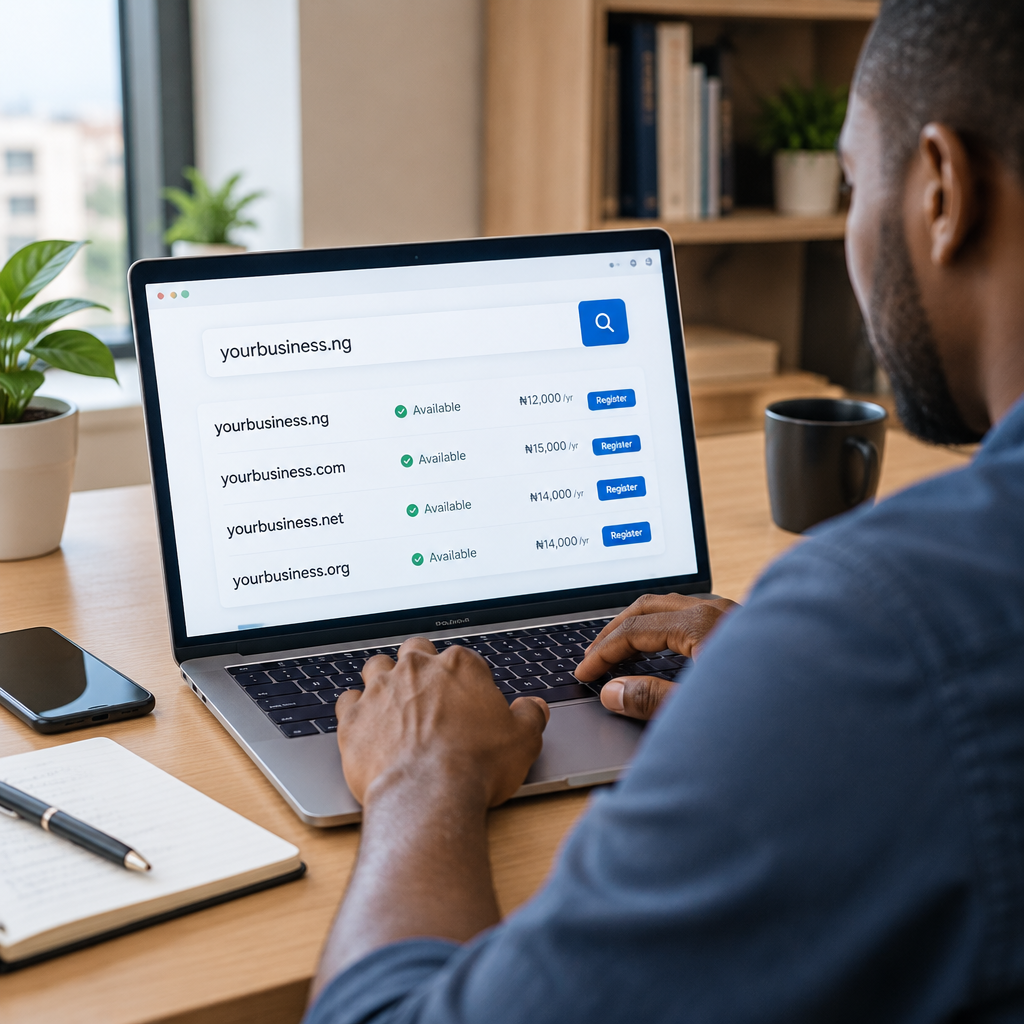
Use a domain search tool from a reputable registrar to see whether your preferred name is available. If it is already registered, do not assume that adding random numbers or extra words is the only solution. Try a shorter variation, a clear service-related phrase or a different suitable extension.

Before registering, check whether the name could be confused with another business, product or organisation. Search engines and social platforms can help you identify similar names, but they are not a substitute for appropriate legal or trademark advice. Avoid registering a name that appears designed to imitate another company or brand.

It is also useful to check how the name looks in lowercase and how it sounds when spoken aloud. Some combinations of words can be misunderstood when written without spaces. This matters when customers type the address from a radio advertisement, conversation or business card.

Register the domain in your own control

When you buy a domain, pay close attention to the registrant or account information. A business should not lose access to its domain because it was registered using a developer’s personal email address, a former employee’s account or an unknown third party’s details.

Use a business-controlled email address where practical, and keep the account login, recovery details and registration records secure. If a web developer or hosting provider helps with registration, confirm that your business is clearly listed as the owner and that you can access the relevant account.

Keep copies of important information, including:

  • The domain name and extension
  • The registrar account email address
  • Renewal dates and payment details
  • Account recovery information
  • Nameservers and DNS records, where relevant

Do not share passwords through informal channels. Use a strong, unique password and enable multi-factor authentication if the registrar provides it.

Understand the total cost

Domain registration is commonly paid for a fixed period, often one year at a time, and it must be renewed to remain active. The first registration price may differ from the renewal price, so check the ongoing cost before making a decision.

Also look for related charges or optional services. These may include privacy-related features where available, transfer fees, additional domain extensions or email services. The goal is not to avoid every additional service, but to understand what you are paying for and which features your business actually needs.

For budget-conscious Nigerian businesses, renewal planning is especially important. A domain that expires can interrupt a website and domain-based email. Put the renewal date on a shared business calendar and keep payment information current. Automatic renewal can help, but it should not replace checking that the payment method and account access still work.

Connect the domain to your website and email

After registration, the domain must be connected to your hosting account through DNS settings. This tells the internet where to find your website and how to deliver email. DNS changes can take time to become visible across different networks, so a newly registered domain may not work immediately everywhere.

If you plan to use business email, make sure the email records are configured correctly. Website hosting and email hosting may be provided together or as separate services, but both need reliable account management. Test sending and receiving messages before printing the address on signs, invoices or marketing materials.

Enable HTTPS for the website through an SSL certificate. Visitors should be able to see that the connection is encrypted, particularly when they submit contact details, log in or make a payment. HTTPS is one part of website security; strong passwords, updates, backups and secure hosting practices are also important.

A practical buying workflow

  1. Define the brand, audience and geographic focus.
  2. List several simple domain name options.
  3. Check spelling, pronunciation and possible confusion.
  4. Compare suitable extensions and ongoing renewal costs.
  5. Search availability through a reputable domain provider.
  6. Register the domain using accurate business or owner information.
  7. Secure the account with a unique password and recovery method.
  8. Record the renewal date and set a reminder.
  9. Connect the domain to hosting, the website and business email.
  10. Test the website, email address and contact details.

What to do if your preferred domain is unavailable

Do not rush into buying a name that is difficult to spell or unrelated to your brand. Consider a clear variation, a suitable Nigerian extension or a name that describes your service more directly. If the domain appears to be owned by someone else, be cautious about paying an inflated resale price. The cost and risk may not make sense for a small business.

You can also choose a temporary alternative while building your brand, but make sure all public materials use one consistent address. Changing domains later can affect email, printed materials, search visibility and customer recognition, so choose carefully before launching.

Keep ownership secure after registration

Buying the domain is only the beginning. Review the account periodically, keep contact information accurate and check that renewal notices reach someone responsible. Limit account access to people who need it, and maintain backups of your website rather than assuming the domain protects your website content.

A domain, dependable hosting, professional email and a secure website work together to create a stable online home. A hosting provider can handle technical tasks such as DNS configuration, WordPress support and security guidance, while you retain access to the business assets that matter.

The best domain name is not simply one that is available. It is one your customers can remember, your business can control and your team can manage reliably for years to come.


How to Build a Website for a Nigerian Law Firm

How to Build a Website for a Nigerian Law Firm

A law firm’s website is often the first place a prospective client looks before making contact. Visitors want to know whether the firm handles their type of matter, where it operates, how to reach it and whether it appears professional and trustworthy.

For a Nigerian law firm, a successful website does not need complicated features or excessive animation. It needs accurate information, clear explanations, dependable hosting, strong security and an easy way for a potential client to make an enquiry. The goal is to reduce uncertainty before the first call or consultation.

Start with the firm’s purpose and audience

Before choosing colours, fonts or a WordPress theme, decide what the website must help the firm achieve. A practice serving corporate clients may need to communicate commercial experience and locations. A firm serving individuals may need simple explanations of services such as family law, property matters, employment disputes or criminal defence.

Identify the main audiences and the questions they are likely to ask:

  • What type of legal matter does the firm handle?
  • Does the firm serve clients in a particular Nigerian state or city?
  • How can a visitor request an appointment?
  • What information should a prospective client prepare before making contact?
  • Is the firm available for individuals, businesses or both?

This exercise helps prevent a common problem: a website that describes the lawyers but does not explain how the firm can help visitors.

Choose and control the firm’s domain

The domain is the website address people type into their browsers. It should be easy to remember, straightforward to spell and closely connected to the firm’s name. A domain based on the firm’s established name is usually easier to build a consistent brand around than a vague phrase.

A Nigerian law firm may consider an appropriate Nigerian domain option or a widely recognised international domain, depending on availability, branding and its intended audience. The important point is to make the choice deliberately and keep accurate ownership and renewal information.

The firm should retain access to:

  • The domain registrar account
  • The domain’s administrative email address
  • The hosting account
  • The website administrator account
  • Business email accounts and recovery details

If a developer registers the domain on the firm’s behalf, the firm should still confirm who owns the account and how access can be transferred. Losing access to a domain can disrupt the website, email and client communications.

Select hosting based on the website’s needs

Hosting is the service that stores the website and makes it available online. The best hosting plan is not automatically the most expensive one. A small firm with a brochure-style website may have different requirements from a large practice publishing extensive resources or operating several websites.

When comparing hosting, consider the number of websites, expected traffic, business email needs, WordPress support, backup arrangements, security features and the level of technical assistance available. Reliable support can be particularly useful for a firm that does not have an in-house website administrator.

The hosting environment should support HTTPS through an SSL certificate, provide sensible account security and make it practical to keep the website software updated. These details affect both visitor confidence and the firm’s ability to manage the site responsibly.

Build a clear, mobile-friendly structure

Many prospective clients will visit from a mobile phone. The website should therefore be easy to read and use on a small screen, with large enough text, clear menus and contact buttons that do not require excessive scrolling or zooming.

A practical initial structure might include:

  • Home: A concise explanation of who the firm serves, its principal services and the next step for visitors.
  • About the firm: The firm’s background, approach, location and relevant professional information.
  • Practice areas: Separate pages explaining each major service in plain language.
  • People: Accurate profiles for partners, associates or other relevant team members.
  • Insights: Articles or updates that answer common questions and demonstrate the firm’s areas of focus.
  • Contact: Phone, email, office location, opening information and a clear enquiry method.

A visitor should be able to reach the contact page quickly from every important page. Avoid hiding contact information behind decorative elements or requiring a visitor to create an account before making a basic enquiry.

Write useful practice-area pages

Practice-area pages should explain problems in terms a potential client understands. A page titled “Corporate and Commercial Law” can be useful, but it should also describe the types of support the firm provides, such as contract review, business formation, commercial agreements or dispute support, where those services genuinely apply.

Each page can answer four practical questions:

  1. What situation does this service address?
  2. What kinds of work can the firm assist with?
  3. Who is the service intended for?
  4. How can the visitor discuss their circumstances with the firm?

Use careful wording. Website content should not imply that every visitor will receive the same result or that general information is a substitute for advice on a specific matter. The firm should review its content to ensure that descriptions, professional titles and any statements about services are accurate and consistent with its applicable professional obligations.

Present the lawyers and firm credibly

People seeking legal help often want to know who they will be dealing with. Lawyer profiles should be factual and useful rather than exaggerated. Include each person’s role, areas of practice, professional background and relevant qualifications only where the information is current and approved for publication.

Professional photographs can help the website feel more personal, but poor-quality or inconsistent images can have the opposite effect. Use a consistent visual style and make sure photographs, biographies and contact details are kept up to date when staff roles change.

Use professional email and protect confidential information

An address such as contact@firmdomain generally presents a more established image than a free consumer email address. Domain-based business email also helps the firm keep communication connected to its own digital identity.

Email accounts should use strong, unique passwords and multi-factor authentication where available. Access should be removed promptly when a staff member leaves, and recovery details should remain under the firm’s control.

A website enquiry form should collect only information that is necessary for the initial contact. Visitors should be told that sending an enquiry does not necessarily create a lawyer-client relationship, and they should be discouraged from submitting highly sensitive details through a general form before the firm has confirmed how the matter will be handled.

Make security and maintenance part of the plan

Launching a website is not the end of the project. WordPress core software, themes and plugins need appropriate maintenance. Unused plugins should not remain installed, administrator access should be limited and the firm should maintain reliable backups.

Backups are especially important because a website can be affected by accidental deletion, compromised accounts, software conflicts or hosting problems. A backup plan should specify what is backed up, how often it is created, where it is stored and how restoration would be tested.

HTTPS should be enabled across the site, and the domain, hosting and email renewal dates should be monitored. These basic controls reduce the risk of an avoidable interruption to the firm’s online presence.

Plan for search and local enquiries

Search visibility begins with useful, specific content rather than repeating the same keyword throughout every page. Use page titles that describe the service and location naturally, write clear headings and publish answers to genuine questions prospective clients ask.

The firm’s name, office address, phone number and email should be consistent across the website and other business listings. Location details should be accurate, and the firm should avoid claiming coverage, experience or results that it cannot substantiate.

Useful insights might explain general legal processes, document preparation, business considerations or common terminology. They should be reviewed regularly because legal information can become outdated and readers may interpret general guidance as advice for their own circumstances.

A practical launch workflow

  1. Define the audience: Choose the main client groups and services the site will prioritise.
  2. Secure the domain: Register it in an account the firm can access and control.
  3. Choose hosting: Match the plan to the website, email, support and maintenance requirements.
  4. Prepare content: Gather approved practice-area descriptions, biographies, contact details and images.
  5. Build for mobile: Test menus, pages, phone links and forms on common mobile screen sizes.
  6. Apply security controls: Enable HTTPS, strong passwords, limited administrator access and backups.
  7. Review before launch: Check every link, email address, location detail, professional statement and form.
  8. Maintain the site: Schedule updates, content reviews, renewal monitoring and backup checks.

The key decision

A Nigerian law firm website should make the next step clear without making promises it cannot support. A suitable domain, dependable hosting, professional email, accurate practice-area content and a secure mobile-friendly design create a stronger foundation than a visually impressive site that is difficult to manage.

For firms without technical staff, managed WordPress support and practical hosting assistance can handle much of the work behind the scenes. That allows lawyers and administrators to focus on clients while keeping control of essential digital assets and information.

How to Build a Professional Church Website

How to Build a Professional Church Website

A church website should do more than display a service timetable. It should help visitors understand who you are, help members find important information and give people a simple way to connect with the church.

For churches in Nigeria and across West Africa, a website can also provide a stable online home beyond social media. It can share service details, sermons, events, announcements and contact information with people who are searching from a phone or considering a first visit.

Building a professional church website does not require complicated technology. The important decisions are choosing a suitable domain, reliable hosting, clear content, mobile-friendly design and a maintenance routine that keeps information accurate and secure.

Start with the church’s purpose and audience

Before choosing colours, themes or plugins, decide what the website needs to help people do. A church website may serve several audiences:

  • First-time visitors looking for service times, location and contact information
  • Existing members checking announcements, programmes and ministry updates
  • People watching sermons or joining online activities
  • Parents looking for children’s ministry information
  • People seeking prayer, counselling or general guidance
  • Partners, volunteers or community members who want to understand the church’s work

These audiences may not use the website in the same way. A visitor may need basic information within seconds, while a member may return regularly to check an events calendar. Write down the most important tasks and make those easy to find from the homepage.

Choose a clear and trustworthy domain name

Your domain is the web address people use to find the church. It should be easy to remember, easy to spell and closely connected to the church’s name. Avoid unnecessary numbers, unusual abbreviations and long phrases that may be difficult to communicate verbally.

A church may choose a suitable generic domain or consider a local Nigerian domain where appropriate. The most important point is not the extension alone but consistency. Use the same official domain on printed materials, social media profiles, event banners and email addresses.

The church should retain control of the domain account and use accurate registration information. Do not leave the domain registered only through a former volunteer, developer or staff member. Keep renewal notices accessible to more than one trusted administrator so the website is not placed at risk if one person becomes unavailable.

Select hosting that matches the website

Web hosting is the service that stores the website and makes it available online. A small church website with pages, announcements, photos and sermon information may not need the most expensive hosting plan. However, it still needs dependable service, reasonable performance, security features and accessible support.

Consider the church’s actual requirements:

  • How many websites need to be hosted?
  • Will the website include audio, video or large downloadable files?
  • Will the church use domain-based email accounts?
  • How often will new content be published?
  • Who will manage updates and technical issues?
  • Is the church likely to grow its online activities?

Large video files can place different demands on a website than ordinary text pages. In many cases, it is practical to publish videos through a suitable video platform and embed them on the website rather than using the website hosting account for every file. The right plan should support current needs while leaving a sensible path for growth.

Build around clear, useful content

Visitors should not have to search through several pages to discover basic information. A professional church website commonly needs the following pages:

  • Home: A clear summary of the church, the next important activity and the main ways to get help or make contact.
  • About: The church’s story, beliefs, leadership and mission explained in language visitors can understand.
  • Plan a Visit: Service times, location, directions, parking or transport information and what a new visitor should expect.
  • Ministries: Information about children, youth, families, small groups and other ministries.
  • Events: Accurate dates, times, venues and registration details for upcoming programmes.
  • Sermons or resources: Recordings, notes, devotionals or other helpful materials.
  • Contact and prayer: A phone number, email address, social links and a clearly explained way to request prayer or assistance.

Content should be written for people who may know nothing about the church. Avoid relying on internal abbreviations or assuming that a first-time visitor understands every ministry name.

Design for mobile visitors first

Many people will visit the website on a mobile phone, often while travelling, sharing a link or deciding whether to attend a service. The site should load comfortably on smaller screens and make important actions easy to tap.

Place service times, location, contact details and current announcements where they can be found quickly. Use readable text, strong contrast and buttons with descriptive labels such as “Get Directions”, “Contact the Church” or “View Upcoming Events”. Avoid filling the homepage with large images that make the most important information difficult to reach.

Photography can make a church website feel welcoming, but images should be relevant, properly sized and used respectfully. Obtain appropriate permission before publishing identifiable photographs, especially images of children or private gatherings.

Use a manageable website platform

A content management system such as WordPress can be suitable when church staff or volunteers need to update announcements, events and resources without editing code. The platform should be configured carefully rather than overloaded with unnecessary themes and plugins.

Assign each administrator only the access they need. For example, a volunteer who publishes event updates may not need full control over hosting or security settings. Use strong, unique passwords and enable additional login protection when it is available.

Choose a theme that supports accessible layouts, responsive design and straightforward editing. A visually impressive theme is not useful if volunteers cannot update it or if the site becomes slow and difficult to maintain.

Add security, backups and business email

Church websites collect trust-sensitive information. People may use a contact form to request prayer, ask for counselling or share personal details. Use an SSL certificate so the website loads over HTTPS and information sent through the site is protected in transit.

Security also depends on regular updates, limited administrator access and sensible password practices. Keep the WordPress core, theme and plugins maintained, and remove extensions that are no longer needed.

Backups provide a way to recover from accidental changes, technical problems or security incidents. Confirm what is being backed up, how frequently backups are created and how restoration would work. A backup that cannot be restored is not a complete recovery plan.

For official communication, use an address connected to the church’s domain, such as info@yourchurchdomain, rather than relying only on a personal free email account. Domain-based email can make communication more recognisable and helps separate church administration from individual accounts. Keep access to the domain, hosting and email services under the church’s control.

Create a simple publishing workflow

Websites become unreliable when nobody is responsible for keeping them current. Assign clear roles for writing, approval, publishing and technical maintenance. A simple workflow might look like this:

  1. A ministry leader submits event information using a standard format.
  2. An assigned editor checks the date, venue, contact details and wording.
  3. The information is published with an expiry or review date.
  4. Another person checks the page on a mobile phone.
  5. After the event, the page is updated, archived or removed as appropriate.

Review service times, leadership details, contact information, forms and links regularly. An outdated event or incorrect phone number can create more frustration than having no information at all.

A practical launch checklist

Before announcing the new website, check that:

  • The domain is registered in the church’s name or under an account the church controls.
  • The homepage explains who the church is and what visitors should do next.
  • Service times and location details are accurate.
  • The website works on common mobile screen sizes.
  • Contact forms and email links have been tested.
  • HTTPS is enabled.
  • Administrator passwords are private and strong.
  • Backups and updates have been planned.
  • Images, testimonials and personal information are used responsibly.
  • At least two trusted people know how to access essential accounts.

Make the website a dependable digital home

A professional church website is not defined by expensive design or a large number of features. It is defined by whether people can find accurate information, understand the church’s purpose and take the next step without confusion.

Start with a suitable domain, reliable hosting and a focused set of pages. Add mobile-friendly design, HTTPS, domain-based email, backups and a clear maintenance process. With those foundations in place, the church can publish sermons, events and ministry information confidently while keeping control of its essential digital assets.

The best church website is one that remains useful after launch: current enough to trust, simple enough to manage and welcoming enough to help a new visitor feel informed before making contact.

How to Back Up a Website Hosted in the Cloud

How to Back Up a Website Hosted in the Cloud

A website hosted in the cloud can still be lost, damaged or made unavailable. Cloud hosting may provide resilient infrastructure, but it does not automatically mean that you have a complete, restorable copy of your website.

Accidental deletion, a faulty update, malware, a compromised administrator account or a hosting configuration problem can affect a website. For a Nigerian business that relies on its website for enquiries, sales, bookings or credibility, recovery should not depend on hoping the hosting environment remains untouched.

A proper backup plan gives you a way to restore the website to a known working state. It also helps you retain control of an important digital asset instead of depending entirely on a developer, former employee or hosting account that may be difficult to access later.

What a website backup should contain

A website is usually made up of more than the pages visitors see in their browsers. A useful backup should account for the components needed to rebuild or restore the site.

  • Website files: These may include WordPress core files, themes, plugins, images, documents, scripts and other uploaded content.
  • The database: For WordPress and many other content management systems, the database contains posts, pages, settings, user accounts, comments and other important information.
  • Configuration details: Some sites depend on configuration files, rewrite rules, environment settings or connection details. Store these securely and avoid exposing passwords in ordinary documents.
  • Custom code and integrations: Record or preserve important changes made to templates, forms, payment tools, analytics systems and other services.
  • Domain and account access: These are not normally part of the website files, but they are essential for recovery. Keep accurate records of the domain registrar, hosting account, email accounts and administrator access.

If you back up only images and page files but omit the database, you may not have a usable copy of the site. If you save the website but lose access to the domain or hosting account, visitors may still be unable to reach it.

Cloud hosting is not the same as a backup

Cloud services are designed to run applications and store data across managed infrastructure. That can improve availability and make it easier to scale or manage a site, but availability and backup solve different problems.

An active website is the working version. A backup is a separate copy that can be used after the working version has been deleted, corrupted or compromised. If a backup remains on the same account, server or storage system as the live website, one incident could affect both copies.

Some hosting plans include automated backups or restore points. Check what is actually included rather than assuming that the word “cloud” guarantees protection. Important questions include:

  • How frequently are backups created?
  • How long are they retained?
  • Are both files and databases included?
  • Can you download a copy outside the hosting account?
  • How is a restoration requested or completed?
  • Can you restore an individual site, or only the whole account?

If the answers are unclear, ask the hosting provider for an explanation in plain language. This is particularly useful for small businesses that want reliable hosting without having to manage server administration themselves.

Choose a backup schedule based on how often your site changes

There is no single schedule that suits every website. A brochure-style business site that changes once a month has different needs from an online shop, news site or busy organisation publishing content every day.

Start by asking how much recent information you could afford to lose. This is sometimes called the recovery point objective, or RPO. If losing a week of updates would be acceptable, a weekly backup may be enough for some parts of the site. If losing one day of orders or enquiries would be serious, backups need to be more frequent.

A practical approach might look like this:

  • Occasional-update website: Create a backup before and after major changes, and maintain regular scheduled backups.
  • Active WordPress website: Back up the database more frequently than static files if content, comments or form submissions change regularly.
  • Online shop or frequently updated site: Use a schedule that reflects orders, customer records and other business-critical activity. Consider whether external systems also need their own exports or retention arrangements.

Always create a fresh backup before installing a WordPress update, changing a theme, adding a plugin, migrating the site or making significant configuration changes. A pre-change backup gives you a known point to return to if the change causes an error.

Use more than one copy and location

A dependable backup strategy should not rely on one file in one place. A useful principle is to keep multiple copies, use more than one type of storage, and ensure at least one copy is separate from the live hosting environment.

For example, a business might retain the hosting provider’s automated restore points, periodically download a backup to controlled storage, and keep an additional protected copy in another location. The exact arrangement should reflect the website’s value, size, budget and technical support available.

Protect backup files because they may contain private information, administrator accounts or customer data. Use strong, unique passwords and enable multi-factor authentication where it is available. Limit access to people who genuinely need it, and do not leave backup archives in a publicly accessible website folder.

A practical cloud website backup workflow

1. List what must be recovered

Write down the website domain, hosting account, content management system, database, email arrangements, important integrations and the people responsible for access. This simple record can save time when the person who normally manages the site is unavailable.

2. Confirm the available backup tools

Review your hosting control panel, managed WordPress service or backup software. Determine whether it can create full backups, database-only backups and downloadable archives. If a provider manages the technical work, ask how restoration is handled and what information they would need from you.

3. Create and label the backup

Use clear filenames that include the website and date. Keep notes about what the backup contains and whether it was created before or after a major change. Avoid keeping only a series of files with vague names that nobody can identify later.

4. Store a separate copy securely

Download or replicate important backups to storage that is not dependent on the same live hosting account. Review who can access that storage and whether old copies are automatically deleted.

5. Test restoration

A backup is not proven until it has been restored successfully. If possible, test it on a temporary environment rather than overwriting the live site. Check that pages load, images appear, forms work, users can sign in where appropriate and the database contains the expected content.

6. Document the recovery process

Record the steps, account details and support contacts needed to restore the website. Store this information securely but make sure it can be accessed by more than one authorised person. Review it after hosting, domain or website changes.

What about business email and the domain?

Website backups do not automatically protect business email or domain ownership. If your organisation uses domain-based email, such as an address connected to your company domain, check how messages, contacts and calendars are retained by the email provider.

Also confirm that the domain registration account is accessible to the business and that renewal information is accurate. Losing a domain can affect the website, email and customer trust even when a perfect website backup exists. Keep the registrar details, renewal dates and authorised contacts up to date.

When professional help is worthwhile

Manual backups can be suitable for a simple site, but they become harder to manage as a website grows. A managed WordPress service or hosting provider can help with scheduled backups, updates, security practices and recovery planning. This can be valuable for business owners who need a reliable website but do not want to become server administrators.

The right solution should match the site’s traffic, content changes, email requirements, budget and tolerance for downtime. The most expensive option is not automatically the best one, but the cheapest arrangement may be unsuitable if nobody can restore it when needed.

For Nigerian small businesses, creators and organisations, a straightforward plan is often the best starting point: know who controls the domain and hosting, maintain current copies of the files and database, keep at least one separate copy, and test recovery before an emergency.

The key takeaway: treat backups as part of website ownership and business continuity, not as an optional hosting feature. A cloud-hosted website is easier to manage when its recovery plan is clear, tested and accessible to the people responsible for the business.

How to Back Up a VPS Properly

How to Back Up a VPS Properly

A VPS gives you more control than ordinary shared hosting, but that control also means more responsibility. If you manage a VPS for a business website, WordPress installation, application or online store, a failed update, accidental deletion, compromised account or storage problem can make important data unavailable.

A proper backup plan helps you recover instead of starting again. The goal is not simply to create a copy of your server. A useful backup must contain the right data, be stored separately from the VPS, run often enough for your business, and be tested so you know it can actually be restored.

What should a VPS backup include?

Before choosing a backup tool or schedule, identify what your business would need to restore. A VPS may contain more than website files. Depending on how it is configured, you may need to protect:

  • Website and application files
  • MySQL, MariaDB, PostgreSQL or other databases
  • Uploaded images, documents, videos and customer files
  • Configuration files for the web server, applications and scheduled tasks
  • SSL certificate information and renewal configuration
  • Email data, if email is hosted on the VPS
  • DNS settings and domain-related records
  • System packages, scripts and deployment files
  • Credentials, keys and other sensitive configuration information

For a WordPress website, backing up only the WordPress files is not enough. The database contains posts, pages, users, settings and orders. Uploads contain images and other media. You may also need the configuration file and details of themes, plugins and scheduled tasks.

Make an inventory before setting up backups. Knowing what is on the server makes it easier to estimate storage requirements and decide what must be restored first.

Understand the two main types of VPS backup

File and database backups

These backups copy selected files and databases to another location. They are useful when you need to restore a website, recover a deleted database or retrieve one particular file.

A typical website backup might include the site directory, database dump, web-server configuration and SSL-related files. Database backups should normally be exported into a format that can be restored independently, rather than relying only on live database files.

Full server or snapshot backups

A full image or snapshot captures the VPS at a particular point in time. It can make recovery faster when the entire server is damaged or badly misconfigured.

However, snapshots are not always a complete backup strategy. They may remain connected to the same provider or storage system as the original VPS. If the account, provider or storage platform becomes inaccessible, both the server and snapshot may be unavailable. Snapshots can also be less convenient when you need to restore one database or one file.

For important websites, use full-server protection where appropriate alongside separate file and database backups.

Use the 3-2-1 backup principle

A practical way to reduce risk is the 3-2-1 approach:

  • Three copies: Keep the original data and at least two backup copies.
  • Two types of storage: Store copies on different systems or storage locations.
  • One off-site copy: Keep at least one copy away from the VPS and its hosting environment.

For example, a business might keep the live website on its VPS, a recent backup in separate cloud storage, and an older encrypted copy on another storage system. The exact services are less important than the separation between copies.

Do not treat a backup stored in the same VPS as a reliable backup. If the disk fails, an attacker gains access, or the VPS is deleted, that backup may disappear too.

Choose a backup schedule based on business activity

Backup frequency should reflect how much data the business can afford to lose. A brochure website that changes once a week has different needs from an online store receiving orders throughout the day.

Consider these questions:

  • How frequently do website files or databases change?
  • How many hours of new data could the business recreate?
  • How long can the website remain unavailable?
  • Are customer orders, enquiries or uploaded documents stored on the VPS?
  • Would a failed update require restoring the entire server or only a recent file?

A common approach is to run database and file backups daily, with more frequent database backups for active applications. Keep several recent daily copies and some older weekly or monthly copies. The right schedule depends on storage capacity, traffic, data volume and recovery needs.

Automated backups are generally safer than relying on someone to remember them manually. Automation should still produce alerts when a job fails. A backup process that silently stops is not a dependable process.

Protect backup access and sensitive data

Backups often contain everything needed to operate a website, including personal information, database contents and configuration secrets. Protect them as carefully as the VPS itself.

  • Use a separate backup account or storage destination where possible.
  • Use strong, unique passwords and multi-factor authentication when available.
  • Limit access to people who genuinely need it.
  • Encrypt backups during transfer and while stored when the tool or service supports it.
  • Keep encryption keys or recovery credentials somewhere separate from the backup.
  • Do not place database passwords or storage credentials in publicly accessible website directories.
  • Review old backups and remove copies you no longer need, while retaining the versions required by your policy.

Access control is especially important for businesses handling customer details, payment-related information or internal documents. A backup should help you recover from an incident, not create another easy route to sensitive data.

Test whether the backups can be restored

The most overlooked part of VPS backup management is restoration testing. A completed backup job only confirms that files were copied. It does not prove that the files are complete, readable or usable.

Schedule a test restoration in a safe environment. Restore a database and confirm that it opens correctly. Restore a website to a temporary location and check pages, images, forms, logins and important functions. If you run an application, test the actions customers depend on.

Also document the recovery process. Record:

  • Where backups are stored
  • Which credentials and keys are required
  • How to restore the server or create a replacement VPS
  • How to import the database
  • How to update DNS records if the server changes
  • Which services must be started after restoration
  • Who is responsible for approving and performing recovery

A simple recovery guide is valuable when the usual administrator is unavailable. It also reduces pressure during an emergency.

Plan for recovery, not just backup

Backup and recovery are related but different. Backup creates copies; recovery returns the business to operation. Define a realistic recovery order, starting with the services that matter most.

For a typical business website, the sequence may be to secure a replacement server, install the operating system and required software, restore configurations, restore the database and website files, test the site, and then point the domain or DNS records to the recovered server. Email, background jobs and third-party integrations may need separate attention.

Keep domain ownership and account access under the business’s control. If the domain, hosting account or backup storage was registered by a former employee or developer, recovery may be delayed even when the backup itself is available. Accurate account details and accessible credentials are part of business continuity.

A practical VPS backup checklist

  • List every website, database, application and service on the VPS.
  • Identify files and data that must be restored first.
  • Automate regular file, database or full-server backups.
  • Store copies outside the VPS.
  • Keep multiple versions so a recent mistake can be undone.
  • Protect backup storage with restricted access and encryption where appropriate.
  • Set failure alerts and review backup logs.
  • Test restoration on a planned schedule.
  • Document the recovery process and required credentials.
  • Review the plan whenever the website, application or business needs change.

A VPS backup is properly managed when it is separate, recent, protected and proven to restore. If server administration is not part of your team’s normal work, managed hosting or technical support can reduce the risk of missed updates, failed backup jobs and confusing recovery steps. The important decision is not simply whether a backup exists, but whether your business could use it confidently after a serious problem.

How to Add a Contact Form to Your Website

How to Add a Contact Form to Your Website

A contact form gives website visitors a simple way to ask a question, request a quotation, book a service or report a problem. Without one, visitors may have to copy an email address, open another app or search through social media to contact you. Each extra step can reduce the chance of receiving a useful enquiry.

Adding a form is not only about placing fields on a page. You also need to decide what information to collect, where submissions should go, how to protect the form from spam and how to confirm that messages have been received. A well-planned form can improve customer experience while helping a small business organise enquiries more effectively.

What a contact form needs to do

A basic contact form normally collects a visitor’s details and sends the information to a selected email address. Depending on the purpose of the website, it may include:

  • Name
  • Email address or telephone number
  • Subject or enquiry type
  • Message
  • Optional service, budget or preferred contact details

For most small businesses, fewer fields are better. A visitor who only wants to ask a simple question should not have to complete a long application form. Request additional information only when it helps you respond properly.

For example, a Nigerian web designer could ask for a name, email address, phone number, type of website required and project description. A school or organisation might use a separate form for admissions or event registration, because those enquiries require different information.

Choose the right way to add the form

There are several ways to add a contact form. The best option depends on your website platform, technical skills and how much control you need.

Use a form plugin on WordPress

If your website runs on WordPress, a form plugin is often the most practical approach. Form plugins usually provide a visual builder, configurable fields, email notifications and basic spam protection without requiring you to write code.

Before choosing a plugin, check that it is maintained, compatible with your WordPress setup and able to send notifications through a reliable mail system. A plugin can create the form, but it does not automatically guarantee that every email will arrive in your inbox.

Use a form feature from your website builder

Many website builders include contact forms as part of their page editor. This can be convenient because the form, design and hosting are managed within one service. Review where submissions are stored, which email address receives notifications and whether the service supports spam prevention.

Add a custom-coded form

A developer can create a form tailored to your website’s design and workflow. This may be useful when submissions need to connect to a customer relationship system, booking process or internal application. However, custom forms require careful handling of validation, security, email delivery and maintenance.

For a typical small business website, a maintained WordPress form plugin or website-builder form is usually simpler than building everything from the beginning.

Plan the fields before building

Start by deciding what you need to know in order to give a helpful reply. Avoid collecting information simply because a form allows it. Unnecessary fields make the form feel demanding and may discourage mobile visitors.

A general enquiry form could use:

  • Name: So you can address the person correctly.
  • Email: For sending a reply.
  • Phone number: Optional, unless a call is necessary.
  • Subject: To help identify the purpose of the message.
  • Message: The main details of the enquiry.

Use clear labels such as “Your name” and “How can we help?” rather than relying on faint placeholder text. Labels remain useful when a visitor has already started typing and are generally clearer for people using assistive technologies.

Mark only essential fields as required. If customers may not know exactly what information to provide, add short instructions below the field. For instance, a quotation form could explain what to include about the requested service, deadline or approximate scope.

Place the form where visitors will find it

A contact form usually belongs on a dedicated Contact page, but it can also appear on service pages, quotation pages and relevant blog articles. Place it close to the point where a visitor is ready to ask for help.

The page should also display practical business information, such as your business name, email address, telephone number or service area where appropriate. A form should not be the only way to contact you. Some customers may prefer email or a phone call, particularly when they are using a mobile device or have difficulty completing online forms.

Make sure the page works well on smaller screens. Fields should be large enough to tap, the text should be readable and the submit button should be easy to identify. A visitor in Nigeria may be viewing the form on a mobile connection, so avoid unnecessary images, complex animations and heavy page elements.

Connect submissions to a monitored email address

Configure the form to send notifications to an inbox that someone checks regularly. A domain-based business email address can make communication appear more professional and keeps enquiries separate from personal messages.

Do not assume that the form is working because the page loads correctly. Send test messages and check:

  • Whether the notification reaches the intended inbox.
  • Whether the visitor receives a confirmation message.
  • Whether the sender address is correct when you reply.
  • Whether the message avoids the spam or junk folder.
  • Whether submitted details are readable on a phone.
  • Whether more than one person receives important enquiries when necessary.

If notifications are unreliable, the website may need properly configured mail delivery rather than a different visual form. Your hosting provider, email provider or developer can help identify the cause. Keep a second way to monitor important submissions where possible, such as storing entries in the website dashboard or sending notifications to an additional business inbox.

Show a clear confirmation

After a visitor submits the form, tell them what happened. A short message such as “Thank you. Your message has been sent” is better than leaving the page unchanged.

You can display the confirmation on the same page or send the visitor to a thank-you page. The message should set realistic expectations without promising a response time your business cannot consistently provide. If you normally reply within a particular business process, explain that clearly. For example, you might state when the team usually reviews enquiries, provided that statement is accurate for your organisation.

Also make sure validation messages are understandable. Instead of displaying only “Error,” explain that the email address is missing or that the message field must be completed.

Reduce spam without making the form difficult

Public forms often attract automated spam. Basic protections can reduce unwanted submissions, but excessive security checks can frustrate genuine visitors.

Useful measures may include:

  • Spam protection provided by the form tool.
  • Server-side validation, not just checks performed in the browser.
  • Limits on repeated submissions.
  • A hidden field designed to identify simple automated bots.
  • Keeping WordPress, plugins and themes updated.
  • HTTPS through an SSL certificate.

Do not ask visitors for sensitive information through a general contact form unless you have a clear reason and appropriate safeguards. A contact form is normally suitable for ordinary enquiries, not passwords, payment card details or highly confidential documents.

Test the complete customer journey

Test the form as a visitor would, rather than only checking its settings. Use a phone and a computer. Try submitting a valid message, leaving a required field empty and entering an incorrectly formatted email address.

Then follow the message through the entire process: submit it, check the notification, reply from the business inbox and confirm that the customer receives the response. If several staff members handle enquiries, decide who owns the next step and how messages will be tracked.

Review the form periodically, especially after changing your website, hosting, domain, email settings or WordPress plugins. A form can stop sending messages after an update even though the page still appears normal.

A simple decision framework

Use these questions when deciding how to build your form:

  • Do you use WordPress? Consider a maintained form plugin with suitable email and spam features.
  • Do you use a website builder? Start with its built-in form and confirm how submissions are delivered.
  • Do you need bookings, payments or system integrations? A specialist tool or custom development may be more suitable.
  • Are messages business-critical? Pay particular attention to domain-based email, delivery testing, backups and access to submitted entries.
  • Do you want minimal technical management? Choose an approach that is supported and easy to maintain rather than the most complex option.

A contact form is a small website feature, but it affects trust, communication and potential sales. Keep it short, make it easy to use on mobile, connect it to an inbox that is actively monitored and test delivery regularly. When hosting, email, SSL security and website maintenance are handled reliably, the form can quietly do its job: helping the right visitors start a conversation with your business.

How to Add SSL to Your Website: A Practical Guide for Beginners

How to Add SSL to Your Website: A Practical Guide for Beginners

If your website still opens with http:// instead of https://, visitors may see a security warning or feel uncertain about sharing information. This can affect enquiries, purchases and trust, especially for Nigerian small businesses and entrepreneurs building credibility online.

Adding SSL is the process of installing an SSL certificate on your website and configuring the site to use HTTPS. The technical work is often handled through your hosting account, but understanding the process helps you protect your website, keep control of your digital assets and identify problems when something does not work correctly.

What is SSL and why does it matter?

SSL stands for Secure Sockets Layer. The term is still widely used, although modern website security relies on its successor, Transport Layer Security. In everyday website management, “SSL certificate” usually means the certificate that enables an encrypted HTTPS connection.

When a visitor connects to an HTTPS website, information exchanged between the visitor’s browser and the website is encrypted. This makes it more difficult for an unauthorised person to read data while it is being transferred.

SSL is useful when your website includes:

  • Contact or enquiry forms
  • Customer logins
  • Online payments or bookings
  • Newsletter subscriptions
  • Business email or account portals
  • Any page where visitors may submit personal information

SSL does not make a website completely secure, and it does not replace strong passwords, updates, backups or secure website development. It protects the connection between a visitor and the website, which is an important part of a wider security approach.

SSL, HTTPS and the padlock icon

These terms are related but not identical:

  • SSL certificate: The digital certificate installed for your domain.
  • HTTPS: The secure version of HTTP used when a certificate is working correctly.
  • Padlock icon: A browser indicator that the connection is using HTTPS. It should not be treated as proof that every part of a website is trustworthy.

For example, a website may have a valid certificate but still contain inaccurate information, outdated software or unsafe downloads. SSL helps secure the connection; it does not verify the honesty or quality of the organisation behind the website.

Before you add SSL

Prepare a few details before starting. First, confirm the exact domain or domains that need protection. This might include example.com, www.example.com, or a subdomain such as shop.example.com. Your certificate must cover the addresses visitors actually use.

Next, make sure you can access the relevant hosting account and domain settings. A business should retain access to its domain registrar, hosting account and important email accounts instead of relying entirely on a former developer or employee.

It is also sensible to create a backup before changing website settings. If your website runs on WordPress, a backup of both the files and database gives you a safer way to recover if a configuration change causes an unexpected issue.

How to add SSL to your website

1. Choose the appropriate certificate

Many websites need a standard certificate for one domain. A website with several subdomains or multiple domains may need a different certificate arrangement. The right choice depends on your domain structure and hosting setup, not simply on choosing the most expensive option.

For a basic company website, blog or portfolio, the main requirement is usually a valid certificate that covers the domain visitors use. An online store or website handling customer accounts may also need careful attention to payment providers, forms and other integrations.

2. Activate the certificate through your hosting provider

SSL may be activated through your hosting control panel or by your hosting provider’s support team. Some hosting environments make this largely automatic; others require selecting the domain and confirming the certificate installation.

If you are not comfortable changing hosting settings, ask your provider to handle the installation. This is often safer than guessing at certificate, DNS or server settings. A hosting company that supports small businesses should be able to explain what is being changed in clear language.

3. Confirm that the certificate is installed

Open your website using https:// followed by your domain name. Check that the page loads without a certificate warning and that the certificate is issued for the correct domain.

Test both common versions of the address, such as:

  • https://example.com
  • https://www.example.com

Your hosting configuration should normally direct visitors to one preferred version. The important point is consistency: visitors and search engines should not be presented with several competing versions of the same website.

4. Force visitors to use HTTPS

Installing SSL does not always redirect old HTTP links automatically. You may need to configure a redirect so that a visitor who enters the HTTP version is sent to the HTTPS version.

This can be configured by your hosting provider, through a hosting control panel or with server settings. WordPress websites may also use a suitable security or URL-management tool, but plugins should be selected carefully and kept updated.

Do not change several URL and server settings at once without a backup. A small configuration error can create redirect loops, login problems or an inaccessible website.

5. Update your website URLs

Change the website’s main URL from HTTP to HTTPS wherever it is stored. On WordPress, this normally includes the WordPress Address and Site Address settings. You may also need to update links in menus, images, scripts, stylesheets and database content.

Update important external settings too, including:

  • Google or other analytics configurations
  • Search engine verification accounts
  • Payment and booking integrations
  • Social media profile links
  • Business directory listings
  • Email signatures and marketing materials

Updating these references helps visitors reach the secure version and reduces confusion when your domain appears in different places.

Fixing the most common SSL problems

Mixed content warnings

A mixed content warning appears when an HTTPS page still tries to load an image, script, stylesheet or other resource through HTTP. The page may show as partly insecure, or some features may stop working.

Review the page source or use your browser’s developer tools to identify the HTTP resource. Replace the old link with its HTTPS version, update the relevant plugin or theme, or ask your developer or hosting provider for help.

Certificate warnings

A warning may appear if the certificate has expired, does not cover the domain being visited, or is not correctly installed. Check the exact domain in the browser address bar and contact your hosting provider if the certificate details do not match.

Redirect loops

A redirect loop can happen when the hosting server and a WordPress plugin both try to enforce HTTPS in conflicting ways. Disable duplicate rules carefully and check your website’s URL settings. If the site becomes inaccessible, restore the previous configuration or request technical support.

Some pages still use HTTP

Check old blog posts, image links, downloadable files and custom landing pages. A website can appear secure on its homepage while older content contains insecure links.

A practical SSL workflow for a small business

Imagine a Nigerian consulting business with a WordPress website, a contact form and domain-based business email. A sensible workflow would be:

  1. Confirm ownership and access to the domain and hosting accounts.
  2. Back up the WordPress files and database.
  3. Activate an SSL certificate for the main domain and the version visitors use.
  4. Test the HTTPS address before changing every link.
  5. Set one clear HTTPS version as the preferred address.
  6. Update WordPress URLs, forms, images and external profiles.
  7. Submit a test enquiry and check that the form still works.
  8. Monitor the site after the change and renew the certificate when required.

This approach avoids treating SSL as a single button click. It connects website security with ownership, backups, customer communication and reliable hosting support.

SSL and business email

Website SSL does not automatically secure every part of your business email service. Email has its own security settings and authentication requirements. If your business uses a domain-based email address, confirm that your email service is configured separately and that changing website DNS records will not disrupt mail delivery.

Keep website and email changes organised, especially when the domain is important to daily operations. If you are unsure which DNS record belongs to your website and which belongs to email, ask your hosting or email provider before editing it.

What to remember

Adding SSL is an important step toward a safer and more professional website, but it works best as part of a wider maintenance routine. Keep WordPress, themes and plugins updated, use strong unique passwords, maintain backups and monitor domain and certificate renewals.

For a small business, the practical goal is simple: visitors should reach the correct HTTPS version of your website without warnings, forms should work, and your organisation should retain access to the domain and hosting accounts. If the technical settings feel confusing, use managed hosting or request support rather than risking downtime. Good hosting support should remove complexity while keeping you informed about the changes that protect your online presence.

How Server Location Affects Website Performance in Nigeria

How Server Location Affects Website Performance in Nigeria

When a website feels slow to visitors in Nigeria, the hosting server’s location may be part of the problem. The farther data must travel—and the more networks it must pass through—the longer it can take for a browser to receive a response.

Server location is not the only factor that determines performance. Website design, hosting resources, database queries, images, mobile networks and caching all matter too. However, choosing a hosting location that is reasonably close to your main audience can reduce network delay and create a more responsive experience.

For a Nigerian small business, entrepreneur, organisation or creator, this matters on both mobile and desktop connections. A faster website can make it easier for visitors to read information, submit an enquiry, make a purchase or contact the business.

What server location actually means

Your website files are stored on a physical server in a data centre. When someone visits your domain, their browser requests those files from the server. The server then sends back the HTML, images, stylesheets, scripts and other resources needed to display the page.

Server location refers to the physical or network location of that server. A website aimed mainly at Nigerian visitors might be hosted in Nigeria, another West African location, Europe, North America or elsewhere. The best choice depends on the audience, the hosting provider’s network and the type of website being operated.

The request does not always travel in a simple straight line. Internet traffic is routed between networks, and the route can change depending on connectivity, congestion and technical arrangements between providers. This is why geographic distance is useful as a guide, but it is not a complete performance measurement.

How location affects website speed

Latency and the first response

Latency is the time taken for data to travel between a visitor and a server. A server located closer to the visitor will often produce lower latency, especially for the first connection and for requests that cannot be served from a cache.

This can affect the time before a page begins to load. It may also affect actions that require repeated communication with the server, such as logging in, searching a catalogue, adding an item to a basket or submitting a form.

Network routes and congestion

Two servers at a similar distance can perform differently if their network routes are not equally efficient. Traffic may pass through several networks before reaching its destination. Congestion, peering arrangements and routing changes can influence the experience at different times.

For this reason, a hosting location should be considered together with the provider’s network quality, server capacity and support process. A nearby server that is overloaded is not automatically better than a well-managed server in another region.

Repeated requests

Modern websites usually make many requests. A page may load content from the web server, a database, an email or form service, a payment provider, analytics tools and external fonts or scripts. If several important requests depend on distant services, the benefit of a nearby main server may be reduced.

A well-built website limits unnecessary external requests, compresses images and uses caching so that visitors do not need to download the same resources repeatedly.

Why this is especially relevant for Nigerian websites

Nigerian visitors use a wide range of mobile networks, broadband services and devices. Some visitors may have fast connections, while others may be browsing on a busy mobile network or a lower-powered phone. A website that is technically heavy can therefore feel slow even when the server is performing normally.

Reducing network delay helps, but it should be part of a broader mobile-first approach. Clear page layouts, appropriately sized images, limited scripts and straightforward navigation are just as important. Visitors should be able to find a phone number, address, service description or enquiry option without waiting for unnecessary visual effects to load.

Location can also matter for business email, WordPress administration and other regular activities. Lower latency may make dashboards and administrative actions feel more responsive, although email delivery depends on several mail systems and should not be judged by website-server location alone.

Local hosting, international hosting or a CDN?

There is no universal answer for every website. Consider the main audience and the website’s operational needs.

Option May suit Points to consider
Hosting closer to Nigeria Businesses whose main visitors and customers are in Nigeria or nearby markets Check actual network performance, support quality, backups and available resources rather than relying on location alone.
Hosting in another region Websites serving an international audience or using a platform with stronger resources and connectivity elsewhere Test performance from Nigeria and confirm that the provider can support the site’s audience and requirements.
Content delivery network (CDN) Websites serving visitors in multiple countries or delivering many static files such as images, stylesheets and scripts A CDN can reduce the distance for cached content, but it does not move the main database or eliminate slow application processing.

A CDN is not a replacement for capable hosting. It is a layer that can cache and deliver eligible content from locations nearer to visitors. Pages that require personalised data, live database queries or account access may still need to contact the main server.

Server location is not the same as website performance

Choosing a nearby server will not fix a website with oversized images, an overloaded WordPress installation or an inefficient theme. Performance can also suffer from:

  • Insufficient CPU, memory or storage resources;
  • Unoptimised images and videos;
  • Too many plugins or poorly configured plugins;
  • Slow database queries;
  • Missing page or object caching;
  • Unnecessary advertising, tracking or third-party scripts;
  • Weak maintenance, outdated software or security problems.

For a WordPress website, hosting support and routine maintenance can be particularly valuable when the business owner does not want to become a server administrator. A managed WordPress arrangement may help with practical technical tasks, but the exact services vary by provider and should be confirmed before purchase.

A practical way to choose a hosting location

1. Identify where visitors and customers are located

Start with the business model. A Lagos-based service provider serving Nigerian customers has different needs from a Nigerian creator with readers across West Africa, or an online store selling internationally. Use website analytics when available, and consider the locations you expect to serve—not only where the business is based.

2. Prioritise the most important actions

Decide what must feel responsive. For a brochure website, the priority may be fast page display and a reliable contact form. For an online shop, product pages, search, checkout and payment-related steps may matter more. For an organisation, it may be access to documents, updates and enquiry forms.

3. Compare the whole hosting service

Ask about resource limits, backups, SSL availability, support, migration assistance, WordPress compatibility and account access. A professional website is only useful if it remains available, secure and manageable. Make sure the business retains access to its domain, hosting account, website files and important email accounts.

4. Test from the target market

Test the website from Nigerian networks and devices where possible. Check the first load, repeat visits, mobile display and important forms. Test at different times rather than drawing conclusions from one result. A single speed score cannot describe every visitor’s experience.

5. Improve the website before changing providers

Compress large images, remove unnecessary scripts, review plugins, enable suitable caching and keep WordPress and its extensions maintained. If performance remains poor, investigate server resources, network routes and application bottlenecks with the hosting provider.

An example decision

Imagine a Nigerian consulting firm whose website mainly serves local clients. Its pages contain service information, staff profiles, a blog and a contact form. The firm should first consider hosting with dependable connectivity to Nigerian visitors, then optimise images and keep the site lightweight. It may not need the most expensive plan or a complex global delivery setup.

Now consider a creator whose audience is divided between Nigeria, Ghana, the United Kingdom and the United States. The creator may benefit from a hosting region with strong international connectivity and a CDN for images and other static files. Testing from each major audience region would be more useful than choosing a location based only on the business owner’s address.

The key takeaway

Server location affects the distance and network delay between your website and its visitors, so it deserves attention when choosing hosting for a Nigerian audience. But location works alongside server capacity, routing, caching, website quality and support.

Choose based on your real audience and the actions your website must support. Look for reliable hosting, practical assistance and clear ownership of your domain and accounts. When these foundations are in place, performance improvements become a manageable business decision rather than a confusing technical gamble.

How Regular Website Backups Protect Your Business

How Regular Website Backups Protect Your Business

A website can disappear or stop working after one wrong setting, failed update, hacked account or accidental deletion. For a small business, the consequences may include lost enquiries, interrupted sales, missing customer information and damage to trust.

Regular backups provide a way back. They save a usable copy of your website and its important data so you can restore the site after a problem instead of rebuilding everything from the beginning.

Backups are especially important for Nigerian businesses and entrepreneurs that depend on their websites for enquiries, bookings, online sales, portfolios or customer support. A backup does not prevent every problem, but it can significantly reduce the time, cost and stress involved in recovering from one.

What a website backup actually contains

A complete website backup usually includes more than the pages visitors see in their browsers. Depending on how the site is built, it may contain:

  • Website files, including themes, plugins, images and uploaded documents
  • The database containing pages, posts, products, settings, comments and user information
  • Configuration files needed for the website to connect correctly to its hosting environment
  • Email or other related data, if these services are included in the backup arrangement

For a WordPress website, both the files and the database matter. Saving only the images or only a copy of the visible content may not be enough to restore the working website. A backup plan should therefore make clear what is being copied, where it is stored and how it can be restored.

Why businesses lose website data

Data loss is not limited to dramatic events such as a server failure. Ordinary business activity can create problems too.

Failed updates

WordPress core updates, themes and plugins generally need to be maintained, but an update can sometimes create a conflict. The site may show an error, display a broken layout or become inaccessible. A recent backup makes it easier to return to the previous working version while the cause is investigated.

Human error

An administrator may delete a page, overwrite a product description or change a setting without realising its effect. This is more likely when several people manage a website or when a business owner is handling technical tasks alongside daily operations.

Malware and unauthorised access

Weak passwords, outdated software and compromised accounts can allow attackers to modify or delete website content. Security measures such as strong passwords, updates, access controls and SSL certificates remain important, but a clean backup adds a recovery option if those measures fail.

Hosting or hardware problems

Hosting providers work to keep websites available, but no technical environment is completely free from risk. A serious infrastructure problem, account issue or accidental deletion can affect access to a website. Independent or properly separated backup copies can provide additional protection.

Backups protect more than files

A website represents work that may be difficult to recreate. It may include carefully written service descriptions, product information, brand images, blog posts, search-friendly content, customer forms and custom settings. Rebuilding these assets can take days or weeks.

There is also a business continuity benefit. If a company relies on its website to collect enquiries, a long outage can mean missed opportunities even when the website itself does not generate direct online sales. Customers may decide that a business is unavailable or unreliable if an important page remains broken.

For a professional website, dependable hosting, a suitable domain, HTTPS security and accurate contact information all contribute to trust. Backups support that foundation by helping the business recover when something goes wrong.

How often should a website be backed up?

The right schedule depends on how often the website changes and how much data the business could afford to lose.

Website activity Practical starting point
Mostly static business website Weekly backups, plus a backup before major changes
Regularly updated blog or content site Backups at least as often as important content is published
Online shop, booking site or active membership website More frequent backups because orders, bookings or account data change regularly
Website undergoing migration or redesign A full backup before work begins and additional copies during major stages

These are starting points rather than universal rules. A business should consider two questions: how much recent work could it afford to lose, and how quickly would it need to restore the website? If losing a week of enquiries or product updates would be serious, weekly backups may not be frequent enough.

A reliable backup plan has more than one copy

Keeping one backup in the same place as the live website is better than having no backup, but it may not be enough. If the hosting account is compromised or the storage becomes unavailable, the backup could be affected too.

A stronger approach includes multiple copies, with at least one stored separately from the live hosting environment. Businesses should also consider retaining several backup versions rather than replacing the only copy each time. This helps if a problem is discovered days after it first occurred; the newest backup might already contain the problem.

Access to backups should be protected with strong, unique passwords and appropriate account permissions. A backup that anyone can delete or download may create another security risk.

Do not confuse a backup with a restore plan

A backup is useful only if it can be recovered. Before relying on a backup system, confirm:

  • Where the backup copies are stored
  • How many versions are retained
  • How often backups run and whether failures generate an alert
  • Who can access and restore them
  • Whether the database, files and important configuration are included
  • How the website will be tested after restoration

It is sensible to test a restore periodically, particularly before a major website launch or after changing hosting arrangements. A test can reveal that a backup is incomplete, corrupted or difficult to use while the website is still functioning normally.

A simple recovery workflow

Imagine that a WordPress update causes a business website to show a blank page. A sensible response would be:

  1. Record what changed and when the problem started.
  2. Prevent further changes while the issue is investigated.
  3. Check whether the hosting or WordPress tools offer a safe rollback.
  4. Restore a known working backup if fixing the update is not practical.
  5. Test key pages, contact forms, images, links and administrative access.
  6. Update the software carefully after identifying the conflict.

This example does not mean every problem should be solved by immediately restoring an old copy. Restoration can remove changes made after that backup was created. The correct approach depends on the incident and the value of recent data. Technical support can help assess the safest option.

Who should manage your backups?

Some business owners prefer to manage backups themselves. That can work when someone has the time and technical confidence to monitor results, protect access and test restoration. Others prefer managed WordPress support or hosting assistance so that backup tasks do not become another responsibility.

When choosing a hosting or support arrangement, ask clear questions about backup frequency, retention, storage location and restoration assistance. Do not assume that the word “backup” describes the same service everywhere.

For businesses using hosting, domains, business email and WordPress together, it is also important to keep account ownership organised. The business should retain access to its domain, hosting and backup-related accounts rather than relying entirely on a former employee, developer or unknown third party.

The practical takeaway

Regular backups are a basic part of responsible website management, not an optional extra for large companies. They protect the time and effort invested in a website and give a business a clearer response when updates fail, accounts are compromised or data is accidentally deleted.

Start by identifying what needs to be backed up, choosing a frequency that matches how often the site changes, storing copies separately from the live website and testing that restoration works. Combined with secure passwords, software updates, reliable hosting and clear account ownership, a tested backup plan helps keep your online presence dependable when your business needs it most.

How Much Website Hosting Space Does a New Site Need?

How Much Website Hosting Space Does a New Site Need?

Choosing a hosting plan can feel more complicated than it should. A new website may be offered storage measured in megabytes or gigabytes, but it is not always clear how much space your files, images, email accounts and backups will actually require.

The good news is that most new business websites do not need a large amount of hosting space at the beginning. A simple website can work well with a modest plan, provided it has room for growth and the hosting account is managed properly.

The right amount depends on what you are building, what you plan to store, and how quickly the website may grow. This guide explains what uses hosting space and how to make a practical choice without automatically paying for the most expensive option.

What does website hosting space include?

Hosting space, sometimes called disk space or storage, is the amount of data your hosting account can store on a server. This may include:

  • Website files such as HTML, CSS, JavaScript and theme files
  • Images, videos, documents and downloadable files
  • WordPress core files, plugins, themes and media uploads
  • Databases that store website content, settings and customer information
  • Business email messages and attachments, if email is hosted in the same account
  • Logs, temporary files and other technical data
  • Backups, depending on how the hosting service stores them

Storage is different from bandwidth. Storage is about how much data is kept on the account. Bandwidth is about how much data is transferred when visitors load pages, download files or use your website. A website can use very little storage but still need more bandwidth if it receives many visitors or serves large files.

Typical storage needs for different new websites

There is no single correct amount for every website, but the following examples can help you estimate your starting point.

Small brochure or service website

A website for a consultant, professional, local business or organisation may contain a few pages, a contact form, images and basic company information. The website files themselves may be relatively small, but high-quality images, plugins and backups add to the total.

For this type of website, a modest hosting plan is often sufficient at launch. Allow additional space for future pages, image uploads and routine maintenance rather than calculating only the size of the initial files.

WordPress business website

WordPress websites need space for the WordPress software, themes, plugins, media library and database. A new WordPress installation is not usually large by itself. The storage requirement can increase when a site collects many images, stores multiple backup copies or uses plugins that create large amounts of data.

If you want managed WordPress support, ask how backups, updates, security monitoring and other technical tasks are handled. These services can affect how storage is used and how much maintenance you need to perform yourself.

Blog, news or content website

A blog may start small but grow steadily as you publish articles, photographs, downloadable guides and other resources. Image-heavy content is usually the main source of growth. A content website should begin with enough room for a publishing schedule, not just the first few articles.

Online shop or catalogue

An online shop may need more storage because it can contain product images, variations, order data, customer information and marketing assets. A catalogue with hundreds of products may need more room than a simple service website, particularly if each product has several large images.

Before choosing a plan, consider not only the number of products you have today but also how often you will add new products and whether customers will upload files or images.

Website with video or large downloads

Video files, software packages, design files and large documents can use hosting space quickly. In many cases, it is more practical to host large media through a service designed for media delivery and link to it from your website. This can reduce storage pressure and improve the experience for visitors, especially those browsing on mobile connections.

A simple way to estimate your storage requirement

Use this basic planning method:

  1. Estimate the website files. Include the content management system, theme, plugins and database.
  2. Estimate your media. Count the images, documents, audio files and other uploads you expect to use.
  3. Add email requirements. If your hosting account includes business email, consider how many mailboxes you need and whether staff will keep years of messages online.
  4. Allow for growth. Leave space for new pages, products, blog posts and website improvements.
  5. Check backup arrangements. Find out whether backups use your account storage, separate storage or a combination of both.

For example, a small Nigerian business launching a five-page website with a company profile, services, contact details, a few staff photographs and domain-based email may not need a large storage allocation at the start. A growing online shop with hundreds of product images and downloadable catalogues should plan for considerably more room and review its usage regularly.

Why buying the largest plan is not always best

More storage can be useful, but it should not be the only factor in your decision. A large plan may not solve problems caused by oversized images, unnecessary backups, poor website configuration or an unsuitable hosting environment.

Paying for unused resources can also make your online costs higher than necessary. For budget-conscious small businesses and entrepreneurs, it is usually better to choose a suitable starting plan with a clear upgrade path.

Instead of asking, “What is the biggest plan I can afford?” ask:

  • How large is my website likely to become?
  • Will I host business email in the same account?
  • Will I upload large files or mostly text and compressed images?
  • How many people will manage the website?
  • Can the plan be upgraded when the business grows?
  • Will I receive practical support when I am unsure what to change?

What can cause storage to grow unexpectedly?

Many website owners are surprised when a previously small account starts using much more space. Common causes include:

  • Uploading full-size photographs instead of resizing and compressing them
  • Keeping several old versions of large backup files
  • Installing plugins or themes that are no longer needed
  • Allowing email messages with large attachments to accumulate
  • Storing videos, software files or design assets on the hosting account
  • Keeping old website copies after a redesign or migration

Regular maintenance helps prevent these issues. Remove unused themes and plugins, review large files, compress images before uploading them, and confirm that backups are stored safely without creating unnecessary duplicates.

Storage is only one part of a good hosting decision

A website can have plenty of storage and still provide a poor experience if the hosting arrangement is unreliable, difficult to manage or poorly secured. Consider storage alongside:

  • Website performance and the expected visitor traffic
  • SSL support for HTTPS
  • Backup and restoration options
  • Security features and software maintenance
  • Business email needs
  • Support for your website platform, such as WordPress
  • The ease of upgrading as your organisation grows

For a business serving customers in Nigeria or across West Africa, accessible support can be especially valuable when a website, domain or email account needs attention. A practical hosting provider should explain the difference between services clearly rather than expecting every customer to become a server administrator.

How to know when it is time to upgrade

Review your hosting usage periodically, especially after adding a shop, publishing a large amount of content or creating more email accounts. An upgrade may be appropriate when you are regularly close to your storage limit, need more mailboxes, are adding many large files, or require resources that your current plan cannot provide.

Do not upgrade based on storage alone if the real issue is slow performance, a badly configured plugin, oversized images or a growing number of visitors. Ask the hosting provider to help identify the cause before changing plans.

The practical takeaway

Most new websites should start with a sensible amount of hosting space, not the largest number available. Estimate your website files, media, email and backups, then leave room for realistic growth. A small business website may need far less storage than an image-heavy shop or content platform.

Choose a plan that matches your actual project, includes the support and security features you need, and offers a straightforward upgrade path. Good hosting should make it easier to run your website, domain and business email without forcing you to manage technical details that do not help you serve your customers.

Your Cart

©2018 - currentyear Sonhosting • By Digital Nigeria - RC 7487481
All Rights Reserved
Powered by ShootOut Now Services