
How to Organise Business Email When Your Team Grows

How to Organise Business Email When Your Team Grows

When a business has one or two people, email organisation often happens informally. One person may use a personal address, another may share a general inbox, and important messages may be forwarded wherever they need to go. This can work temporarily, but it becomes risky as the team grows.

Customers may not know which address to use. Staff may miss enquiries. Former employees may still have access to important conversations. Meanwhile, a business that uses inconsistent or personal email addresses can appear less established than it really is.

A clear business email structure helps your team respond faster, protect information and present a more trustworthy image. The aim is not to create a complicated system. It is to make responsibilities, access and ownership easy to understand.

Start with a domain-based email system

A professional email address normally uses the same domain as the business website, such as [email protected] or [email protected]. This gives customers a consistent point of contact and connects your email identity to a digital presence your business owns.

Using a domain-based address is particularly useful for Nigerian small businesses, entrepreneurs and organisations that want to build trust with customers, suppliers and partners. A domain-based address is not a substitute for good service, but it is an important part of a consistent business identity.

Before creating accounts, confirm that the business—not an individual employee or outside developer—controls the domain registration and the email administration account. Keep renewal details, login information and recovery methods accessible to authorised business owners or managers.

Separate personal addresses from team functions

A growing team usually needs two kinds of email addresses:

Individual addresses make conversations more personal and accountable. Role-based addresses make it easier for customers to reach the right team even when a particular employee is unavailable or changes jobs.

Avoid using a single shared login for several employees where possible. Shared credentials make it difficult to know who sent a message, increase the impact of a compromised password and create problems when someone leaves the company. Use individual accounts with appropriate access to shared mailboxes or team addresses instead.

Choose a small set of useful addresses

Creating too many addresses can make the system harder to manage. Begin with the functions customers and staff actually need. A small business might use:

  • hello@ for general enquiries
  • sales@ for quotations and new business
  • support@ for customer help
  • accounts@ for invoices and payment questions
  • admin@ for official administrative communication

The right structure depends on how the business operates. A solo entrepreneur may only need a personal business address and one general inbox. A company with separate sales and support responsibilities may benefit from distinct addresses and clear ownership.

Do not create a role-based address unless someone is responsible for checking it. An address that nobody monitors can be worse than having no address at all because customers may believe their message has reached an active team.

Decide which messages need a shared inbox

Shared inboxes are useful when several people need to see and respond to the same conversations. Customer support, sales enquiries and accounts correspondence are common examples.

For each shared address, decide:

  • Who checks the inbox?
  • How quickly should new messages be acknowledged?
  • Who owns a message after it is assigned?
  • How will the team avoid sending two replies to the same customer?
  • What happens when the responsible person is absent?

Even a simple process can help. For example, one team member checks support@ in the morning, another checks it later in the day, and each message is marked or recorded once it has been assigned. The specific tool may vary, but the responsibility should be clear.

Consider using aliases or forwarding only for addresses that do not require separate accounts. For example, info@ could deliver messages to a monitored general inbox. However, forwarding should not replace a proper access plan for sensitive or high-volume communication.

Create access rules before problems occur

Email often contains customer information, invoices, passwords, contracts and links to other business services. Access should therefore be based on a person’s role rather than convenience.

Use these principles:

  • Give each employee an individual email account.
  • Only provide access to shared inboxes that the person needs.
  • Use strong, unique passwords for every account.
  • Turn on multi-factor authentication where the email service supports it.
  • Keep recovery email addresses and phone numbers under business control.
  • Review access when someone changes role or leaves.

When an employee leaves, do not simply delete the account immediately if it contains business records. First identify important conversations, redirect relevant customer communication, preserve necessary records and remove the person’s access. Then decide whether the address should be closed, converted into a role-based address or retained for a limited transition period.

Set a consistent naming convention

Small decisions become more valuable as the team expands. Agree on a naming pattern before creating many accounts. Common options include firstname@domain or firstname.lastname@domain.

Choose a format that is easy to tell customers and easy to maintain. If two people have the same first name, decide in advance how you will handle the difference. Avoid nicknames, random numbers and names that may become unsuitable if an employee changes department.

Keep display names consistent as well. A message should clearly show the person’s name and business role, such as “Amaka Okafor | Customer Support,” rather than an unclear device name or informal nickname.

Protect the domain and email administration account

The domain and email administration account are central business assets. If the wrong person controls them, the company may lose access to its website, email or renewal notifications.

Limit administrative access to trusted people. Store account recovery information securely, monitor renewal dates and document who is responsible for changes. If a web developer or hosting provider helps manage the service, the business should still retain appropriate ownership and access.

Business email should also be supported by sensible website and account security practices. A domain, reliable hosting, HTTPS protection and maintained software work together to support a credible online presence. Email organisation cannot compensate for an unsecured website or neglected WordPress installation, but it is an important part of the same overall system.

Document the system in one simple page

You do not need a long technical manual. Create a short internal document containing:

  • Every active individual and role-based address
  • The purpose of each address
  • Who has access
  • Who is responsible for monitoring it
  • How new accounts are approved
  • What happens when a staff member leaves
  • Where renewal and administrator details are maintained

Review this document whenever the team, departments or responsibilities change. It can prevent confusion when someone is absent and make onboarding faster for a new employee.

A practical growth example

Imagine a small online retailer that begins with one founder using [email protected]. As sales increase, a second person handles customer questions and another manages payments. Instead of giving everyone the founder’s password, the business creates individual accounts, adds [email protected] and [email protected], and assigns access based on responsibilities.

The founder keeps administrative control. The support worker can manage customer enquiries without accessing accounting conversations. The accounts worker can handle payment-related email without needing access to every operational mailbox. If either person leaves, access can be removed without disrupting the business’s main identity.

Make organisation part of growth

The best time to organise business email is before the inbox becomes difficult to control. Start with a domain the business owns, a small number of purposeful addresses and individual accounts for each team member. Then add shared inboxes, access rules and documentation as the organisation develops.

For businesses that do not want to manage server settings and technical administration alone, a managed business email or hosting service can provide practical support while keeping the structure understandable. The goal is not to make email more technical. It is to ensure that customers reach the right people, business information remains protected and the company keeps control of its essential digital assets.

A well-organised email system should make everyday work easier: fewer missed enquiries, clearer responsibility, safer account management and a more consistent experience for customers.
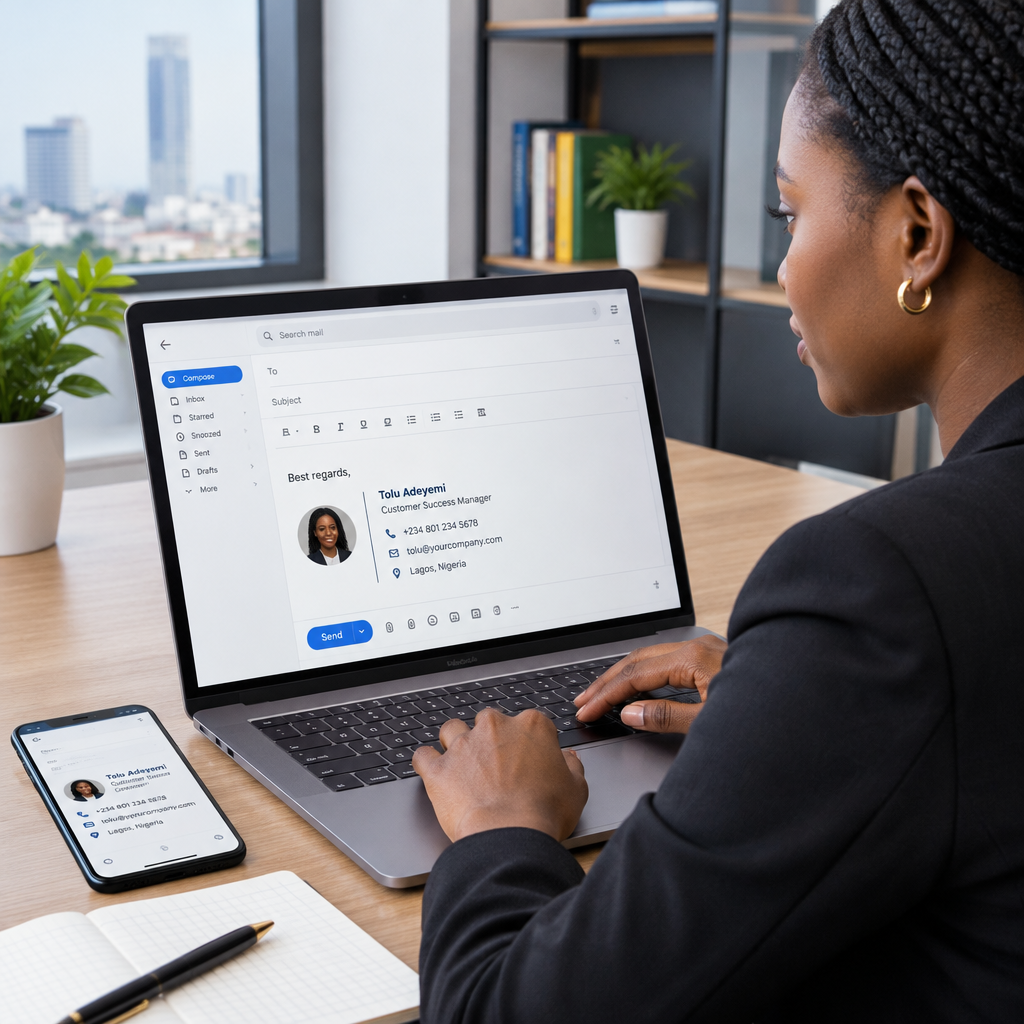

How to Create a Professional Email Signature for Your Company

How to Create a Professional Email Signature for Your Company

A company email signature is more than a name at the bottom of a message. It is a small part of your business identity that appears whenever you communicate with a customer, supplier, partner or potential client.

For a Nigerian small business, entrepreneur or organisation, a well-designed signature can make everyday email look more established and easier to trust. It can also help customers find your website, call your business, visit your office or contact the right person without searching through an old message.

The goal is not to add as much information as possible. The goal is to make each email clear, recognisable and useful.

What a professional email signature should achieve

A good signature answers several basic questions quickly:

  • Who sent the message?
  • What is the person’s role?
  • What organisation do they represent?
  • How can the recipient contact them?
  • Where can the recipient learn more?

It should support the message rather than compete with it. A signature with multiple banners, large images, long quotations and several social media icons may look busy, but it can distract from the actual conversation. It may also display poorly on phones or trigger unnecessary concerns about email attachments and links.

Think of the signature as a compact business card attached to your digital communication.

Start with a domain-based business email

Before designing a signature, consider the email address it will represent. An address such as [email protected] generally presents a more professional impression than an address created only for personal use.

A domain-based email address also keeps communication connected to the company’s digital identity. If your business already has a website domain, business email can help create consistency between your website, email messages and other branded channels.

For example, a company might use:

Choose addresses that your team can manage consistently. If you use a domain registered through a developer, former employee or third party, make sure the business retains access to the domain account and email administration. Losing access to these essential accounts can disrupt customer communication and renewals.

The essential elements of a company email signature

A practical signature usually includes the following information.

Full name

Use the sender’s real name so the recipient knows who they are dealing with. This is especially important when a customer is having an ongoing conversation with a member of your team.

Job title or business role

A role gives context. Examples include Founder, Operations Manager, Customer Support Officer or Sales Consultant. Avoid titles that are unclear to your audience.

Company name

Write the business name in the same form used on your website and other official materials. Consistency helps reinforce recognition.

Primary contact details

Include the most useful contact method for the recipient. Depending on the business, this may include a phone number, WhatsApp contact, office address or a support email address.

Do not include every possible number. If customers rarely use a fax number or an old landline, leaving it out keeps the signature easier to scan.

Website

Add a clickable link to your website. Your website is your stable digital home, where customers can learn about your services, confirm your contact details and take the next step.

Location, when relevant

If your location matters to customers, include your city or service area. A Nigerian business may benefit from showing its city or region when it serves customers locally, while an online business may prefer to state that it serves clients across Nigeria or West Africa.

Optional elements that can add value

Some businesses can improve their signatures with a small number of additional elements:

  • A logo that remains clear at a modest size
  • A link to book an appointment or request a quotation
  • A link to a relevant service page
  • Professional social media links
  • A short, specific call to action
  • A confidentiality notice where the organisation genuinely needs one

Use these elements only when they serve a clear purpose. A link labelled “View our services” may be useful. Five different social media icons, each leading to an inactive account, are not.

If you add a banner, keep it simple and make sure it does not look like an unrelated advertisement. The signature should remain appropriate for routine replies, not just promotional campaigns.

Use a simple visual hierarchy

The recipient should be able to understand the signature in a few seconds. A useful hierarchy is:

  1. Name: the most prominent text
  2. Role and company: slightly smaller supporting information
  3. Contact details: practical ways to respond
  4. Website or action link: one clear next step

Use one or two readable fonts and avoid excessive colours. Your company’s brand colour can be used for a name, divider or link, but body text should remain easy to read.

Do not rely on colour alone to communicate important information. Some recipients may use dark mode, low-contrast screens or accessibility tools.

Design for mobile email

Many customers read email on a phone. A signature that looks neat on a large desktop screen can become difficult to use when it wraps across several lines on a smaller display.

Test the signature by sending messages to at least one phone and one desktop email account. Check whether:

  • The phone number is easy to tap
  • The website link opens correctly
  • The logo is not too large
  • Text does not run beyond the screen
  • There is enough spacing between links
  • The signature does not become longer than the email itself

Keep images compressed and provide meaningful alternative text if your email system supports it. Remember that some recipients block images by default, so the written contact information must still work without the logo.

Example of a practical signature

The following is a simple example for a fictional business:

Amina Yusuf
Client Services Manager | Example Creative Studio
+234 800 000 0000
[email protected]
www.examplecreativestudio.com
Lagos, Nigeria

This format provides identity, role, company, direct contact information and a website without overwhelming the recipient. A real business can adapt it with its own details and brand style.

Create different signatures for different roles

One signature may not suit every employee or department. A support team might need a support portal and service hours, while a sales representative may need a link to request a quotation. A director may use a direct phone number, whereas a general inbox may be more suitable for an organisation’s public enquiries.

Keep the core identity consistent across the company. Names, job titles, logos, colours and website links should follow a shared standard. This helps customers recognise that messages come from the same organisation.

It is also useful to decide who is responsible for updating signatures when a phone number, website page, job title or staff member changes.

Common email signature problems to avoid

Too much information

Long legal wording, multiple addresses, several phone numbers and unrelated links can hide the details customers actually need.

Unprofessional personal accounts

Sending company communication from a personal address can make it harder for customers to identify the business and can create access problems when staff change roles.

Large image-only signatures

If all contact details are contained in an image, recipients may not be able to copy the information, search it or access it when images are blocked.

Outdated details

An old phone number or broken website link damages confidence. Review signatures whenever your business changes its contact information, domain, branding or services.

Unnecessary quotes and disclaimers

A motivational quote may not add value to a business message. Legal disclaimers should be used thoughtfully and according to your organisation’s actual requirements, not copied automatically from another company.

A simple implementation workflow

To create a consistent company signature, follow this process:

  1. List the contact details customers genuinely need.
  2. Choose the business name, colours and logo format to use.
  3. Create a short standard template.
  4. Make website and phone details clickable where possible.
  5. Test it on mobile and desktop email accounts.
  6. Set it up for each relevant mailbox.
  7. Review it whenever business information changes.

Keep a copy of the approved template somewhere accessible to the people responsible for business email. If your email is hosted with your domain, document who controls the domain and mailbox administration so important accounts remain available to the organisation.

Make every email reinforce trust

An email signature cannot replace reliable service, a useful website or clear communication. It can, however, make every message easier to understand and act on. Combined with a professional domain, dependable business email, HTTPS-secured website and accurate contact information, it becomes part of a coherent online presence.

The best signature is usually the one that answers the recipient’s immediate questions without creating new ones. Keep it accurate, readable and easy to use, then review it as your company grows.

How to Choose Mailboxes for Staff, Sales and Support

How to Choose Mailboxes for Staff, Sales and Support

As a business grows, email can become difficult to manage. Messages may be sent from one personal address, sales enquiries may be missed, and customers may not know where to ask for help. Giving every business email address a clear purpose makes communication more organised and more trustworthy.

This is especially important for Nigerian small businesses, entrepreneurs and organisations that rely on email for enquiries, quotations, customer support and daily operations. A professional address using your domain can help create a more established impression than a personal mailbox, but the domain itself is only the beginning. You also need to decide which mailboxes people should use, who can access them and how they should be managed.

This guide explains how to choose mailboxes for staff, sales and support without creating unnecessary complexity or paying for accounts you do not need.

Start with responsibilities, not job titles

The best mailbox structure reflects the work that needs to be done. A business does not necessarily need a separate email address for every employee or department. It needs clear places for important conversations to go.

Before creating addresses, list the main types of communication your business receives:

  • Private communication with individual staff members
  • Sales enquiries and quotation requests
  • Customer questions and complaints
  • General information and partnership messages
  • Billing, accounts or supplier communication
  • Website, hosting and technical notifications

For example, a small web design company might need personal addresses for its founder and designer, a sales address for new project enquiries, and a support address for existing clients. A retail business may need staff addresses, a sales or orders mailbox and a customer care address.

This approach prevents a common problem: creating several addresses that look professional but have no clear owner or process behind them.

Personal staff mailboxes

Each person who regularly sends or receives business communication should normally have an individual mailbox based on the company domain. Common formats include name@yourdomain or firstname.lastname@yourdomain.

Personal mailboxes are useful because:

  • Customers know who they are communicating with.
  • Messages can be traced to a specific person.
  • Access can be removed when someone leaves the organisation.
  • Internal communication is easier to organise.
  • The business retains greater control than when staff use personal email accounts.

Use a consistent naming pattern. Mixing formats such as john@, j.smith@ and johnny@ can make the company appear less organised and make addresses harder to guess or remember.

It is also wise to separate a person’s role from their individual identity. A staff member may change responsibilities, but their personal mailbox can remain stable while role-based addresses are redirected or reassigned.

Role-based mailboxes for sales and support

Role-based addresses describe the purpose of the mailbox rather than the person handling it. Examples include:

  • sales@yourdomain for new enquiries, quotations and product questions
  • support@yourdomain for customer assistance and technical problems
  • info@yourdomain for general enquiries
  • accounts@yourdomain for invoices and payment communication
  • admin@yourdomain for administrative matters
  • orders@yourdomain for purchases and order updates

These addresses remain useful even when employees change. Customers do not need to learn a new address every time a sales representative or support agent leaves the business.

However, a role-based mailbox should not become an unattended inbox. Someone must be responsible for checking it, responding within a reasonable internal target and making sure important messages are not lost.

Should you use aliases, shared mailboxes or separate accounts?

These options are often confused, but they solve different problems.

Aliases

An alias is an additional address that delivers messages to another mailbox. For example, enquiries@yourdomain might deliver to the owner’s main mailbox. Aliases can be suitable for a very small business that receives a low volume of messages and has one person handling communication.

They are simple, but they may become difficult to manage as the company grows. If several people need to read, reply to and track messages, sending everything to one person may create delays and unclear ownership.

Separate mailboxes

A separate mailbox has its own login and storage. This may be appropriate for an employee or a department that needs an independent inbox. It can also help separate sales, support and administrative communication.

Separate accounts require careful access management. Do not create one account with a password that is shared informally among several employees. Shared passwords make it harder to know who accessed an account and increase the risk when someone leaves.

Shared access

Where the email platform supports it, shared access allows authorised staff to work from a common mailbox without distributing one password. This is often more suitable for sales and support teams because several people may need to view and respond to the same conversations.

The exact features depend on the email hosting service, so check whether it supports delegated access, multiple users, folders, forwarding rules and clear sender identification.

Choosing mailboxes for a small team

A small business usually benefits from a structure that is easy to understand and maintain. A practical starting point could include:

  • One personal mailbox for each active staff member
  • sales@ for prospective customers
  • support@ for existing customers, if support is part of the business
  • accounts@ if billing communication needs to be separated
  • An alias such as info@ only when there is a clear person responsible for it

Do not create a dozen department addresses simply because they sound professional. An address that nobody checks damages customer experience more than having fewer, well-managed addresses.

For a solo entrepreneur, one personal business mailbox plus one or two role-based aliases may be enough. As message volume increases, those aliases can be changed into shared or separate mailboxes without changing the public address customers already know.

Plan for staff changes and ownership

Business email is a digital asset, so the organisation should control the domain, hosting account and administrator access. Do not allow all essential email accounts to depend on a former employee, an individual developer or an unknown third party.

When someone joins, give them only the access they need. When someone leaves, disable their login promptly and decide what should happen to their messages. A role-based address may remain active, while a personal mailbox may be archived or redirected according to the organisation’s policies.

Keep an internal record of:

  • Which mailboxes and aliases exist
  • Who is responsible for each role-based address
  • Who has administrative access
  • Where important recovery details are stored
  • When passwords and access permissions were last reviewed

This record does not need to be complicated. Its purpose is to prevent uncertainty when a staff member is unavailable or leaves the business.

Protect every mailbox

Professional email does not remove security risks. Use long, unique passwords and enable multi-factor authentication where the email service supports it. Avoid forwarding business email automatically to personal accounts unless there is a clear business reason and suitable protection.

Be cautious with unexpected requests for passwords, payments, account changes or sensitive documents. Staff should know how to verify unusual instructions through another trusted channel. Sales and support addresses are particularly attractive targets because they are publicly visible and may receive messages from people outside the organisation.

Also make sure the domain’s email settings are configured appropriately by the person or provider managing your hosting. Good email configuration can help receiving systems assess whether messages claiming to come from your domain are legitimate. It is not a substitute for careful behaviour, but it is an important part of protecting business communication and reputation.

A simple decision framework

For each proposed address, ask four questions:

  1. Who needs to receive the messages? One person, a department or several staff members?
  2. What happens if the responsible person leaves? Can the address continue without disrupting customers?
  3. Does the address need its own login? If not, an alias may be sufficient.
  4. How will messages be tracked? If several people reply, shared access or a helpdesk workflow may be more appropriate than forwarding.

Consider a hypothetical growing consultancy. At first, enquiries@ may be an alias to the founder’s mailbox. When a second salesperson joins, the business could move that address to a shared mailbox or a dedicated sales workflow, while giving both staff members individual addresses. The public address stays the same, but responsibility becomes clearer.

Make the mailbox structure support the customer journey

Your website should direct visitors to the correct address rather than displaying one general mailbox for every purpose. A “Request a quote” button can use sales@, while existing customers can be directed to support@. Include the same addresses in invoices, proposals, email signatures and relevant social profiles.

Review the structure occasionally. If customers keep sending technical questions to sales, your website or email signatures may need clearer guidance. If support messages are unanswered, the problem may be ownership or workflow rather than the mailbox name.

The right setup is not the one with the most addresses. It is the one that gives every important message a clear destination, a responsible owner and an appropriate level of access. Start with a small, consistent structure, protect the accounts carefully and expand only when the volume or complexity of communication justifies it.

Email Forwarding vs Separate Mailboxes for a Small Team

Email Forwarding vs Separate Mailboxes for a Small Team

When a small business creates professional email addresses, one decision often causes confusion: should messages be forwarded to existing personal inboxes, or should every team member receive a separate mailbox?

For a two- or three-person team, forwarding can seem simpler. You create addresses such as [email protected] or [email protected], then send incoming messages to Gmail, Outlook or another inbox the team already uses. Separate mailboxes, on the other hand, give each person an individual account connected to the business domain.

Neither option is automatically right for every business. The better choice depends on how many people need access, whether they send replies, how sensitive the messages are, and how important accountability and continuity will become as the business grows.

What email forwarding actually does

Email forwarding redirects messages received at one address to another inbox. For example, a message sent to [email protected] might be delivered to the owner’s existing personal email account.

Forwarding does not necessarily create a full mailbox. Depending on the hosting setup, the forwarded address may not have its own inbox, folders, storage or independent login. It is primarily a delivery rule.

This makes forwarding useful for simple roles and public contact addresses. A new entrepreneur may want messages sent to hello@ and enquiries@ to arrive in one place while keeping setup and administration straightforward.

However, forwarding can become less convenient when several people need to work from the same address. Team members may not know whether someone has answered a customer. Replies may be sent from the wrong address, and important conversations can become difficult to track.

What a separate mailbox provides

A separate mailbox is an individual email account with its own login, storage and settings. Examples include [email protected], [email protected] and [email protected].

Each user can sign in independently, organise messages, use a calendar if supported by the service, and send email from the address that represents their role. When a team member leaves, their access can be removed without changing everyone else’s account.

Separate mailboxes are generally more suitable when email is part of daily operations rather than just a contact channel. They can help businesses separate responsibilities, protect private conversations and maintain clearer control over who can access what.

Forwarding and separate mailboxes compared

Consideration Email forwarding Separate mailboxes
Setup Usually quick and simple Requires creating and managing user accounts
Cost control May be suitable when you need addresses without full inboxes Each mailbox may count as a separate account or service allocation
Individual access Limited unless everyone receives forwarded messages Each person has their own login
Accountability Can be unclear who handled a message Clearer ownership of individual conversations
Privacy Messages may arrive in a shared or personal inbox Access can be assigned by user and role
Scalability Works best for simple, low-volume needs Usually better as the team and workflow grow

When forwarding is a sensible choice

Forwarding can be a practical starting point for a small business with limited email activity. It may suit you if:

  • You are the only person managing enquiries.
  • You need a professional address such as info@ or hello@ but do not need another full inbox.
  • The address is mainly used for receiving website notifications or form submissions.
  • The team is small, messages are not highly confidential, and everyone understands who responds.
  • You are testing a new department or service before creating a permanent mailbox.

For example, a Nigerian consultant who works alone could use [email protected] as a public address and forward it to one established inbox. This keeps the customer-facing identity professional without forcing the owner to check several accounts.

Even in this situation, test the setup before publishing the address. Send messages to it from different providers and confirm that they arrive reliably. Also check whether replies are sent from the domain address or from the personal address that received the forwarded message.

When separate mailboxes are the safer option

Separate mailboxes become more valuable when multiple people handle customer communication or business information. Choose them when:

  • Different staff members need individual accounts.
  • Messages contain financial, customer, supplier or internal information.
  • You need to know who sent or received a particular message.
  • Employees must work without sharing passwords.
  • The business is hiring, delegating responsibilities or preparing for growth.
  • You want former staff access removed without disrupting the whole team.

Suppose a small online retailer has one person handling orders, another managing accounts and a founder handling supplier relationships. Individual mailboxes such as orders@, accounts@ and a named address for the founder make responsibilities clearer than forwarding every message to one personal inbox.

Separate accounts also support better security habits. Each user can have a unique password and, where available, multi-factor authentication. Sharing one password for a general mailbox makes it difficult to know who accessed the account and increases the damage if the password is exposed.

A hybrid setup often works best

Small businesses do not have to choose one approach for every address. A hybrid structure is often more practical.

Team members can have separate mailboxes for their daily work, while public addresses can be assigned as aliases, groups or forwarding addresses, depending on what the email service supports. For example:

This arrangement keeps the public-facing structure professional while avoiding unnecessary full mailboxes for every possible address. Review the setup regularly so forwarded messages do not continue reaching people who no longer handle that responsibility.

Important issues to check before choosing

Sending from the correct address

Receiving forwarded mail is only half the process. If a customer writes to support@, the reply should normally come from a recognisable business address, not an unrelated personal account. Confirm that your email service supports sending from the required address and configure it correctly.

Ownership and staff changes

Business email should remain connected to accounts the business controls. Do not let one employee’s personal inbox become the only place where important customer conversations exist. Maintain access to the domain, hosting account and email administration, and document who manages each account.

Storage and backups

Forwarding can create duplicate copies across several inboxes. A mailbox can also fill up if it is used for years without housekeeping. Decide which account is the main record for important conversations and understand how messages are retained and backed up.

Spam and delivery problems

Forwarding may affect how messages are processed, particularly when a message passes through multiple systems. Monitor spam folders and test messages from common providers. If business email is important to sales or customer support, reliable email hosting and correct domain email settings matter more than simply creating an address.

A practical decision framework

Ask these questions:

  1. Who needs access? If only one person receives messages, forwarding may be enough. If several people need independent access, use separate mailboxes or a proper shared-mail process.
  2. Does anyone need to reply? If yes, confirm that replies can be sent from the right domain address.
  3. How sensitive is the information? Private customer, payment or staff information deserves individual access and stronger control.
  4. What happens if someone leaves? Choose a setup that lets you remove access without losing business records.
  5. Will the team grow? A slightly more organised structure now can prevent a disruptive email migration later.

The right setup should reduce business risk

Email forwarding is not inherently unprofessional, and separate mailboxes are not automatically better in every situation. Forwarding is convenient for simple addresses and low-volume communication. Separate mailboxes are stronger for accountability, privacy and team operations. A hybrid approach can combine both advantages.

For a business building a dependable online presence, domain-based email should be treated as a business asset, alongside the website, domain registration and hosting. Start with the simplest arrangement that meets today’s needs, but make sure the business—not an individual employee—controls the domain and administration.

The best email setup is the one that makes responsibilities clear, protects access and still works when the team becomes larger than it is today.

Email Addresses Every Professional Nigerian Business Should Consider

Email Addresses Every Professional Nigerian Business Should Consider

When customers contact a business, the email address they see can influence how seriously they take the organisation. An address such as [email protected] may work when you are starting out, but a domain-based address such as [email protected] or [email protected] gives customers a clearer connection between your email, website and brand.

Professional email is not only about appearance. The right addresses can help a Nigerian business separate enquiries from support requests, protect personal inboxes, organise internal work and make it easier to continue operating as the team grows.

You do not need dozens of mailboxes on the first day. The better approach is to create addresses that match the real responsibilities of the business, then add more as customer communication becomes more complex.

Why domain-based email matters

A business email address using your own domain connects your communication to an online identity that your organisation owns and controls. It can appear more established than a free personal email account, especially when customers are sending payment enquiries, requesting quotations or sharing sensitive business information.

It also creates consistency. If your website is example.ng, addresses such as [email protected] and [email protected] are easier for customers to recognise and remember.

For a small business, this is especially useful when social media accounts, phone numbers or individual staff members change. Your domain and business email can remain part of the organisation’s stable digital home, provided renewal details and account access are properly managed.

The essential addresses to consider

1. hello@ or info@

This is the general front door for the business. Use it for broad questions, partnership requests and customers who are unsure which department to contact.

Hello@ often sounds more approachable and modern, while info@ is immediately familiar. Choose one as your main public address rather than displaying several similar general inboxes everywhere.

2. sales@

A sales address gives potential customers a direct route for product questions, quotations, package recommendations and purchase discussions. It can be useful when the business offers services that require explanation before a customer commits.

Keeping sales enquiries separate from general correspondence makes it easier to identify opportunities and ensures that a general inbox does not become difficult to manage.

3. support@

If customers need help after purchasing, support@ should be clearly displayed on your website or customer documentation. It can receive technical questions, account issues, delivery concerns or requests for assistance.

A support inbox is particularly valuable for businesses offering websites, software, online services or ongoing maintenance. It establishes a clear process instead of requiring customers to search for a staff member’s personal address.

4. accounts@ or billing@

Use accounts@ or billing@ for invoices, receipts, payment confirmations and account-related questions. This helps separate financial communication from marketing and general enquiries.

Not every small business needs a separate mailbox immediately. You could begin with an address that forwards to the person responsible for finance, then create a dedicated mailbox when transaction volume increases.

5. admin@

An admin@ address can handle general administrative matters, supplier communication, registrations and internal coordination. It is useful when the business has multiple people managing daily operations.

Because administrative accounts can receive important documents, access should be limited to authorised team members. Avoid using one shared password without a clear ownership and access process.

6. orders@ or bookings@

If customers place orders, make reservations or schedule appointments, a purpose-specific address can reduce confusion. For example, an online shop might use orders@, while a consultant or service provider could use bookings@.

Display the address wherever customers need to take that action, such as a product page, quotation document or booking instructions. The address should support a clear workflow: receive the request, confirm the details, process it and send an update.

7. careers@

Businesses recruiting staff can use careers@ for applications and job-related questions. This prevents CVs and recruitment messages from being mixed with customer support or sales enquiries.

If you are not actively hiring, there is no need to create this address simply because other businesses use it. An address is useful when someone is responsible for monitoring it.

8. privacy@ or legal@

Larger organisations, organisations handling personal information, and businesses with formal compliance or contract responsibilities may need an address for privacy, legal or formal notices.

A small business can use a monitored general address at first, but should not publish a specialist address that nobody checks. The important principle is that formal messages should have a dependable destination.

9. A named address for each team member

Addresses such as [email protected] or [email protected] help customers know who they are dealing with and make internal accountability easier. They are suitable for staff who regularly communicate with customers, suppliers or partners.

Named accounts should belong to the business, not to an employee personally. When someone leaves, the organisation should be able to suspend access, preserve business correspondence where appropriate and redirect future messages to the correct person.

Mailbox, alias or forwarding address?

Not every address needs its own separate inbox. The right setup depends on how the address will be used.

Type Best used for Example
Mailbox A person or team that needs to sign in, send and reply from the address [email protected]
Alias An additional address that delivers messages to an existing mailbox [email protected] forwarding to [email protected]
Forwarder Sending incoming messages to another approved email account [email protected] forwarding to an HR mailbox
Distribution address Sending one message to several team members [email protected] reaching the sales team

For example, hello@ and info@ may be aliases for one monitored mailbox, while support@ may need its own mailbox if a team must reply using that address.

A practical setup for a small Nigerian business

Suppose a Lagos-based professional services business has one owner and two employees. It may begin with:

  • hello@domain for general enquiries
  • sales@domain for quotations and new business
  • support@domain for existing customers
  • accounts@domain for invoices and payments
  • named addresses for the owner and employees

The owner could monitor the general and accounts addresses, while sales and support are assigned to the appropriate team members. If the company grows, it can add bookings, careers or a dedicated operations address without changing its main domain.

This structure is more practical than creating every possible address before the business knows who will monitor them. An unattended inbox can be worse than having fewer addresses because customers may assume their message has been received and is being handled.

Important controls for business email

Professional email should be treated as a business asset, not as an informal add-on. Keep the following controls in place:

  • Use a domain that the business owns or is authorised to control, and keep registration details accurate.
  • Use strong, unique passwords and enable multi-factor authentication where the email service supports it.
  • Decide who owns administrator access before a staff member or developer sets up the accounts.
  • Review inactive accounts when people leave the organisation.
  • Use shared addresses for roles, not personal accounts, where continuity matters.
  • Configure the domain’s email authentication records correctly with your hosting or email provider to help receiving systems distinguish legitimate messages from suspicious ones.
  • Train staff to recognise phishing, fake payment requests and unusual requests for passwords or account changes.

Reliable email hosting and practical support can reduce the technical burden, but no provider can replace careful account management by the business itself.

How to choose your first addresses

Start by listing the messages your business receives. Are customers asking for prices, requesting support, sending orders, making bookings or asking about payments? Create addresses around these real workflows.

Then assign an owner to every public address. Write down who checks it, how often they check it, who can reply and what happens if that person is unavailable. Finally, publish the selected addresses consistently on your website, quotations, invoices and social media profiles.

The best business email setup is not the one with the most addresses. It is the one customers understand, staff can manage and the organisation can retain control of as it grows. A suitable domain, dependable email hosting and clear ownership give Nigerian businesses a professional communication foundation without adding unnecessary complexity.

Business Email or Free Email: What Should a Small Business Use?

Business Email or Free Email: What Should a Small Business Use?

Choosing an email address may seem like a small decision, especially when free services such as Gmail, Outlook.com and Yahoo Mail are easy to create. For a small business, however, the address customers see can affect trust, communication and control over important business information.

There is a meaningful difference between [email protected] and [email protected]. Both may send and receive messages, but they do not present the same impression or provide the same level of control.

The right choice depends on your stage of business, how you communicate with customers, your budget and whether you already own a domain. This guide explains the practical differences so Nigerian small businesses, entrepreneurs, creators and organisations can make a sensible decision without paying for more than they need.

What is the difference?

A free email address uses a domain owned by the email provider. The part after the “@” might be gmail.com, outlook.com or another public email domain.

A business email address uses a domain connected to your organisation, such as [email protected] or [email protected]. The domain may be hosted alongside your website or connected to a separate email service.

Business email is therefore not simply “a different inbox”. It connects your email identity to a domain that your business can register, manage and retain.

When a free email address may be suitable

A free email account can be a reasonable temporary option for someone testing an idea, working alone or communicating informally. It may be enough when:

  • The business is still in the planning stage.
  • You rarely communicate with customers by email.
  • You are using email mainly for personal administration or account registration.
  • You have not yet chosen a business name or registered a domain.
  • Your current budget does not allow for a domain and email service.

For example, a person testing a small creative service through referrals may begin with a free account while confirming whether there is enough demand. That does not make the business unprofessional by itself. It simply means the email identity has not yet been developed into a branded business asset.

The limitation appears when the address becomes the main contact for quotations, invoices, customer support, partnerships and other important communication.

Why domain-based email can be better for business

It creates a more consistent professional identity

An address such as [email protected] matches the business website and domain. Customers can recognise that the email belongs to the same organisation they found online.

This consistency matters particularly when a customer is comparing unfamiliar businesses. A professional domain does not prove that a company is reliable, but it can make the business identity clearer and easier to verify. It also supports consistent branding across a website, email signatures, documents and social media profiles.

It supports different roles as the business grows

A free personal address often becomes overloaded. The same inbox may be used for sales enquiries, customer complaints, payments, newsletters and private messages.

With a business domain, you can create role-based addresses such as:

  • hello@ for general enquiries
  • sales@ for new business
  • support@ for customer assistance
  • accounts@ for invoices and payment questions

These addresses make it easier to organise communication and can remain useful even when a staff member changes. The business is less dependent on one person’s personal inbox.

You retain a valuable digital asset

A domain is part of a business’s online identity. If your website and email use the same domain, that domain becomes important to daily operations.

Businesses should ensure that domain registration details, renewal notices and administrative access remain under the business’s control. A company can face serious disruption if a domain was registered by a former employee, developer or unknown third party and nobody else can access it.

Keeping control does not mean every owner must manage technical settings personally. It means the business should know who owns the domain, where renewal information is sent and how authorised people can recover access.

Business email is not automatically more secure

A domain-based address can look more professional, but the domain alone does not guarantee security or reliable delivery. Security also depends on the email service, account settings and user behaviour.

At a minimum, businesses should:

  • Use strong, unique passwords for email accounts.
  • Enable multi-factor authentication where the email provider supports it.
  • Limit account access to people who need it.
  • Be cautious with unexpected invoices, login links and attachments.
  • Keep recovery details accurate and accessible.
  • Remove access promptly when a team member leaves.

Businesses should also ask whether their email service supports appropriate domain authentication settings. These settings help receiving mail systems assess whether messages claiming to come from your domain are legitimate. Configuration can require technical knowledge, so practical support may be valuable for a small organisation that does not have an internal administrator.

What does business email usually involve?

Business email normally requires three connected elements:

  1. A registered domain: This is the web address that appears after the “@”. It could be a suitable global domain or a local option, depending on the organisation’s identity and audience.
  2. An email hosting service: This provides the mailboxes, storage and tools used to send and receive messages.
  3. Correct configuration: The domain’s DNS records must point email traffic to the right service, and security-related records may need to be added.

This is one reason that business email can feel confusing to a first-time business owner. A hosting provider such as Sonhosting may provide domain registration, business email and website hosting, allowing these connected services to be managed with clearer support rather than requiring the owner to become a server administrator.

A practical decision framework

Use the following questions before choosing.

1. How do customers contact you?

If email is rarely used and most activity happens through face-to-face referrals or messaging apps, a free address may be acceptable at the beginning. If you send proposals, receive support requests or handle business documents by email, a domain-based address is usually more appropriate.

2. Does your business already have a domain?

If you already own a domain for your website, using it for email creates a more joined-up identity. You do not necessarily need to move your website to a new host just to improve your email, but the setup should be planned carefully so that changing email records does not interrupt website services.

3. Will more people need access?

If you expect to hire staff, work with assistants or separate sales from support, business email gives you a clearer structure. Consider whether you need individual mailboxes, shared addresses, forwarding or controlled access.

4. How important is continuity?

For an organisation that must retain customer conversations, invoices and supplier communication, email should be treated as a business system rather than a personal account. Plan how access, backups, recovery and staff changes will be handled.

5. How much technical management do you want?

Some business owners are comfortable managing DNS records and account settings. Others want a provider to handle the technical work and explain the important decisions in plain language. Choose an option that matches your confidence and available time, not just the advertised features.

A sensible path for a growing small business

You do not have to make every decision at once. A practical progression might look like this:

  • Start with a free address if you are only validating an idea and have little customer communication.
  • Register a suitable domain once the business name and online identity are clear.
  • Create a primary business mailbox for important enquiries and accounts.
  • Add role-based addresses as communication becomes more specialised.
  • Document who controls the domain, email administration and recovery information.
  • Review passwords, access permissions and renewal dates regularly.

For Nigerian businesses and entrepreneurs, this approach can balance budget sensitivity with the need to build trust. A domain-based address is especially useful when a business is presenting itself through a website, receiving online enquiries or serving customers beyond its immediate personal network.

The useful takeaway

A free email address can be a sensible starting point, but it is usually a temporary identity rather than a strong long-term business asset. Once email becomes part of sales, support, payments or formal communication, a domain-based address offers clearer branding, better continuity and greater control.

The best choice is not automatically the most expensive service. Select a domain and email arrangement that fits your current communication needs, future team structure, security responsibilities and willingness to manage technical settings. When your website, domain and email are planned together, your online presence becomes easier for customers to recognise and easier for your business to control.

Business Email Storage Planning for Growing Teams

Business Email Storage Planning for Growing Teams

As a business grows, email storage problems often appear gradually. A few employees begin with small mailboxes, then add large attachments, customer conversations, invoices, contracts and shared addresses. Before long, someone cannot receive a new message, an important attachment is difficult to find, or the team starts deleting records without a clear plan.

Business email storage planning helps prevent these problems. It is not simply a matter of choosing the largest mailbox available. A useful plan considers how your team communicates, what must be retained, where files should be stored and how much room the business needs for future growth.

For Nigerian small businesses, entrepreneurs and organisations, this planning is especially practical when email is being introduced alongside a new website or domain. A professional address such as [email protected] or [email protected] can support trust, but it must also remain accessible, organised and dependable as the business expands.

What business email storage includes

Email storage is the space assigned to a mailbox for messages and their contents. This usually includes:

  • Incoming and outgoing email messages
  • Attachments such as documents, images and PDFs
  • Sent messages and message drafts
  • Deleted messages, depending on the provider’s retention settings
  • Calendar items, contacts or other mailbox data where supported

The visible text of an email usually takes little space. Attachments are often the main source of growth. A single large presentation, product catalogue, high-resolution image or video can use more storage than hundreds of ordinary messages.

Storage may be measured per mailbox or shared across an account. These models lead to different planning decisions. Per-mailbox storage gives each user a clear limit. Shared storage can be flexible, but one mailbox that accumulates large files may affect the room available to other users.

Why storage needs change as a team grows

A two-person business may use email mainly for enquiries and routine communication. A larger team may use it for sales proposals, customer support, supplier records, recruitment, project coordination and internal approvals. The number of messages is only one part of the change; the type and importance of the messages also develop.

Storage needs commonly increase when:

  • The business hires more employees or creates additional departmental addresses
  • Customers send large files or photographs
  • Staff keep every message instead of archiving or organising old records
  • Email is used as a substitute for proper document storage
  • Several people access shared addresses such as info@, support@ or sales@
  • The business needs to retain records for operational, contractual or internal reasons

Growth can also create access and ownership risks. If all mailboxes are controlled by one former employee, developer or unknown third party, the business may struggle to recover important communication. Storage planning should therefore be considered alongside account access, domain ownership, passwords and staff offboarding.

Estimate your current and future requirements

Begin with evidence rather than guesswork. List each mailbox, its purpose and its current usage. Separate personal mailboxes from shared addresses, because they tend to grow differently.

Mailbox type Typical use Planning question
Personal mailbox One employee’s daily communication Will the employee handle large attachments or long-running customer conversations?
Shared department address Sales, support or enquiries How many people need access, and how long should messages remain available?
Role-based address Accounts, operations or a business function Will the address continue when a staff member changes?
Administrative mailbox Domain, hosting or service notifications Who has access, and how will important alerts be preserved?

Next, review the storage used by each account and identify the largest categories of messages or attachments. If you do not have historical figures, use a cautious planning estimate based on current usage and expected hiring. A business adding five team members should consider both five new mailboxes and the additional shared addresses those employees may need.

It is sensible to leave headroom rather than plan to operate at the limit. A mailbox that is nearly full can create disruption before the team has time to clean it up or upgrade the service. The exact amount of headroom depends on the business, but the principle is straightforward: storage should support normal growth, not only today’s usage.

Separate email from file storage

Email is useful for sending and receiving files, but it is not always the best place to keep a company’s working documents. Using mailboxes as permanent file cabinets can create duplicate versions, slow searches and unnecessary storage pressure.

Consider which files belong in a managed document or cloud storage system instead. Examples include:

  • Current marketing images and design files
  • Shared spreadsheets and operational documents
  • Large videos or product assets
  • Templates that many employees use
  • Working copies of proposals and reports

Email should preserve the conversation and its context, while the active document can be maintained in an appropriate shared location. This makes it easier to control access, find the latest version and remove outdated files without deleting the related correspondence.

This separation does not mean that attachments should be deleted immediately. Important contracts, approvals and customer records may need to be retained. The business should decide which records are important before introducing a cleanup routine.

Create a practical retention and cleanup process

Storage planning works best when it includes simple habits. Ask staff to review large attachments, duplicate messages and old drafts periodically. Unwanted newsletters and automatic notifications can often be removed, while important records should be labelled or moved according to the organisation’s process.

A basic process might include:

  1. Review mailbox usage at a regular interval.
  2. Identify large attachments and messages that no longer have operational value.
  3. Move active files out of email when a suitable shared storage location exists.
  4. Keep important correspondence according to the business’s documented retention needs.
  5. Remove or archive data only when the responsible person understands its importance.
  6. Check that former employees’ accounts are handled without losing business records.

Do not treat automatic deletion as a complete storage strategy. Deletion rules can remove information that someone still needs, especially when they are applied without understanding the business’s work processes.

Plan for shared mailboxes and team access

Shared addresses need special attention. A support address may receive more messages than an individual mailbox, and several staff members may need access at once. If team members simply share one password, it becomes difficult to know who accessed an account and risky when someone leaves the organisation.

Where the email service supports it, use controlled access, individual user accounts or delegated permissions. Keep a record of who is responsible for each shared address. Also decide whether messages should remain in the shared mailbox, be assigned to individuals or be copied into a customer-support workflow.

Storage planning should include administrative access as well. Domain registration, hosting and email accounts are connected, but they are not the same thing. The business should retain accurate ownership information and ensure that authorised people can access renewal notices, billing information and service settings.

Know when to upgrade

An upgrade may be appropriate when a mailbox repeatedly approaches its limit, the team cannot retain necessary records, or storage cleanup is consuming too much staff time. However, more storage is not always the first or only answer.

Before upgrading, check:

  • Whether large files can be stored elsewhere
  • Whether old messages can be archived safely
  • Whether a shared mailbox is being used inefficiently
  • Whether the business needs more accounts rather than larger accounts
  • Whether the service provides the access and support the growing team requires

Choose a plan based on mailbox count, expected growth, attachment habits, shared-address usage and the level of technical management your team wants. A small organisation may value clear support and straightforward administration more than a complex enterprise setup.

A simple planning example

Imagine a Nigerian consultancy with four employees, one shared enquiries address and one accounts address. The team stores proposals and invoices in email and regularly receives large client attachments. If the consultancy expects to hire two people, its plan should account for six personal mailboxes, continued access to the two shared addresses, additional message volume and a separate location for working documents.

The sensible next step is not automatically to buy the largest package. The team can measure current usage, identify which attachments need to be retained, move active shared files to suitable storage and set a review point before existing mailboxes become full. It can then compare the cost and simplicity of an upgrade with the cost of staff time spent managing storage problems.

The useful takeaway

Business email storage should be planned around people, communication patterns and the value of the information being retained. Count the mailboxes, measure current usage, leave room for growth and keep large working files out of email where practical. At the same time, protect access to the domain, hosting and email accounts so the business remains in control of its digital assets.

A dependable business email setup is not only about having enough space. It should help the team communicate professionally, find important information, handle staff changes and grow without avoidable disruption. Reviewing storage as part of broader hosting and email management makes that goal much easier to achieve.

Professional Email Addresses Every Small Business Should Have

Professional Email Addresses Every Small Business Should Have

When a customer contacts a business, the email address they see can influence how seriously they take the conversation. An address such as [email protected] may be useful when starting out, but a domain-based address such as [email protected] gives customers a clearer connection to your brand.

Professional email is not only about appearance. The right addresses help a small business organise enquiries, separate responsibilities and avoid losing important messages when a staff member leaves. For Nigerian businesses, entrepreneurs, creators and organisations serving customers online, a reliable email system is an important part of a trustworthy digital presence.

Why domain-based email matters

A domain-based email address uses the same domain as your website, for example [email protected]. It helps customers recognise that an email belongs to your organisation rather than to an unrelated personal account.

It also connects important parts of your online presence. Your domain, website and business email can work together as assets that the business owns and controls. This is especially important if a website was originally set up by a developer, former employee or third-party provider. The business should retain access to its domain registration, hosting account and email administration.

Professional email cannot guarantee that every message will reach the inbox or that every customer will trust a business immediately. However, it provides a more consistent foundation for communication and branding than relying only on personal addresses.

The essential email addresses to consider

1. hello@ or info@

This is the general-purpose address for new enquiries. It can appear on your website, social media profiles, business cards and other public materials.

Use hello@ if you want a friendly, approachable tone. Use info@ if your organisation handles formal enquiries or serves institutions and professional clients. You may use one as the main inbox and configure the other to deliver to the same team, provided messages are monitored consistently.

This address should not be left unattended. If it is published publicly, someone should be responsible for reviewing it, assigning enquiries and replying within a reasonable internal timeframe.

2. sales@

A dedicated sales address helps separate potential customer enquiries from general messages. It is useful for questions about services, quotations, packages, availability and next steps.

For a small business with one person, sales@ may simply deliver to the owner’s main inbox. As the business grows, it can be shared with the people responsible for preparing proposals or speaking with prospective customers.

Keeping sales messages together also makes it easier to review which enquiries still need a response. It prevents a quotation request from becoming mixed with routine administration or technical notifications.

3. support@

Use support@ for existing customers who need help after making a purchase or starting a project. This address is suitable for questions about delivery, account access, website updates, hosting issues or service problems.

Do not publish a support address unless someone can monitor it. An unattended support inbox can create frustration, especially when customers believe they have contacted the official help channel.

A simple support workflow can be enough:

  • Check the inbox at scheduled times.
  • Confirm receipt of the message when a full answer will take longer.
  • Record the customer’s name, account details and issue clearly.
  • Escalate technical or billing questions to the appropriate person.
  • Close the conversation only after the next step is clear.

4. accounts@ or billing@

Financial communication should not depend on a personal email address. An address such as accounts@ or billing@ can be used for invoices, payment confirmations, receipts and supplier communication.

This separation is useful when the person handling customer enquiries is not the person responsible for financial records. It also helps maintain continuity if responsibilities change later.

Limit access to financial email to the people who need it. Use strong, unique passwords and ensure the account remains accessible to the business rather than being controlled by one individual’s personal account.

5. yourname@yourdomain

Business owners and team members should also have individual addresses, such as [email protected] or [email protected]. Personal addresses make conversations more direct and professional while still keeping communication connected to the company domain.

Individual accounts are preferable for one-to-one conversations, introductions and appointments. However, they should not replace shared addresses for important business functions. If a staff member leaves, messages sent only to that person may become difficult to access.

6. noreply@, used carefully

A noreply@ address can be suitable for automated notifications that genuinely do not require a reply, such as a system-generated confirmation. It should not be used for normal customer communication.

When customers receive an email from noreply@ but need assistance, they may not know where to respond. A better approach is to provide a monitored address, such as support@, in the message.

Which addresses does a small business actually need?

You do not need to create every possible address on the first day. Begin with the functions your business already performs.

Business situation Practical starting addresses
Solo entrepreneur yourname@, hello@ or info@, accounts@
Service business with regular enquiries hello@, sales@, support@, accounts@
Online shop or product business orders@, support@, sales@, accounts@
Organisation or association info@, membership@ or programmes@, accounts@, support@
Growing team Individual staff addresses plus shared addresses for sales, support and administration

These addresses can be separate mailboxes, shared inboxes or forwarding aliases, depending on the email service and the way your team works. The important point is that each public address has a clear purpose and an assigned owner.

How to set up professional email properly

Use a domain the business controls

Register a suitable domain and keep the ownership information accurate. Do not allow a former developer, employee or informal intermediary to remain the only person with access to domain or email administration.

Protect administrative access

Use strong passwords, limit administrator permissions and enable available multi-factor authentication. The email administrator account can affect every mailbox, so it deserves more protection than an ordinary inbox.

Decide who monitors each address

A professional address is useful only when messages receive attention. Write down who checks each inbox, how often it is reviewed and what happens when that person is unavailable.

Use a consistent signature

A useful signature can include the person’s name, role, business name, website and relevant contact details. Keep it readable on mobile devices, since many customers will open messages on phones.

Plan for staff changes

When someone joins or leaves, review their email access promptly. Transfer business information where appropriate, remove unnecessary permissions and update public contact details. Shared addresses such as sales@ and support@ can help the business continue operating when individual responsibilities change.

Common mistakes to avoid

  • Using one personal inbox for everything: sales, support, receipts and private messages can become difficult to manage.
  • Creating addresses nobody checks: publishing support@ creates an expectation of support.
  • Giving every person administrator access: access should match each person’s responsibilities.
  • Forgetting renewals and account recovery: keep domain, hosting and email recovery details current.
  • Relying only on free personal email: a personal address may not reflect the company’s domain or provide clear continuity.
  • Ignoring email security: weak passwords and unprotected accounts can expose sensitive customer or business information.

A practical setup for a new Nigerian business

Imagine a small Lagos-based design studio with two founders. It could start with hello@ for general enquiries, sales@ for project discussions, accounts@ for invoices and one individual address for each founder. Once it begins handling ongoing client work, it could add support@ without changing its public domain.

The studio would then have a simple structure: prospects go to sales, financial messages go to accounts, existing clients go to support, and direct conversations go to the relevant founder. The setup is small enough to manage but organised enough to grow.

Final takeaway

The best professional email setup is not the one with the most addresses. It is the one that makes it obvious where customers, suppliers and team members should write—and ensures that someone is responsible for each inbox.

For most small businesses, a domain-based general address, individual team addresses, and dedicated sales, support and accounts addresses provide a strong starting point. Pair them with a domain the business controls, dependable email hosting, secure account practices and a clear response process. That combination can make everyday communication more organised while supporting a credible online presence.

How to Troubleshoot Email Delivery Problems

How to Troubleshoot Email Delivery Problems

Email problems can quickly become business problems. A customer may not receive a quotation, a supplier may miss an important update, or a password-reset message may never arrive. When email is not being delivered, the cause may be anything from a full mailbox to an incorrect DNS record or a message being filtered as spam.

The most effective approach is to avoid changing several settings at once. Start by identifying exactly what failed, then test the likely cause in a logical order. This guide is designed for small businesses, entrepreneurs and organisations using business email with their own domain.

First, identify the type of delivery problem

“My email is not working” can describe several different situations. The solution depends on which one you are experiencing.

  • Sending fails immediately: Your email program may show an error, or the message may remain in the outbox.
  • The message bounces: You receive an automated delivery failure notice.
  • The message appears sent but never arrives: It may be delayed, rejected later or placed in the recipient’s spam folder.
  • You receive email but cannot send: The outgoing mail settings or authentication may be incorrect.
  • You can send email but cannot receive it: The domain’s receiving records, mailbox configuration or storage limit may be involved.
  • Only one recipient has a problem: The issue may be specific to that recipient’s mailbox or email provider.

Record the sender address, recipient address, approximate time, subject and exact error message. These details are often more useful than a general description of the problem.

Read the bounce message carefully

A bounce message is not just an annoyance; it usually provides a diagnostic clue. Look for phrases such as “mailbox full”, “user unknown”, “message rejected”, “authentication required”, “connection timed out” or “message too large”.

Some bounce messages are temporary. A busy receiving server, a short network interruption or a temporary reputation check may cause delivery to be retried automatically. Others are permanent, such as sending to an address that does not exist.

Do not repeatedly resend the same message without understanding the error. Repeated attempts can create confusion and may make filtering more likely. If the notice contains a technical code, keep it available when contacting your hosting or email support provider.

Check the simple causes before changing technical settings

Many delivery issues have a straightforward explanation. Work through these checks first:

  • Confirm that the recipient’s address is spelled correctly.
  • Send a short test message without attachments or links.
  • Check whether your mailbox is full or has reached its storage limit.
  • Review the Sent, Drafts and Outbox folders for messages stuck in a queue.
  • Sign in to webmail, if available, to determine whether the problem is limited to your phone or email application.
  • Check the recipient’s spam, junk or promotions folders.
  • Ask the recipient to add your address to their contacts or approved senders.
  • Try sending to a second recipient to see whether the issue affects one address or many.

This test separates an account or domain problem from a device-specific problem. If webmail works but your phone does not, review the phone’s account settings rather than changing your domain records.

Review your outgoing mail settings

Email applications use separate settings for receiving and sending messages. A device can sometimes download incoming mail correctly while failing to connect to the outgoing mail server.

Check that the outgoing server name, connection security and port match the settings supplied by your email hosting provider. The option requiring authentication for outgoing mail should normally be enabled, using the full email address and its password where required.

Avoid copying settings from an unrelated account. The correct configuration for a personal email provider may not be correct for a domain-based business mailbox. If you recently changed your password, update it on every phone, computer or application connected to the account.

If an account has been configured on several devices, temporarily test one device at a time. This can reveal an old device repeatedly attempting to connect with an outdated password.

Check the domain’s DNS records

When a business uses an address such as [email protected], the domain’s DNS records help other mail servers find where messages should be delivered. Incorrect or missing records can prevent incoming email from reaching the right service.

The most important record for receiving mail is the MX record. It identifies the mail server responsible for the domain. If the domain was recently moved, the MX record may still point to an old provider, or it may have been accidentally removed.

Other records help receiving providers verify that messages sent from your domain are legitimate:

  • SPF: Identifies the servers allowed to send email for your domain.
  • DKIM: Adds a digital signature that helps verify messages have not been altered and came from an authorised system.
  • DMARC: Tells receiving providers how to handle messages that fail authentication checks and provides reporting options.

These records must be entered accurately and should not be duplicated without a clear reason. For example, publishing multiple separate SPF records can cause validation problems. DNS changes may also take time to appear across different networks, so avoid repeatedly replacing records while they are propagating.

If you are unsure which records your email service requires, ask your hosting provider to review the domain configuration. This is safer than guessing, particularly when the same domain is used for the website and email.

Investigate spam and reputation issues

A message that leaves your mailbox successfully can still be filtered by the recipient’s provider. Spam filtering may consider the sending domain, server reputation, message content, links, attachments and authentication results.

Start with a controlled test: send a plain-text message with a descriptive subject, a normal signature and no attachment or shortened link. If that arrives but a marketing-style message does not, compare the content and sending method.

Also review whether your account may have been compromised. Unexpected sent messages, unfamiliar login alerts or a sudden increase in bounced messages can indicate that someone else has accessed the mailbox. Change the password to a strong, unique one and contact your email provider for help reviewing the account. Enable additional sign-in protection when it is available.

Do not respond to requests for passwords or payment details merely because they appear to come from an email provider. Use the provider’s known website or support channel instead.

Reduce problems caused by attachments and message size

Large attachments are a common reason for delayed or rejected messages. The sender’s mailbox may allow a file that the recipient’s provider does not. Multiple images, videos and scanned documents can also make a message unexpectedly large.

For important documents, consider sending a secure sharing link through a service you trust, with appropriate access controls. If an attachment is necessary, compress files where practical and send several smaller messages only when that will not create confusion. Never assume that a message was delivered simply because it left the Outbox.

Use a repeatable troubleshooting workflow

A simple workflow helps a small business resolve problems without losing time:

  1. Capture the exact error or bounce message.
  2. Confirm the addresses and test with a short message.
  3. Check webmail, mailbox storage and the Outbox.
  4. Test another recipient and another device.
  5. Review outgoing server settings and password status.
  6. Ask the email host to verify MX, SPF, DKIM and DMARC records.
  7. Check for spam filtering, account compromise or unusual sending activity.
  8. Retest and document the final change.

For example, if a Nigerian business can send mail to one customer but not another, the domain may be working correctly. The next step is to examine the bounce notice and ask the recipient to check filtering. If nobody can receive messages sent to the business domain after a website or hosting change, the MX records deserve attention.

When to ask for technical support

Contact your hosting or email provider when the error is unclear, several users are affected, DNS records need changing, messages are being rejected consistently, or you suspect an account has been compromised. Provide the domain, affected addresses, error text, time of the failed attempt and the troubleshooting steps already completed.

Business email should be managed as part of the organisation’s wider online presence. Keep domain ownership and renewal access under the business’s control, maintain accurate account details, use strong passwords and ensure more than one responsible person knows how to reach the provider.

The fastest solution is usually not a random setting change. It is a clear diagnosis: determine whether the failure is caused by the recipient, the mailbox, the device, the email application, the domain’s DNS records or message filtering. Once that distinction is clear, the right fix becomes much easier to apply and verify.

How to Set Up an Email Account in Webmail

How to Set Up an Email Account in Webmail

Using a professional email address such as [email protected] can make your business communications look more established than using a general address. It also keeps customer enquiries connected to your own domain instead of placing an important business channel entirely under a free email provider.

However, the phrase “set up an email account in webmail” can mean two different things:

  • Creating a new mailbox: setting up an address and password through your hosting control panel.
  • Accessing an existing mailbox: signing in to webmail to read and send messages.

This guide explains both processes. The exact button names may vary between hosting providers, but the general workflow is similar for most domain-based email services.

Before you begin

You will need a few details before creating or accessing the account:

  • Your registered domain name, such as yourbusiness.com.
  • Access to your hosting control panel or email administration area.
  • The mailbox name you want to create, such as info, sales or your personal name.
  • A strong password that is not reused on your website, social media or other services.

You should also confirm that your domain is active and connected to the correct hosting service. A domain is your online address, while hosting provides the services that store your website and may handle your business email. Registering a domain alone does not always create an email mailbox automatically.

Choose a suitable business email address

Choose an address that is clear and easy to communicate over the phone or in person. Common options include:

Try to avoid long strings of numbers, unnecessary punctuation and names that may become confusing as your organisation grows. If several people need access to the same mailbox, use a shared address such as support@ rather than tying the address to one employee.

How to create a new email account

1. Sign in to your hosting control panel

Open the control panel provided with your hosting account and sign in using your administrator credentials. Depending on the service, the email section may be labelled Email Accounts, Mailboxes or Email Management.

Do not confuse the hosting control panel with the webmail login page. The control panel is normally where you create, remove or manage mailboxes. Webmail is where you use a mailbox after it has been created.

2. Open the email account section

Find the option for managing email accounts and select Create, Add Account or a similar button. If your hosting account contains more than one domain, select the domain that should appear after the “@” symbol.

3. Enter the mailbox name

Enter the first part of the address. For example, entering accounts for the domain yourbusiness.com creates [email protected].

Check the spelling carefully. A small mistake in the mailbox name can cause customers to send messages to an address nobody monitors.

4. Create a strong password

Use a long, unique password containing a combination of words, numbers and symbols where supported. Do not use your business name, domain name, phone number or an obvious sequence.

Store the password in a reputable password manager or another secure location. Avoid sending it through an unsecured group chat or writing it on a paper note beside a shared computer.

5. Review mailbox storage and settings

Some hosting panels let you choose the mailbox storage limit. Select a limit appropriate for the account’s purpose. A support mailbox that receives attachments may need more space than an address used only for occasional enquiries.

Do not set a very small limit without a plan for managing old messages. When a mailbox reaches its limit, new messages may be rejected or delayed. Regularly remove unnecessary messages, download important records where appropriate, or choose a larger allowance if your service provides that option.

6. Save the account

Save or create the mailbox. The system may take a short time to apply the settings. Once it is available, look for an option such as Check Email, Access Webmail or Webmail Login.

How to sign in to webmail

After the mailbox exists, open the webmail address supplied by your hosting provider. Many hosting services use a webmail URL connected to your domain, or provide a link from the hosting dashboard.

Enter the complete email address, not only the mailbox name. For example, use [email protected], together with the mailbox password. A common mistake is attempting to sign in with the hosting account username instead of the email address.

After signing in, you can normally:

  • Read, reply to and compose messages
  • Upload and download attachments
  • Create folders for organising mail
  • Manage contacts and signatures
  • Search previous conversations
  • Change some mailbox preferences

If the webmail interface offers more than one mail application, choose the one you find easiest to use. The available options depend on the hosting platform.

Set up a professional signature

A consistent signature helps recipients understand who is contacting them. Keep it useful rather than overly decorative. It can include:

  • Your name and role
  • Business name
  • Telephone or WhatsApp contact, if appropriate
  • Website address
  • Business location or service area

For a Nigerian business serving customers in different cities or across West Africa, a clear website link and practical contact details can reduce uncertainty. Make sure the information is accurate and consistent with the contact details on your website and other business profiles.

Connect webmail to a phone or email application

Webmail is useful from a browser, but you may also want to use the mailbox on a mobile phone or desktop application. The email setup area will usually provide incoming and outgoing mail server details, along with the required ports and security settings.

Use the provider’s recommended secure settings rather than guessing. You will generally need:

  • Your full email address
  • Your mailbox password
  • The incoming mail server
  • The outgoing mail server
  • The recommended security type and port

Mail applications may offer IMAP and POP options. IMAP normally keeps messages synchronised across webmail, phones and computers, which is useful when more than one device is used. POP may download messages to one device and can be less suitable for teams or users who need the same mailbox view everywhere. Follow the instructions supplied for your hosting service before choosing.

Basic security steps

Business email can contain customer details, invoices, account information and internal conversations. Protect it as carefully as you protect your website and domain account.

  • Use a unique, strong password for each mailbox.
  • Enable multi-factor authentication where your provider supports it.
  • Sign out on shared or public computers.
  • Be cautious with unexpected links and attachments.
  • Do not share one password among several people if individual accounts are available.
  • Review forwarding rules and filters for anything you did not create.
  • Keep recovery and administrator contact details accurate.

It is also important that the business retains access to its hosting, domain and email administration accounts. If a former employee, developer or third party controls these accounts, password recovery and mailbox management can become unnecessarily difficult.

Common problems and practical fixes

Problem What to check
Login fails Confirm that you are using the full email address and the correct mailbox password. Check for typing errors and reset the password through the control panel if necessary.
Webmail page does not open Check the webmail address, your internet connection and whether the domain is connected to the correct hosting service.
You cannot send messages Confirm the outgoing mail settings, authentication requirement and security settings in your email application.
Messages are not arriving Check the mailbox spelling, storage limit, spam folder and domain mail settings. A recently changed domain or DNS configuration may also need time to update.
Attachments fail Check the file size limit, available mailbox space and whether the recipient’s service blocks that file type.

A simple setup workflow for a small business

For example, a growing business could create info@ for general questions, sales@ for enquiries and individual addresses for staff members. The owner keeps control of the main hosting and domain accounts, each user receives only the access they need, and important customer messages are organised into folders or handled through an agreed process.

This approach is more dependable than giving several people the same personal email password. It also makes it easier to remove access when someone leaves the organisation or changes responsibilities.

Keep your email reliable

Creating the mailbox is only the first step. Monitor available storage, keep passwords secure and test that important addresses can both send and receive messages. Make sure your domain renewal is monitored as well: if the domain expires, the website and domain-based email may both be affected.

For Nigerian small businesses, entrepreneurs and organisations, a domain-based mailbox is one part of a broader online presence that includes a suitable domain, reliable hosting, a secure website and accurate contact information. If you are unsure whether the issue is with webmail, hosting, DNS or the mailbox itself, contact your hosting provider with the exact error message and the steps you have already tried.

The practical takeaway: create the mailbox in your hosting control panel, access it through webmail using the full email address, secure the account properly and keep ownership of the domain and hosting credentials. That gives your business a professional communication channel without making email management more complicated than it needs to be.

Your Cart

©2018 - currentyear Sonhosting • By Digital Nigeria - RC 7487481
All Rights Reserved
Powered by ShootOut Now Services