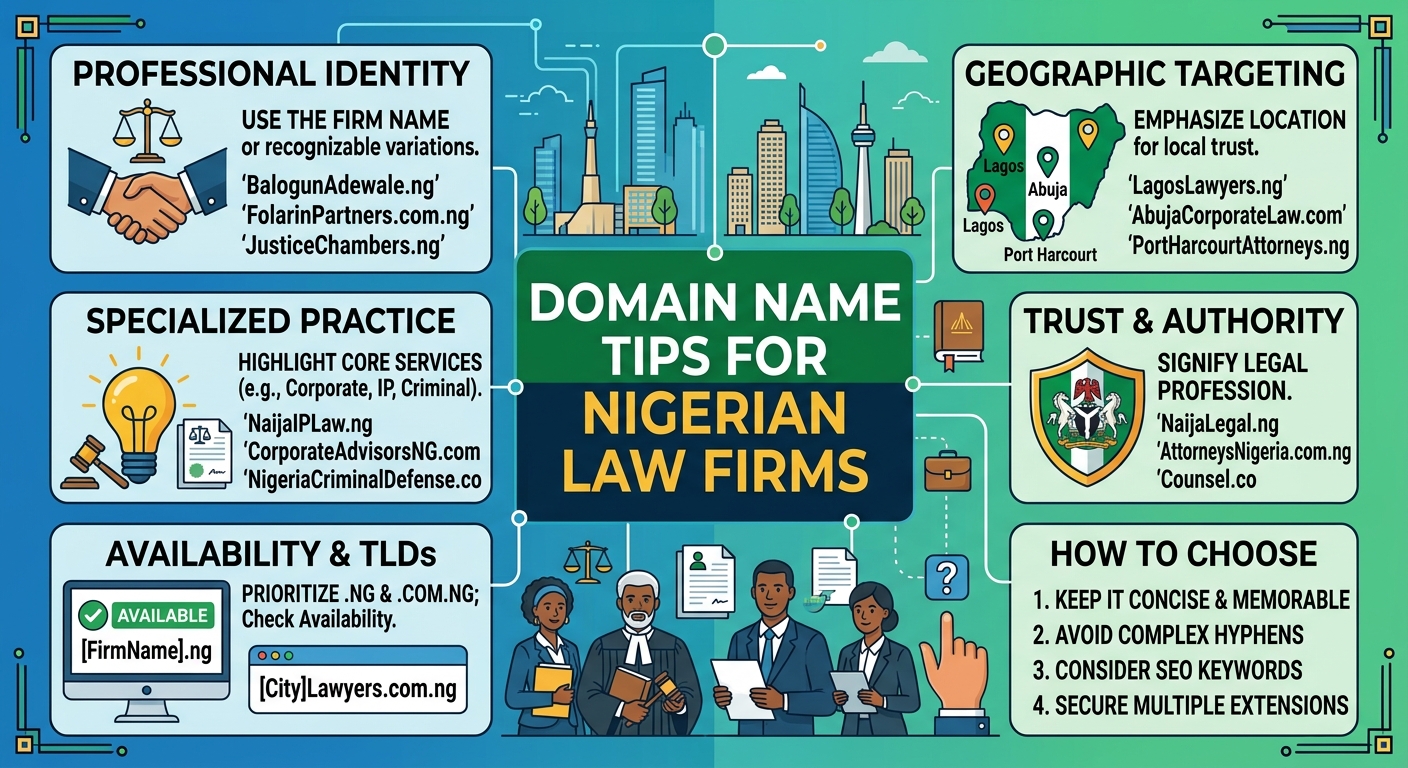
Domain Name Tips for Nigerian Law Firms
For a Nigerian law firm, a domain name is more than a website address. It is part of the firm’s professional identity and may appear on letterheads, business cards, email signatures, legal articles and online directories. A clear, credible domain can make it easier for prospective clients to find the firm and feel confident when contacting it.
Choosing a domain name requires more thought than simply selecting an available word. The name should be easy to remember, connected to the firm’s identity and practical for use over many years. The following tips can help Nigerian law firms make a sound decision.
Choose a name that reflects the firm
The safest starting point is usually the firm’s established name or a clear abbreviation of it. A domain that closely matches the name clients already know can support brand recognition and reduce confusion.
For example, a firm might consider a domain based on:
- The firm’s full name
- A distinctive shortened version of the firm’s name
- The firm’s initials, if they are already well known
- The firm’s name combined with a relevant location or practice focus
Avoid names that are so broad or generic that visitors cannot tell which organisation operates the website. It is also wise to avoid unusual spellings, excessive hyphens and strings of numbers. These features can make a domain harder to communicate over the phone and easier to mistype.
Select an appropriate domain extension
The extension is the part after the final dot, such as .com or a Nigerian country-code extension. A Nigerian law firm may consider both a general commercial extension and an extension associated with Nigeria, depending on availability, eligibility requirements and its branding goals.
A Nigerian-focused extension can help communicate the firm’s connection to the local market. A .com domain may be familiar to a wider audience, particularly if the firm works with international clients. Neither choice automatically makes a website more trustworthy; the quality of the website, the firm’s professionalism and the accuracy of its information remain important.
Before registering a country-code domain, check the current requirements set by the relevant registry or accredited registrar. Requirements, documentation and available options can change. If the preferred name is available in more than one extension, registering suitable variations may help protect the firm’s online identity.
Keep the domain short, clear and easy to say
A good legal-services domain should be simple enough for a client to remember after hearing it once. Read the proposed name aloud and ask whether another person would know how to spell it.
Consider these practical checks:
- Can someone type it correctly without seeing it written down?
- Does it contain words that could be misunderstood when joined together?
- Is it short enough to fit comfortably in an email address and printed material?
- Will the name still make sense if the firm expands its services?
Do not select a highly specific domain if the firm may soon add new practice areas or open offices in other Nigerian cities. A flexible name can remain useful as the business develops.
Check name availability and possible conflicts
Domain availability is not the same as permission to use a name. Before registering a domain, the firm should consider whether it is confusingly similar to another law firm, business or recognised brand. A domain that appears available may still create disputes or reputational problems.
Search for similar business names and review relevant business and professional records where appropriate. If the domain will be used as part of a broader brand, the firm may also wish to obtain professional advice about name protection and intellectual property considerations. This is especially important where the proposed name is distinctive, commercially valuable or similar to an existing organisation.
Register the domain in the correct legal or business identity where possible, rather than using an individual employee’s personal details. This helps the firm maintain control if staff or service providers change.
Use a professional email address
A domain becomes more valuable when it is used consistently for professional email. Addresses such as info@yourfirmdomain or contact@yourfirmdomain can look more established than a free personal email address and make it easier for clients to identify official correspondence.
Law firms should create separate addresses for common functions, such as general enquiries, billing, recruitment or specific departments. Personal staff addresses should follow a consistent format. The firm should also establish clear procedures for managing former employees’ accounts and preserving important business correspondence.
Email authentication and strong account security are important because legal practices handle confidential client information. Use strong, unique passwords, enable multi-factor authentication where available and restrict administrative access to trusted personnel.
Register the domain through a reliable provider
When comparing domain providers, look beyond the first-year registration offer. Check the renewal terms, domain management tools, support options, transfer process and the way ownership details are recorded. A low introductory price may not represent the long-term cost or service experience.
The firm should receive direct access to its domain account and retain control of the account’s main email address. Avoid arrangements where a web designer or employee is the only person who can renew, update or transfer the domain. Service providers can assist with management, but ownership and administrative control should remain with the firm.
Sonhosting provides domain and web hosting services for organisations that want a simpler way to manage their online tools. When choosing any provider, Nigerian law firms should confirm that the selected plan supports their domain extension, email needs and expected website requirements.
Protect the domain account
A domain account can control the firm’s website and email, so it deserves the same care as other important business systems. Limit access to people who need it and keep recovery information current.
Useful safeguards include:
- Using a dedicated business email account for domain administration
- Enabling multi-factor authentication when the provider offers it
- Keeping registrar login details out of shared public documents
- Reviewing account users and permissions periodically
- Enabling available domain-locking or transfer-protection features
- Keeping accurate records of renewal dates and account ownership
Staff should also be trained to recognise renewal scams. Fraudulent messages may imitate a registrar and ask the recipient to pay an urgent invoice or click a suspicious link. Verify renewal notices by signing in through the provider’s official website rather than relying on an unexpected email link.
Plan for renewals and continuity
Allowing a domain to expire can interrupt the firm’s website and email. In some cases, the name may become difficult or costly to recover. Assign responsibility for renewals to a role rather than relying on one person’s memory.
Keep a simple record containing the registrar, account administrator, renewal date, payment method and recovery contact. If the registrar supports automatic renewal, consider whether it is suitable for the firm and make sure the payment details remain valid. Automatic renewal should supplement, not replace, periodic account reviews.
Review the domain portfolio at least periodically. Remove unused domains only after confirming that they are not connected to old email addresses, redirects, marketing materials or important client communications.
Make the website match the domain
A professional domain should lead to a website that is accurate, secure and easy to use. The site should clearly identify the firm, explain its services in understandable language and provide reliable contact information. Check that the domain works correctly on mobile devices and that links, email addresses and forms are maintained.
Use secure website hosting and keep the website software updated. A hosting plan should provide the resources and support the site needs without making management unnecessarily complicated. For a small or growing practice, the right choice may differ from the requirements of a firm with a large content library or several locations.
Review the domain as the firm grows
A domain decision should support the firm’s future, not only its current website. Reassess the firm’s online identity when there is a merger, name change, new office, major change in services or expansion into a different market.
Do not abandon an old domain immediately after a rebrand. Plan redirects, email continuity and communication with existing clients before changing addresses. Keep relevant records and monitor both domains during the transition so that enquiries are not lost.
Conclusion
The right domain name can give a Nigerian law firm a clear and dependable online identity. Choose a name that matches the firm, check for possible conflicts, select an appropriate extension and register it under the firm’s control. Then protect the account, maintain professional email, renew the domain on time and connect it to a secure, useful website.
With a little planning, the domain can remain a stable business asset while the firm builds its reputation and serves clients online.