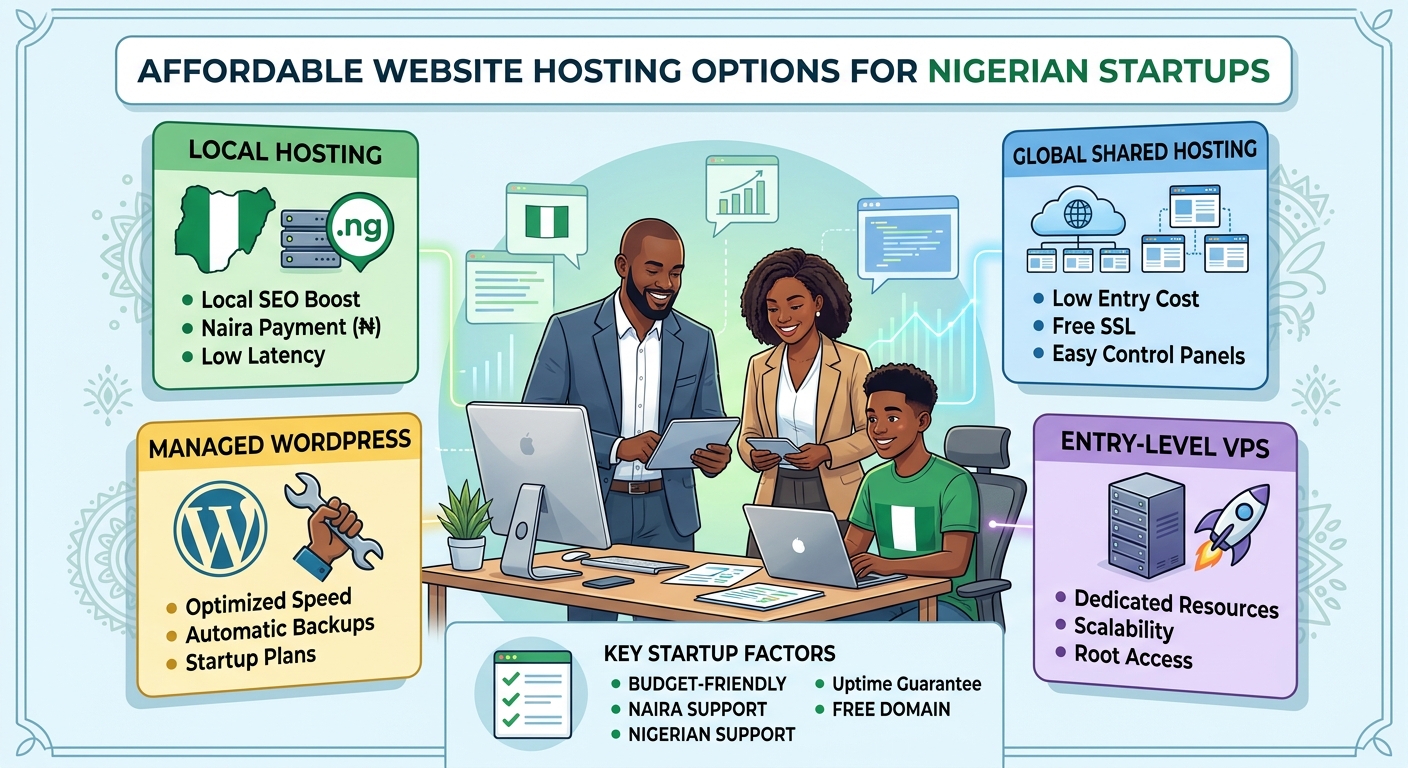
Affordable Website Hosting Options for Nigerian Startups
For a Nigerian startup, a website can support credibility, customer enquiries, online sales and business growth. However, hosting costs and technical decisions can feel difficult when you are working with a limited budget. The cheapest plan is not always the best choice, while an expensive package may include features your business does not yet need.
The right approach is to choose hosting that matches your current website, expected traffic and plans for growth. This guide explains the main hosting options available to Nigerian startups and the factors to consider before making a decision.
What is website hosting?
Website hosting is the service that stores your website files and makes them available to people online. When someone enters your domain name into a browser, the hosting server delivers your website’s pages, images and other content.
Hosting is different from a domain name. A domain is your website address, such as yourbusiness.ng or yourbusiness.com. Hosting is the space and technology used to store and serve the website. Most businesses need both a domain and a hosting plan.
A suitable hosting provider can also make important tasks easier, including setting up email, installing a content management system, creating backups and managing security settings.
Affordable hosting options for startups
Different hosting types suit different stages of business. Understanding the differences can help you avoid overspending or choosing a plan that cannot support your website.
Shared hosting
Shared hosting is often the most accessible option for a new startup. Several websites use resources on the same server, which allows the provider to offer hosting at a lower cost.
It can be suitable for:
- Company websites with a small number of pages
- New blogs and content websites
- Landing pages for services or products
- Small church, law firm or professional-service websites
- Websites that are still building their audience
The main advantage is affordability and simplicity. Many shared hosting plans include a control panel and tools that help users install popular website platforms without advanced technical knowledge.
The trade-off is that your website shares server resources with other customers. Performance may be affected if a site on the same server uses unusually high resources. For a new or modestly sized website, however, a well-managed shared hosting plan may provide practical value.
WordPress hosting
WordPress hosting is designed for websites built with WordPress. It may include WordPress installation, updates, security features, backups or performance settings suited to the platform.
This option can be useful for startups that want to create a website quickly without building everything from scratch. WordPress supports company websites, blogs, service pages, news sections and many types of business content.
Before choosing a WordPress plan, check whether it gives you control over your website and whether important features are included. A low-cost plan may still require you to manage updates, plugins and backups yourself, while a managed service may provide more assistance at a higher cost.
Cloud hosting
Cloud hosting uses connected servers and infrastructure rather than relying on one physical server alone. Depending on the provider and plan, this can offer flexibility, scalability and improved resilience.
Cloud hosting may be appropriate for a startup with:
- Growing visitor numbers
- A web application or customer portal
- More demanding business software
- Seasonal changes in website traffic
- A need to increase resources as the business develops
Cloud hosting is not automatically the most affordable option for every business. Its value depends on how resources are allocated and billed. A startup should understand the plan’s limits and charges before selecting it.
VPS hosting
A virtual private server, or VPS, provides an allocated virtual environment on a physical server. It generally offers more control and dedicated resources than basic shared hosting.
A VPS can be a good next step when a website has outgrown shared hosting or needs specific server software and configurations. It may also suit developers and businesses running applications that require more control.
However, VPS hosting often requires more technical administration. You may need to manage server updates, security, monitoring and backups, or pay for additional management. It is important to consider the full cost of running a VPS rather than looking only at the advertised hosting fee.
How to choose cost-effective hosting in Nigeria
Match the plan to your website
Start by identifying what you are building. A five-page business website does not need the same resources as an online store, membership platform or software application.
Consider the number of pages, expected visitors, image and video usage, databases, email accounts and any special software requirements. Choosing based on actual needs helps prevent both overspending and performance problems.
Check what is included
Hosting plans can vary significantly in what they provide. Review the details rather than comparing only headline prices.
Useful features may include:
- Storage suitable for your website files
- Bandwidth or traffic allowances
- SSL support for secure browsing
- Website backups
- Malware monitoring or security tools
- Database support
- Email services, if required
- A clear control panel
- Migration assistance
- Customer support
Some providers list certain features as optional add-ons. Knowing this in advance makes it easier to compare the total cost of each option.
Consider payment and renewal terms
Hosting is usually an ongoing service rather than a one-time purchase. Review the renewal terms, billing cycle and accepted payment methods before committing. A promotional starting price may not be the same as the price at renewal.
Nigerian startups should also consider whether the provider makes account management and payments convenient for their team. Clear invoices, accessible support and straightforward renewal information can reduce administrative problems later.
Look beyond server location
Some buyers assume that a server must be physically located in Nigeria for a website to perform well for Nigerian visitors. Server location can influence latency, but it is only one factor. Network quality, server configuration, caching, image optimisation and website code also affect speed.
Ask the provider how performance is managed and whether the service can support your expected audience. Avoid choosing solely because of a location claim without considering the complete hosting environment.
Review support quality
When a website becomes unavailable, quick and useful support matters. Check how customers can contact the provider and whether the support team can assist with common issues such as domain connections, email setup, website migration and hosting errors.
Support is especially important for business owners who do not have an in-house technical team. A slightly lower-priced plan may not be good value if resolving problems takes too long or requires specialist knowledge.
Ways to reduce hosting costs
Affordability does not mean choosing the smallest plan indefinitely. It means using resources carefully and avoiding unnecessary costs.
- Begin with a suitable entry plan: Choose enough storage and performance for your current website, with a clear path to upgrade.
- Keep your website efficient: Compress images, remove unused plugins and use a lightweight design where possible.
- Separate essential and optional services: Decide whether you need premium email, advanced security or specialist server management immediately.
- Maintain regular backups: A backup can help prevent the cost and disruption of rebuilding a website after a serious error.
- Track website usage: Monitor storage, traffic and resource consumption so you can change plans based on evidence.
- Protect your domain: Keep domain renewal information current and ensure the business retains control of the domain account.
Common mistakes to avoid
Startups sometimes choose hosting based only on the lowest advertised price. This can lead to unexpected renewal costs, limited support or a plan that cannot handle the website’s needs.
Other common mistakes include ignoring backups, using outdated software, selecting a VPS without the skills to manage it, and buying more resources before they are needed. It is also risky to register a domain or hosting account under the details of someone who may not remain involved in the business.
A practical hosting path for a new startup
A simple business website will often be able to begin with reliable shared hosting or a suitable WordPress plan. As the website gains visitors or requires more complex features, the business can review its resource usage and consider cloud or VPS hosting.
This staged approach keeps early costs manageable while leaving room for growth. The best provider should make upgrading clear and help you move to a more suitable environment when your needs change.
Conclusion
Affordable website hosting for a Nigerian startup should provide more than a low starting price. It should offer the resources, security, support and flexibility your business needs at its current stage.
Compare shared hosting, WordPress hosting, cloud hosting and VPS hosting according to your website’s purpose and expected growth. Check renewal terms, included features, support quality and upgrade options. With a thoughtful choice, your startup can establish a professional online presence without paying for complexity it does not yet need.