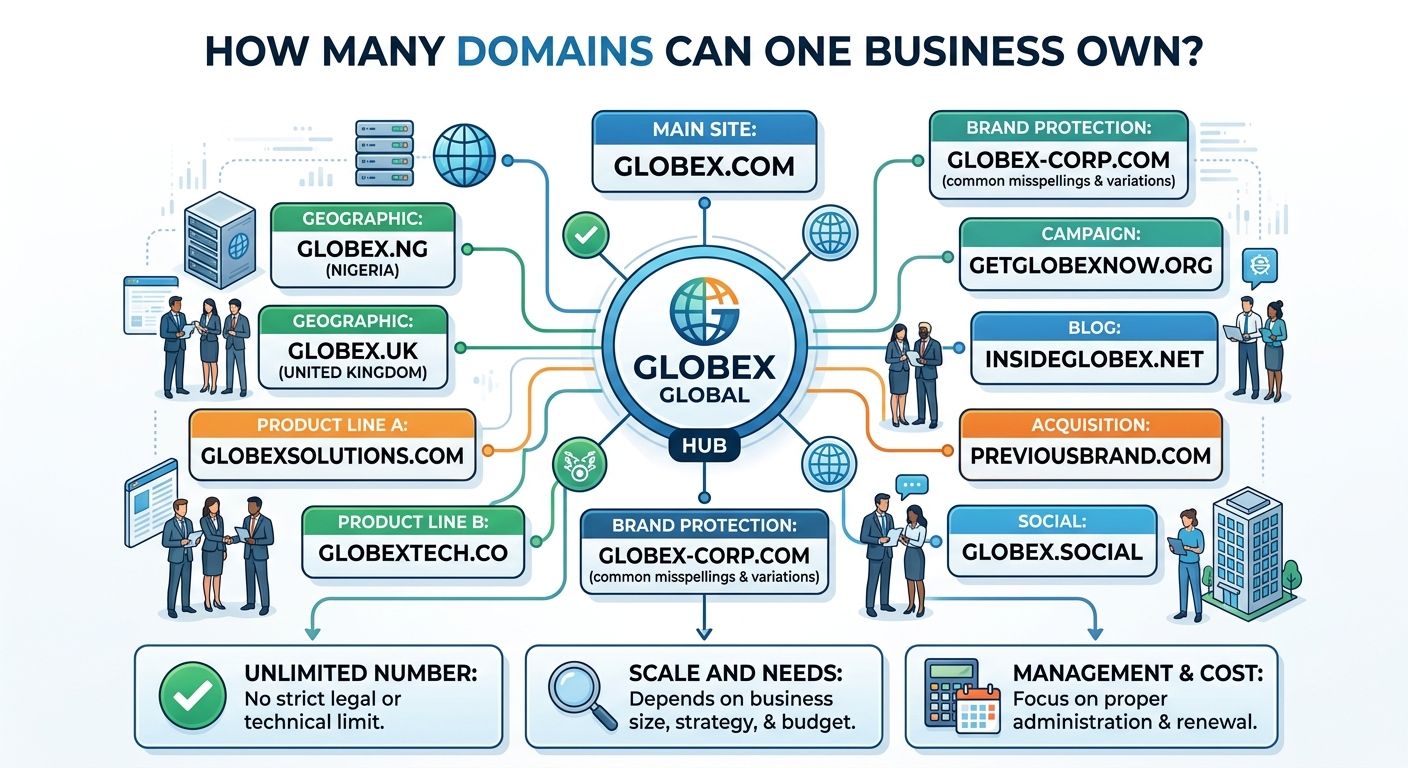
How Many Domains Can One Business Own?

There is usually no single limit on the number of domain names one business can own. A company may register one domain for its main website or manage dozens of domains for different brands, services, locations and marketing campaigns.

However, the practical limit depends on the domain registrar, the domain extensions you choose, registration requirements, budget and your ability to manage the portfolio properly. For businesses in Nigeria, this may include a combination of international extensions such as .com and country-code domains such as .ng or other relevant options.

Before buying several domains, it is important to understand why you need them and how each one will be used. A well-planned domain strategy can protect your brand and support growth. Buying names without a clear purpose can create unnecessary renewal costs and administrative work.

Is there a legal limit on business domain ownership?

In most cases, there is no general rule that restricts a business to one domain name. Businesses can register multiple domains as long as they follow the terms set by the registrar and the relevant domain registry.

Different domain extensions may have different requirements. Some are open for general registration, while others may require proof of eligibility, local presence or specific business information. Registration policies can also vary between providers and may change over time.

A business should provide accurate information when registering domains and should avoid using names that infringe another organisation’s trademark or identity. Owning a domain does not automatically give a business the right to use a protected brand name.

Why would a business need multiple domains?

Most companies do not need a large collection of domains, but owning more than one can be useful in several situations.

Protecting your business name

A company may register its main brand under more than one extension to reduce the risk of confusion or impersonation. For example, a business might use one domain for its website while registering a related extension to prevent another party from using a similar address.

These additional domains can redirect visitors to the main website. They may also help customers recognise the official online presence of the business.

Supporting different brands or services

A company with several brands may use separate domains for each brand. A hosting company, for example, could have one main corporate domain and different domains for specialised services, provided each website has a clear business purpose.

Separate domains can make it easier for customers to find information about a particular product or service. They can also help keep different audiences and website content organised.

Serving different locations

Businesses operating in multiple cities, regions or countries may use domains that reflect their target markets. A Nigerian business may choose a country-code domain for its local audience and an international extension for customers outside Nigeria.

A location-specific domain can support a local marketing strategy, but it should not be purchased simply because it is available. The website, contact information and content should clearly serve the intended market.

Using campaign or promotional domains

Some businesses register short, memorable domains for advertising campaigns, events or specific landing pages. These domains can be easier to communicate in print, radio, social media or offline marketing.

Campaign domains should be managed carefully. When a campaign ends, the business must decide whether to renew the domain, redirect it to a permanent page or allow it to expire.

Redirecting common variations

Customers may type a business name incorrectly or use a different extension by mistake. Registering a small number of common variations can help direct those visitors to the correct website.

This approach is most useful when the variations are closely connected to the brand. Registering many random spellings can quickly become expensive without providing meaningful protection.

How many domains does a typical business need?

There is no ideal number for every business. A small business, church, law firm or growing enterprise may only need one primary domain. A second domain may be worthwhile for brand protection, a major service or a distinct location.

Larger organisations may need more domains because they operate multiple brands, regions or online services. The important question is not “How many can we buy?” but “What role does each domain serve?”

Before registering a domain, write down its purpose. A simple review can include:

  • What website, page or service will use this domain?
  • Will it redirect to another website or host separate content?
  • Does it protect a valuable brand name?
  • Who is the intended audience?
  • How will the domain be promoted and maintained?
  • Is the expected benefit greater than the ongoing renewal cost?

What does owning multiple domains involve?

Every domain normally needs to be renewed according to the registrar’s schedule. Owning several domains means tracking renewal dates, registration details, DNS settings and access permissions.

A domain portfolio can become difficult to manage when domains are registered under different accounts or email addresses. For better control, businesses should keep domains in an account owned by the organisation rather than by an individual employee, agency or contractor.

Maintain a simple domain register containing:

  • The domain name and extension
  • The registrar and account owner
  • The registration and renewal dates
  • The purpose of the domain
  • Where the domain points, such as a website, email service or redirect
  • The staff members or providers authorised to manage it

This information makes it easier to renew important domains and remove unused ones. It also reduces the risk of losing access when a staff member leaves the business.

Domains, websites and email are separate services

Buying a domain does not automatically create a website. It is the address visitors use to find your online presence. Website files require hosting, while business email may require a separate email service or hosting arrangement.

A domain can point to a website hosted on shared hosting, a VPS or cloud hosting, depending on the organisation’s technical and performance requirements. Several domains can also point to the same website through redirects or domain configuration.

Businesses should be careful when changing DNS settings. Incorrect records can make a website or email service unavailable. If you are unsure which records to change, ask your hosting provider or technical administrator before making updates.

How to manage multiple domains securely

Domain names are valuable business assets, especially when they are connected to a website, email accounts and customer communications. Basic security controls can help protect them.

  • Use a strong, unique password for the registrar account.
  • Enable two-factor authentication when the provider offers it.
  • Keep account recovery email addresses and phone details current.
  • Limit account access to people who need it.
  • Record renewal dates and enable reminders or automatic renewal where appropriate.
  • Review domain permissions when an employee or service provider no longer works with the business.
  • Be cautious with emails requesting urgent domain transfers or payment changes.

Businesses should also confirm that important domains are registered using accurate legal and contact information. Keep copies of invoices and registration records for internal administration.

Should you register every available domain extension?

No. Registering every possible extension is rarely necessary. The best choice depends on your brand, customers, location and long-term plans.

Start with the domain that will be your primary public address. Then consider a limited number of alternatives that protect the brand or support a genuine business objective. Avoid buying domains solely because they are cheap or available if there is no plan to use or monitor them.

It is also wise to check the name before registration. Search for possible trademark conflicts, confusingly similar businesses and meanings that could create problems in your target market.

When should a business let a domain expire?

A domain may no longer be useful when a campaign has ended, a service has been discontinued or a brand has been replaced. Before allowing it to expire, check whether it is connected to website redirects, email addresses, advertising materials or customer bookmarks.

Unused domains can sometimes be redirected to a current website, but keeping them indefinitely is not always the best option. Review the portfolio periodically and retain domains that provide clear protection or business value.

Conclusion

One business can usually own multiple domain names, and there is no universal number that suits every organisation. The right portfolio may contain one domain or several, depending on your brands, services, markets and marketing plans.

Choose domains with a clear purpose, keep them in a business-controlled account and track renewals carefully. If you need help connecting domains to hosting, email or a new website, a reliable hosting provider can help you manage the technical setup while you focus on running the business.
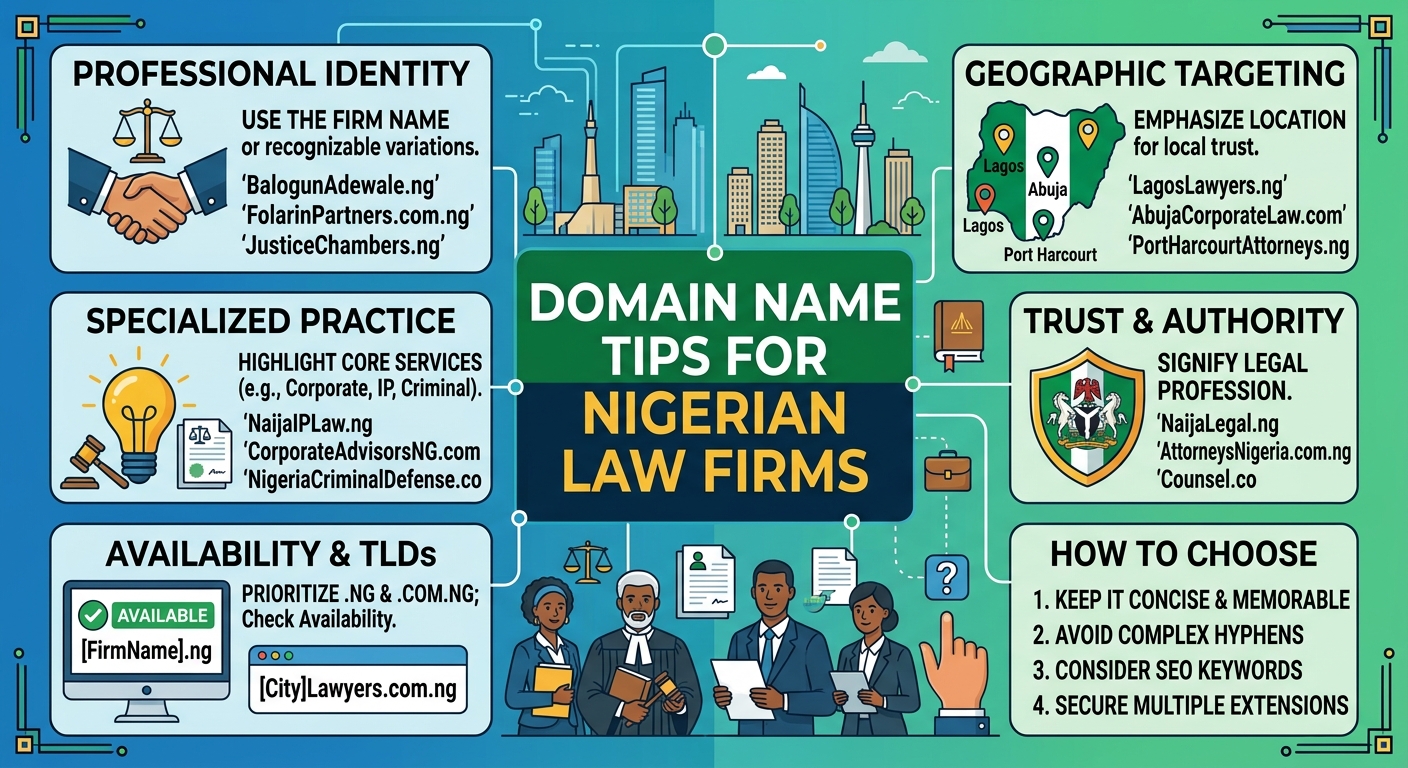
Domain Name Tips for Nigerian Law Firms

For a Nigerian law firm, a domain name is more than a website address. It is part of the firm’s professional identity and may appear on letterheads, business cards, email signatures, legal articles and online directories. A clear, credible domain can make it easier for prospective clients to find the firm and feel confident when contacting it.

Choosing a domain name requires more thought than simply selecting an available word. The name should be easy to remember, connected to the firm’s identity and practical for use over many years. The following tips can help Nigerian law firms make a sound decision.

Choose a name that reflects the firm

The safest starting point is usually the firm’s established name or a clear abbreviation of it. A domain that closely matches the name clients already know can support brand recognition and reduce confusion.

For example, a firm might consider a domain based on:

  • The firm’s full name
  • A distinctive shortened version of the firm’s name
  • The firm’s initials, if they are already well known
  • The firm’s name combined with a relevant location or practice focus

Avoid names that are so broad or generic that visitors cannot tell which organisation operates the website. It is also wise to avoid unusual spellings, excessive hyphens and strings of numbers. These features can make a domain harder to communicate over the phone and easier to mistype.

Select an appropriate domain extension

The extension is the part after the final dot, such as .com or a Nigerian country-code extension. A Nigerian law firm may consider both a general commercial extension and an extension associated with Nigeria, depending on availability, eligibility requirements and its branding goals.

A Nigerian-focused extension can help communicate the firm’s connection to the local market. A .com domain may be familiar to a wider audience, particularly if the firm works with international clients. Neither choice automatically makes a website more trustworthy; the quality of the website, the firm’s professionalism and the accuracy of its information remain important.

Before registering a country-code domain, check the current requirements set by the relevant registry or accredited registrar. Requirements, documentation and available options can change. If the preferred name is available in more than one extension, registering suitable variations may help protect the firm’s online identity.

Keep the domain short, clear and easy to say

A good legal-services domain should be simple enough for a client to remember after hearing it once. Read the proposed name aloud and ask whether another person would know how to spell it.

Consider these practical checks:

  • Can someone type it correctly without seeing it written down?
  • Does it contain words that could be misunderstood when joined together?
  • Is it short enough to fit comfortably in an email address and printed material?
  • Will the name still make sense if the firm expands its services?

Do not select a highly specific domain if the firm may soon add new practice areas or open offices in other Nigerian cities. A flexible name can remain useful as the business develops.

Check name availability and possible conflicts

Domain availability is not the same as permission to use a name. Before registering a domain, the firm should consider whether it is confusingly similar to another law firm, business or recognised brand. A domain that appears available may still create disputes or reputational problems.

Search for similar business names and review relevant business and professional records where appropriate. If the domain will be used as part of a broader brand, the firm may also wish to obtain professional advice about name protection and intellectual property considerations. This is especially important where the proposed name is distinctive, commercially valuable or similar to an existing organisation.

Register the domain in the correct legal or business identity where possible, rather than using an individual employee’s personal details. This helps the firm maintain control if staff or service providers change.

Use a professional email address

A domain becomes more valuable when it is used consistently for professional email. Addresses such as info@yourfirmdomain or contact@yourfirmdomain can look more established than a free personal email address and make it easier for clients to identify official correspondence.

Law firms should create separate addresses for common functions, such as general enquiries, billing, recruitment or specific departments. Personal staff addresses should follow a consistent format. The firm should also establish clear procedures for managing former employees’ accounts and preserving important business correspondence.

Email authentication and strong account security are important because legal practices handle confidential client information. Use strong, unique passwords, enable multi-factor authentication where available and restrict administrative access to trusted personnel.

Register the domain through a reliable provider

When comparing domain providers, look beyond the first-year registration offer. Check the renewal terms, domain management tools, support options, transfer process and the way ownership details are recorded. A low introductory price may not represent the long-term cost or service experience.

The firm should receive direct access to its domain account and retain control of the account’s main email address. Avoid arrangements where a web designer or employee is the only person who can renew, update or transfer the domain. Service providers can assist with management, but ownership and administrative control should remain with the firm.

Sonhosting provides domain and web hosting services for organisations that want a simpler way to manage their online tools. When choosing any provider, Nigerian law firms should confirm that the selected plan supports their domain extension, email needs and expected website requirements.

Protect the domain account

A domain account can control the firm’s website and email, so it deserves the same care as other important business systems. Limit access to people who need it and keep recovery information current.

Useful safeguards include:

  • Using a dedicated business email account for domain administration
  • Enabling multi-factor authentication when the provider offers it
  • Keeping registrar login details out of shared public documents
  • Reviewing account users and permissions periodically
  • Enabling available domain-locking or transfer-protection features
  • Keeping accurate records of renewal dates and account ownership

Staff should also be trained to recognise renewal scams. Fraudulent messages may imitate a registrar and ask the recipient to pay an urgent invoice or click a suspicious link. Verify renewal notices by signing in through the provider’s official website rather than relying on an unexpected email link.

Plan for renewals and continuity

Allowing a domain to expire can interrupt the firm’s website and email. In some cases, the name may become difficult or costly to recover. Assign responsibility for renewals to a role rather than relying on one person’s memory.

Keep a simple record containing the registrar, account administrator, renewal date, payment method and recovery contact. If the registrar supports automatic renewal, consider whether it is suitable for the firm and make sure the payment details remain valid. Automatic renewal should supplement, not replace, periodic account reviews.

Review the domain portfolio at least periodically. Remove unused domains only after confirming that they are not connected to old email addresses, redirects, marketing materials or important client communications.

Make the website match the domain

A professional domain should lead to a website that is accurate, secure and easy to use. The site should clearly identify the firm, explain its services in understandable language and provide reliable contact information. Check that the domain works correctly on mobile devices and that links, email addresses and forms are maintained.

Use secure website hosting and keep the website software updated. A hosting plan should provide the resources and support the site needs without making management unnecessarily complicated. For a small or growing practice, the right choice may differ from the requirements of a firm with a large content library or several locations.

Review the domain as the firm grows

A domain decision should support the firm’s future, not only its current website. Reassess the firm’s online identity when there is a merger, name change, new office, major change in services or expansion into a different market.

Do not abandon an old domain immediately after a rebrand. Plan redirects, email continuity and communication with existing clients before changing addresses. Keep relevant records and monitor both domains during the transition so that enquiries are not lost.

Conclusion

The right domain name can give a Nigerian law firm a clear and dependable online identity. Choose a name that matches the firm, check for possible conflicts, select an appropriate extension and register it under the firm’s control. Then protect the account, maintain professional email, renew the domain on time and connect it to a secure, useful website.

With a little planning, the domain can remain a stable business asset while the firm builds its reputation and serves clients online.

Your Cart

©2018 - currentyear Sonhosting • By Digital Nigeria - RC 7487481
All Rights Reserved
Powered by ShootOut Now Services