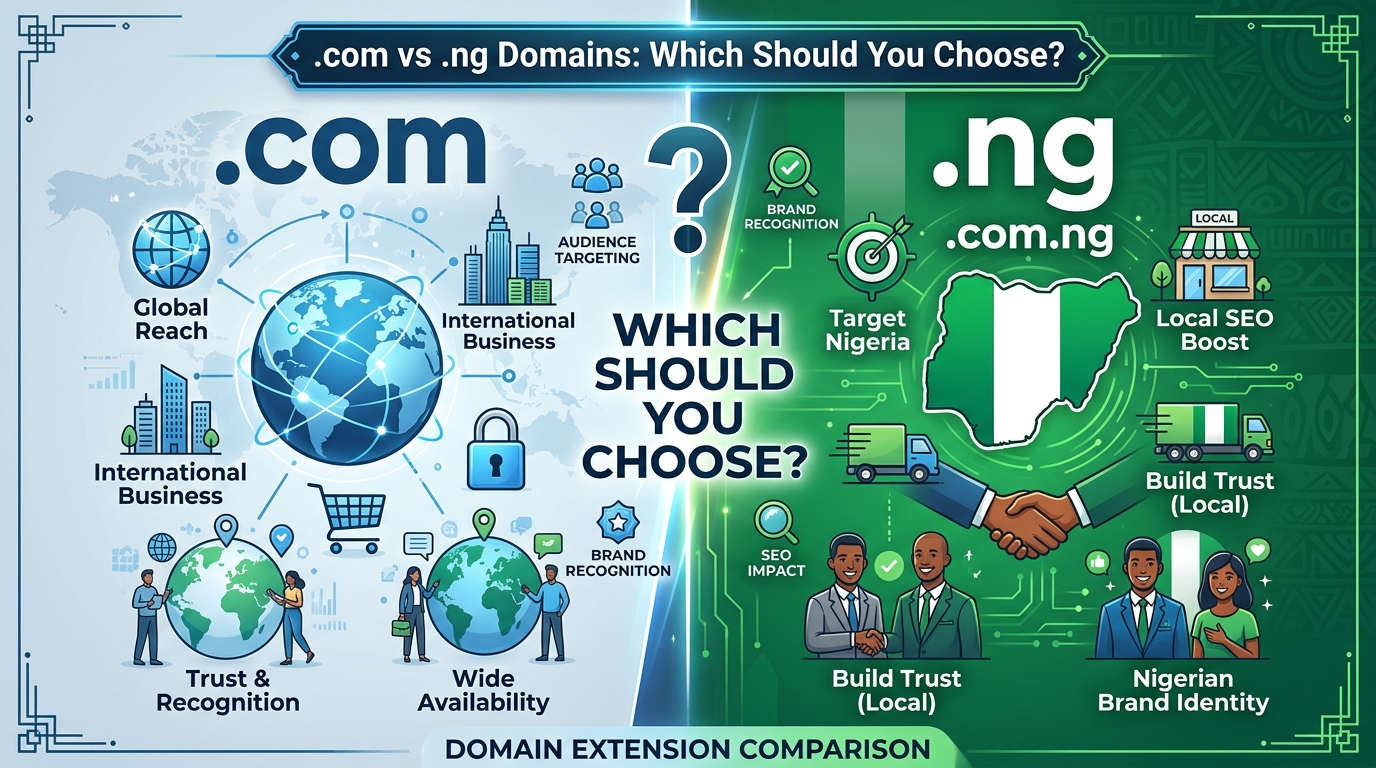
.com vs .ng Domains: Which Should You Choose?
Choosing a domain name is one of the first important decisions when creating a website. Your domain is more than a web address: it is part of your brand identity, appears in marketing materials and can influence how visitors perceive your organisation.
For businesses and organisations in Nigeria, the choice often comes down to a .com domain or a Nigerian country-code domain such as .ng or .com.ng. Both can be suitable, but the best option depends on your audience, business goals and the image you want to build.
This guide explains the main differences between .com and .ng domains so you can make a confident decision before purchasing your domain and hosting.
What is a .com domain?
A .com domain is a generic top-level domain. It was originally associated with commercial organisations, but it is now used by businesses, individuals, non-profits, churches, professionals and many other types of websites around the world.
Because .com has been used for many years, it is familiar to internet users in Nigeria and internationally. When people hear a business name, they may automatically try the .com version first. This familiarity can make a .com domain easy to remember and suitable for organisations serving customers across multiple countries.
However, popular .com names are often already registered. You may need to adjust your preferred name, add a relevant word or choose a different extension if the exact domain is unavailable.
What is a .ng domain?
A .ng domain is Nigeria’s country-code top-level domain. It identifies a website with a connection to Nigeria and can help communicate that a business, organisation or service is focused on the Nigerian market.
There are also second-level options such as .com.ng, which is commonly associated with commercial websites, and other Nigerian domain categories intended for particular types of organisations. The appropriate option may depend on the domain provider’s requirements and the organisation applying for it.
A .ng domain can be useful for a Nigerian SME, local service provider, church, law firm or community organisation that wants its Nigerian identity to be clear. It can also make a brand name available when the corresponding .com has already been taken.
Key differences between .com and .ng
1. Audience and market focus
The clearest difference is geographical positioning. A .com domain has a global feel, while .ng signals Nigeria.
If your organisation mainly serves customers in Lagos, Abuja, Port Harcourt or other parts of Nigeria, a .ng domain can reinforce your local presence. It may help visitors immediately understand that your services are intended for the Nigerian market.
A .com domain may be more appropriate if you plan to serve customers in several countries, sell internationally or build a brand that is not tied to one location. It is also a sensible choice when your target audience is already familiar with your business name under a .com address.
2. Brand perception
Neither extension automatically makes a website more professional. A trustworthy brand depends more on the quality of its website, communication, security, customer service and consistency.
That said, the extensions communicate different things. A .com domain can make a company appear broadly international. A .ng domain can present a business as proudly Nigerian, locally relevant and focused on serving people in the country.
For a Nigerian church, a .ng domain may clearly identify the organisation’s location. For a law firm serving Nigerian clients, it can support a local professional identity. A company with international expansion plans may prefer .com as its primary domain, even if it starts in Nigeria.
3. Availability of names
Domain availability is a practical consideration. Short, obvious .com names are often unavailable because many businesses and individuals already use them.
You may have more naming flexibility with a .ng or .com.ng domain. This can allow you to use your preferred business name without adding unnecessary numbers, hyphens or extra words.
Before deciding, check the exact name across the extensions you are considering. A good domain should be easy to spell, easy to say aloud and closely related to your organisation’s name or services.
4. Memorability
People are generally familiar with .com, which can make it easy to remember. However, familiarity does not mean that every .com domain is memorable. A long or complicated name can still be difficult to recall.
A concise .ng domain may be more memorable than a crowded .com alternative. For example, a clear business name with a relevant Nigerian extension may be easier to communicate than a .com address containing several extra words.
When comparing options, say each domain aloud and consider how it will look on a sign, invoice, social media profile, business card or radio advertisement.
5. Search engine considerations
Changing the domain extension alone does not guarantee better search engine visibility. Search engines consider many aspects of a website, including useful content, technical performance, relevance, links and the quality of the user experience.
A Nigerian country-code domain can provide a useful geographic signal for searches connected to Nigeria. A .com domain can support a broader international positioning. The extension should therefore match your intended audience, while your website content and technical setup support your search goals.
Most importantly, choose a domain that you can build consistently. A relevant, trusted website is more valuable than selecting an extension based only on assumptions about rankings.
When should you choose a .com domain?
A .com domain may be the better choice if:
- Your business plans to serve customers outside Nigeria.
- You want a broadly international brand identity.
- Your audience is already familiar with your .com name.
- You expect to expand into different countries or markets.
- The .com version of your brand name is available and easy to use.
For example, a technology company developing services for customers across Africa may choose .com to avoid limiting its brand to one country. A Nigerian business can still use .com while clearly showing its location through its website content, contact information and business messaging.
When should you choose a .ng domain?
A .ng or .com.ng domain may be a strong choice if:
- Your main customers are in Nigeria.
- Your organisation wants to emphasise its Nigerian identity.
- You provide location-based services to Nigerian clients.
- The matching .com domain is unavailable or too expensive for your budget.
- You want a short, clear alternative to a long .com name.
This can work well for local retailers, schools, churches, professional practices, community organisations and SMEs whose services are primarily delivered within Nigeria.
Can you buy both .com and .ng?
Yes, many organisations choose to register both versions when they are available. One domain can be used as the main website, while the other redirects visitors to it.
Owning both can help protect your brand and reduce the risk of another party registering a similar domain. It can also prevent confusion when customers type the wrong extension. However, registering multiple domains adds renewal responsibilities, so keep your domain records organised and renew every important domain on time.
If you use more than one domain, decide which one is your primary address. Use that version consistently on your website, email addresses, social media profiles, invoices and promotional materials.
What to check before registering your domain
- Check the spelling: Avoid names that are difficult to pronounce or easy to mistype.
- Keep it practical: Shorter domains are usually easier to share and remember.
- Consider the future: Choose a name that still fits if your products or services expand.
- Review registration requirements: Requirements and policies can vary by domain extension and provider.
- Plan for renewal: Keep your registration email and payment details current.
- Protect your brand: Consider related extensions if the name is important to your organisation.
Does the domain extension affect hosting?
Your choice of .com or .ng does not prevent you from using standard web hosting, VPS hosting or cloud hosting. The domain points visitors to your website, while hosting provides the server space and resources needed to run it.
When purchasing hosting, check that the provider can help you connect your chosen domain, manage DNS records and set up professional email addresses. A reliable setup should also support website security, backups and the software your organisation needs.
Final recommendation
Choose .com if you want a global identity, plan to expand internationally or already have a strong .com brand. Choose .ng or .com.ng if your organisation mainly serves Nigeria and you want your local identity to be immediately clear.
There is no universally superior extension. The best domain is available, easy to remember, aligned with your audience and suitable for your long-term plans. Once you choose it, focus on building a fast, secure and useful website that gives visitors a reason to return.