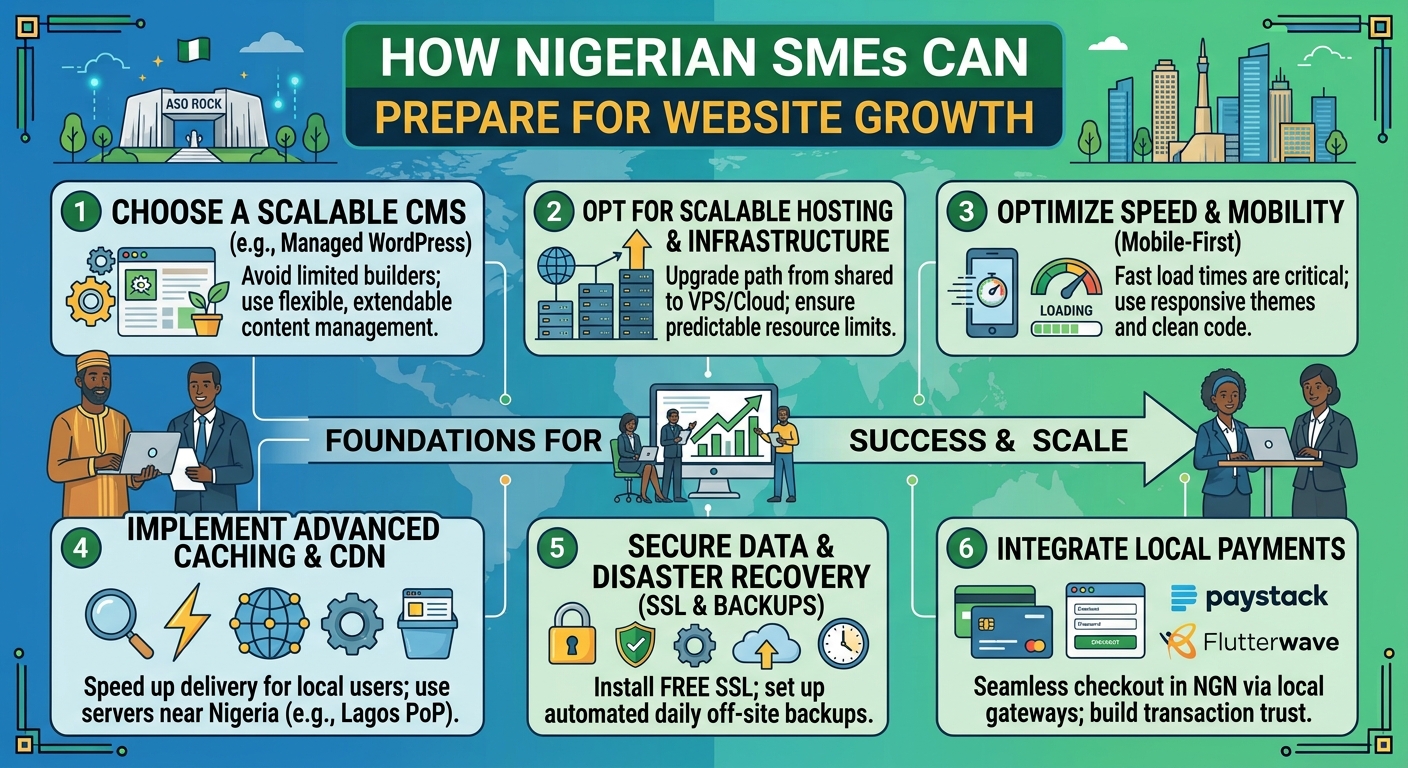
Benefits of Cloud Hosting for Growing Nigerian Businesses
For a growing Nigerian business, a website problem can quickly become a business problem. If customers cannot open your website, complete an enquiry form, view your products or reach you by email, you may lose opportunities and credibility.
Cloud hosting offers a practical way to support a growing online presence. Instead of relying on one physical server, cloud hosting uses connected computing resources to deliver website files, applications and services. The exact setup varies between providers, but the main idea is that a business can access hosting resources more flexibly as its needs change.
That flexibility can be useful for Nigerian small businesses, entrepreneurs, creators and organisations that are moving beyond a basic online presence. However, cloud hosting is not automatically the right choice for every website. The best decision depends on your traffic, website type, budget, email needs, growth plans and willingness to manage technical tasks.
What cloud hosting means for a business
Traditional hosting arrangements often place a website on one server or within one fixed hosting environment. Cloud hosting distributes or supports the hosting environment across connected resources. This can provide more room to adjust capacity and may reduce the effect of a problem affecting one individual server.
You do not need to become a server administrator to benefit from cloud hosting. A suitable provider can handle much of the technical work behind the scenes, while you manage the website and focus on serving customers. This is especially important for businesses that need dependable online services but do not have a dedicated technical team.
Cloud hosting should also be viewed as more than server space. Hosting affects website availability, loading performance, security, backups, email and the overall customer experience. A technically advanced hosting environment cannot compensate for a neglected website, weak passwords or missing business information, but it can provide a stronger foundation.
1. Better support for business growth
A new business may begin with modest website traffic. Over time, traffic can increase because of advertising, social media activity, search visibility, referrals, seasonal demand or a successful product launch. A hosting plan that was suitable at the beginning may become restrictive as the website grows.
Cloud hosting can make it easier to adjust resources as demand changes. Depending on the service, this may include increasing processing capacity, memory, storage or other resources. The practical benefit is that you have more options than simply moving from a small fixed plan to a completely different setup.
For example, imagine a Nigerian online retailer promoting a new collection through social media. A sudden increase in visitors may place greater pressure on the website. A hosting environment designed for flexibility can give the business more room to prepare for higher demand and reduce the risk of the site becoming difficult to use during an important promotion.
This does not mean cloud hosting guarantees that a website will never slow down. Website code, images, plugins, databases and network conditions also affect performance. It means the hosting environment may be better suited to changing requirements than a plan with very limited capacity.
2. More resilience than a single-server setup
Businesses depend on their websites for more than general information. A website may receive enquiries, display a catalogue, collect bookings, support customer service or provide access to important resources. Extended downtime can interrupt these activities.
Because cloud hosting can use connected resources, it may offer greater resilience than a basic setup that depends entirely on one physical server. If one resource experiences a problem, the hosting environment may be able to continue operating through other resources, depending on its design and provider policies.
It is important to ask what a provider actually means by cloud hosting. The label alone does not explain the architecture, backup process, support arrangements or recovery options. Before choosing a plan, ask:
- How are website files and databases protected?
- What backup options are included?
- How are service interruptions handled?
- What support is available if the website becomes unavailable?
- Can the resources be adjusted as the business grows?
A dependable hosting arrangement should be supported by good website maintenance, current software and tested backups. Cloud hosting is one part of business continuity, not a replacement for planning.
3. Improved performance potential
Website visitors expect pages to respond promptly, particularly on mobile devices. This matters in Nigeria, where many customers access websites through smartphones and variable network conditions. A slow website can make visitors leave before they read your offer or contact your business.
Cloud hosting may provide access to more flexible computing resources than a basic shared environment. This can create better performance potential when the website is properly configured and has sufficient resources.
Performance also depends on practical choices such as:
- Compressing large images before uploading them.
- Using a lightweight theme and only necessary WordPress plugins.
- Keeping WordPress, themes and plugins maintained.
- Using caching where appropriate.
- Reducing unnecessary scripts and page elements.
- Checking the website on mobile devices.
If a business website is built with WordPress, managed WordPress support can make these responsibilities easier to handle. The goal is not to pursue technical improvements for their own sake. The goal is to help customers find information, make enquiries and complete important actions with less friction.
4. More suitable for changing workloads
Not every business receives the same level of traffic every day. A training organisation may receive more visitors when registration opens. A professional service may see increased interest after a media mention. A retailer may experience seasonal demand. A content creator may receive a traffic surge after publishing a popular video.
Cloud hosting can be valuable when workloads are unpredictable or likely to grow. Rather than choosing a plan based only on today’s traffic, the business can consider how its online activities may develop over the next stage of growth.
This is particularly useful when a website includes more than simple pages. Membership areas, online booking, customer dashboards, product catalogues and content-heavy websites may require more resources than a small brochure website.
5. A stronger foundation for security and backups
Security is a business responsibility, not just a technical concern. A compromised website can damage trust, expose information or interrupt normal operations. Cloud hosting may provide access to security and backup features, but the protection available depends on the provider and the selected plan.
Businesses should look for practical safeguards such as secure account access, SSL support, monitoring options, malware protection where offered and regular backups. An SSL certificate helps enable HTTPS, which protects data exchanged between a visitor’s browser and the website and gives customers a more trustworthy browsing experience.
Backups deserve special attention. A backup is useful only if it exists, can be accessed and can be restored when needed. Ask how often backups are created, how long they are retained and whether restoration support is available. Important websites should not depend on an untested backup that nobody knows how to use.
Businesses should also use strong, unique passwords and enable additional account protection where available. Keep ownership and access details for your domain, hosting account, website and business email accurate. Losing access to these assets can be costly, especially if they were registered or managed by a former employee, developer or third party.
6. Easier expansion into related online services
As a business grows, its online requirements often expand. It may need a professional domain, domain-based business email, additional websites, landing pages, WordPress support or a virtual private server for a more demanding application.
Cloud hosting can provide a path for gradual expansion. Instead of rebuilding the entire online setup every time the business needs more capacity, the business may be able to add resources or move to a more suitable hosting arrangement.
A domain-based email address can support credibility and make communication easier to manage. For example, an address using the business domain is usually more appropriate for customer enquiries than a personal free email address. Hosting, email and website services do not have to be complicated, but they should be planned as parts of one reliable online presence.
Is cloud hosting right for your business?
Cloud hosting may be suitable if your website is growing, traffic changes frequently, your current hosting has limited capacity or your business needs a more flexible foundation. It may be unnecessary for a small, low-traffic website with simple requirements and a carefully selected basic hosting plan.
Use this decision framework before upgrading:
- Website type: Is it a simple information site, WordPress publication, online store, booking system or application?
- Traffic: Is traffic stable, growing or difficult to predict?
- Business impact: What would downtime prevent customers from doing?
- Resources: Do you need more storage, processing capacity or database support?
- Management: Will you handle technical work, or do you need managed support?
- Budget: Can the business afford the service over time, including renewals and related services?
- Control: Will your organisation retain access to the domain, hosting account, website and email?
Making the move without unnecessary complexity
Start by recording your current website, domain, email and hosting details. Confirm who controls each account and make sure renewal information is current. Create a backup before making changes, and identify any applications, databases or email accounts that need to be migrated.
Next, match the hosting plan to the actual business requirement rather than choosing the most expensive option. Ask the provider about migration assistance, backups, security, resource adjustments and support. After the move, test the website on mobile and desktop devices, check forms and links, confirm email delivery and monitor the website for problems.
A practical hosting partner should explain these steps in clear business language. You should not need to understand every server technology to make a sensible decision, but you should understand what is included, what you are responsible for and how to get help.
The practical takeaway
Cloud hosting can help a growing Nigerian business prepare for changing traffic, improve its hosting flexibility and build a stronger foundation for websites, WordPress services, business email and online customer interactions. Its value is greatest when it is combined with sensible maintenance, secure access, reliable backups and clear ownership of digital assets.
Choose hosting according to your real needs, not technical fashion. If your current website is becoming harder to manage or your business is preparing for growth, compare the available options and select a setup that gives you enough capacity, appropriate support and room to develop without creating unnecessary complexity.