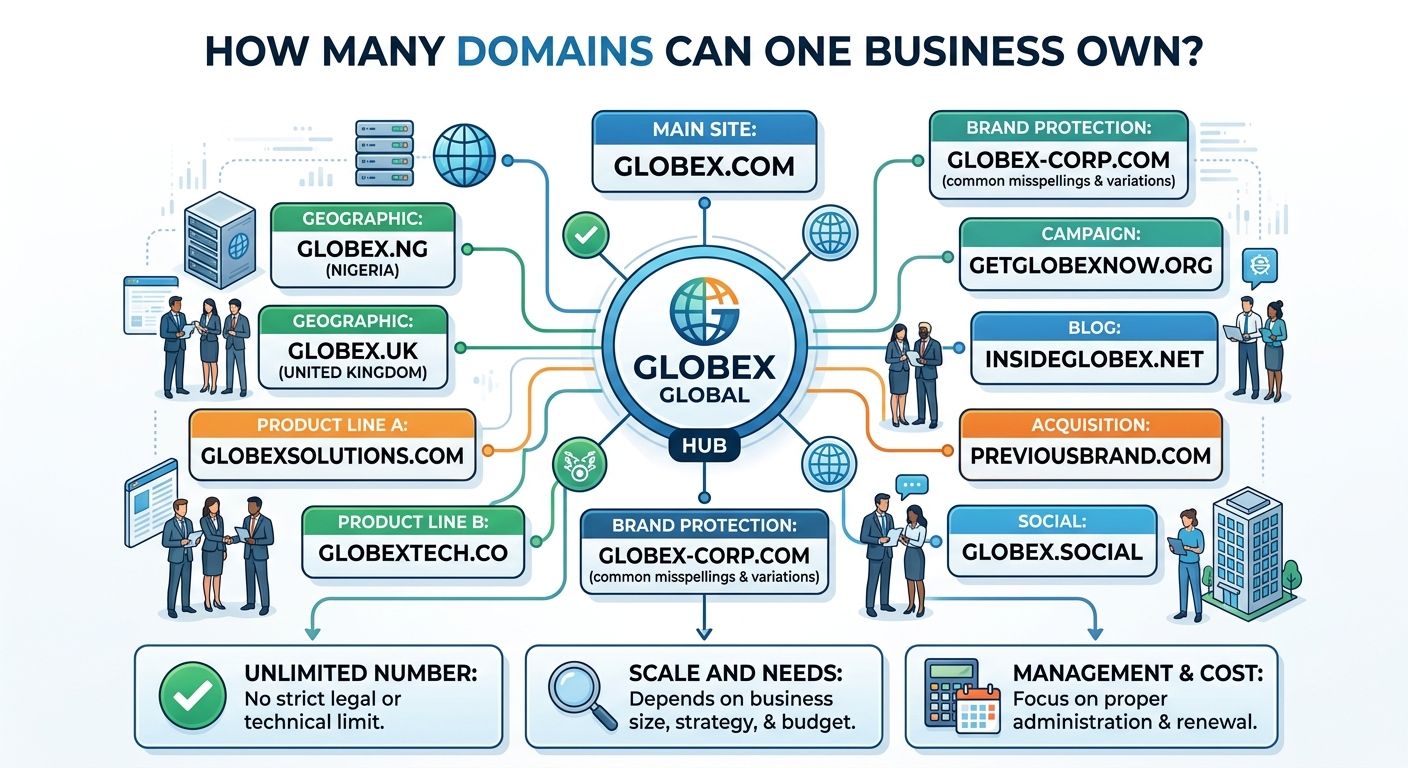
How Many Domains Can One Business Own?
There is usually no single limit on the number of domain names one business can own. A company may register one domain for its main website or manage dozens of domains for different brands, services, locations and marketing campaigns.
However, the practical limit depends on the domain registrar, the domain extensions you choose, registration requirements, budget and your ability to manage the portfolio properly. For businesses in Nigeria, this may include a combination of international extensions such as .com and country-code domains such as .ng or other relevant options.
Before buying several domains, it is important to understand why you need them and how each one will be used. A well-planned domain strategy can protect your brand and support growth. Buying names without a clear purpose can create unnecessary renewal costs and administrative work.
Is there a legal limit on business domain ownership?
In most cases, there is no general rule that restricts a business to one domain name. Businesses can register multiple domains as long as they follow the terms set by the registrar and the relevant domain registry.
Different domain extensions may have different requirements. Some are open for general registration, while others may require proof of eligibility, local presence or specific business information. Registration policies can also vary between providers and may change over time.
A business should provide accurate information when registering domains and should avoid using names that infringe another organisation’s trademark or identity. Owning a domain does not automatically give a business the right to use a protected brand name.
Why would a business need multiple domains?
Most companies do not need a large collection of domains, but owning more than one can be useful in several situations.
Protecting your business name
A company may register its main brand under more than one extension to reduce the risk of confusion or impersonation. For example, a business might use one domain for its website while registering a related extension to prevent another party from using a similar address.
These additional domains can redirect visitors to the main website. They may also help customers recognise the official online presence of the business.
Supporting different brands or services
A company with several brands may use separate domains for each brand. A hosting company, for example, could have one main corporate domain and different domains for specialised services, provided each website has a clear business purpose.
Separate domains can make it easier for customers to find information about a particular product or service. They can also help keep different audiences and website content organised.
Serving different locations
Businesses operating in multiple cities, regions or countries may use domains that reflect their target markets. A Nigerian business may choose a country-code domain for its local audience and an international extension for customers outside Nigeria.
A location-specific domain can support a local marketing strategy, but it should not be purchased simply because it is available. The website, contact information and content should clearly serve the intended market.
Using campaign or promotional domains
Some businesses register short, memorable domains for advertising campaigns, events or specific landing pages. These domains can be easier to communicate in print, radio, social media or offline marketing.
Campaign domains should be managed carefully. When a campaign ends, the business must decide whether to renew the domain, redirect it to a permanent page or allow it to expire.
Redirecting common variations
Customers may type a business name incorrectly or use a different extension by mistake. Registering a small number of common variations can help direct those visitors to the correct website.
This approach is most useful when the variations are closely connected to the brand. Registering many random spellings can quickly become expensive without providing meaningful protection.
How many domains does a typical business need?
There is no ideal number for every business. A small business, church, law firm or growing enterprise may only need one primary domain. A second domain may be worthwhile for brand protection, a major service or a distinct location.
Larger organisations may need more domains because they operate multiple brands, regions or online services. The important question is not “How many can we buy?” but “What role does each domain serve?”
Before registering a domain, write down its purpose. A simple review can include:
- What website, page or service will use this domain?
- Will it redirect to another website or host separate content?
- Does it protect a valuable brand name?
- Who is the intended audience?
- How will the domain be promoted and maintained?
- Is the expected benefit greater than the ongoing renewal cost?
What does owning multiple domains involve?
Every domain normally needs to be renewed according to the registrar’s schedule. Owning several domains means tracking renewal dates, registration details, DNS settings and access permissions.
A domain portfolio can become difficult to manage when domains are registered under different accounts or email addresses. For better control, businesses should keep domains in an account owned by the organisation rather than by an individual employee, agency or contractor.
Maintain a simple domain register containing:
- The domain name and extension
- The registrar and account owner
- The registration and renewal dates
- The purpose of the domain
- Where the domain points, such as a website, email service or redirect
- The staff members or providers authorised to manage it
This information makes it easier to renew important domains and remove unused ones. It also reduces the risk of losing access when a staff member leaves the business.
Domains, websites and email are separate services
Buying a domain does not automatically create a website. It is the address visitors use to find your online presence. Website files require hosting, while business email may require a separate email service or hosting arrangement.
A domain can point to a website hosted on shared hosting, a VPS or cloud hosting, depending on the organisation’s technical and performance requirements. Several domains can also point to the same website through redirects or domain configuration.
Businesses should be careful when changing DNS settings. Incorrect records can make a website or email service unavailable. If you are unsure which records to change, ask your hosting provider or technical administrator before making updates.
How to manage multiple domains securely
Domain names are valuable business assets, especially when they are connected to a website, email accounts and customer communications. Basic security controls can help protect them.
- Use a strong, unique password for the registrar account.
- Enable two-factor authentication when the provider offers it.
- Keep account recovery email addresses and phone details current.
- Limit account access to people who need it.
- Record renewal dates and enable reminders or automatic renewal where appropriate.
- Review domain permissions when an employee or service provider no longer works with the business.
- Be cautious with emails requesting urgent domain transfers or payment changes.
Businesses should also confirm that important domains are registered using accurate legal and contact information. Keep copies of invoices and registration records for internal administration.
Should you register every available domain extension?
No. Registering every possible extension is rarely necessary. The best choice depends on your brand, customers, location and long-term plans.
Start with the domain that will be your primary public address. Then consider a limited number of alternatives that protect the brand or support a genuine business objective. Avoid buying domains solely because they are cheap or available if there is no plan to use or monitor them.
It is also wise to check the name before registration. Search for possible trademark conflicts, confusingly similar businesses and meanings that could create problems in your target market.
When should a business let a domain expire?
A domain may no longer be useful when a campaign has ended, a service has been discontinued or a brand has been replaced. Before allowing it to expire, check whether it is connected to website redirects, email addresses, advertising materials or customer bookmarks.
Unused domains can sometimes be redirected to a current website, but keeping them indefinitely is not always the best option. Review the portfolio periodically and retain domains that provide clear protection or business value.
Conclusion
One business can usually own multiple domain names, and there is no universal number that suits every organisation. The right portfolio may contain one domain or several, depending on your brands, services, markets and marketing plans.
Choose domains with a clear purpose, keep them in a business-controlled account and track renewals carefully. If you need help connecting domains to hosting, email or a new website, a reliable hosting provider can help you manage the technical setup while you focus on running the business.